Online first
Current issue
Archive
Special Issues
About the Journal
Publication Ethics
Anti-Plagiarism system
Instructions for Authors
Instructions for Reviewers
Editorial Board
Editorial Office
Contact
Reviewers
All Reviewers
2025
2024
2023
2022
2021
2020
2019
2018
2017
2016
General Data Protection Regulation (RODO)

RESEARCH PAPER
Epidemiology of dog bites in the West Pomeranian Province based on data from the District Veterinary Inspectorate in Szczecin, 2021–2023
1
Department of Animal Anatomy and Zoology, West Pomeranian University of Technology in Szczecin, Poland
2
Laboratory of Biostatistics, Bioinformatics and Animal Research, West Pomeranian University of Technology in Szczecin, Poland
Corresponding author
Daniel Zaborski
Laboratory of Biostatistics, Bioinformatics and Animal Research, West Pomeranian University of Technology in Szczecin, Klemensa Janickiego 29, 71-270, Szczecin, Poland
Laboratory of Biostatistics, Bioinformatics and Animal Research, West Pomeranian University of Technology in Szczecin, Klemensa Janickiego 29, 71-270, Szczecin, Poland
KEYWORDS
TOPICS
ABSTRACT
Introduction and objective:
One of the most frequently described risks associated with the relationship between humans and dogs is dog bites which, according to the WHO, remain a global public health problem. The aim of the study is to analyze dog bite cases recorded by the District Veterinary Inspectorate in Szczecin between 2021–2023.
Material and methods:
A total of 321 cases were studied, including breed, age, gender, and vaccination status of the dog, as well as the age of the victims and their relationship with the dog. In addition, aggression type, incident location and circumstances were taken into account.
Results:
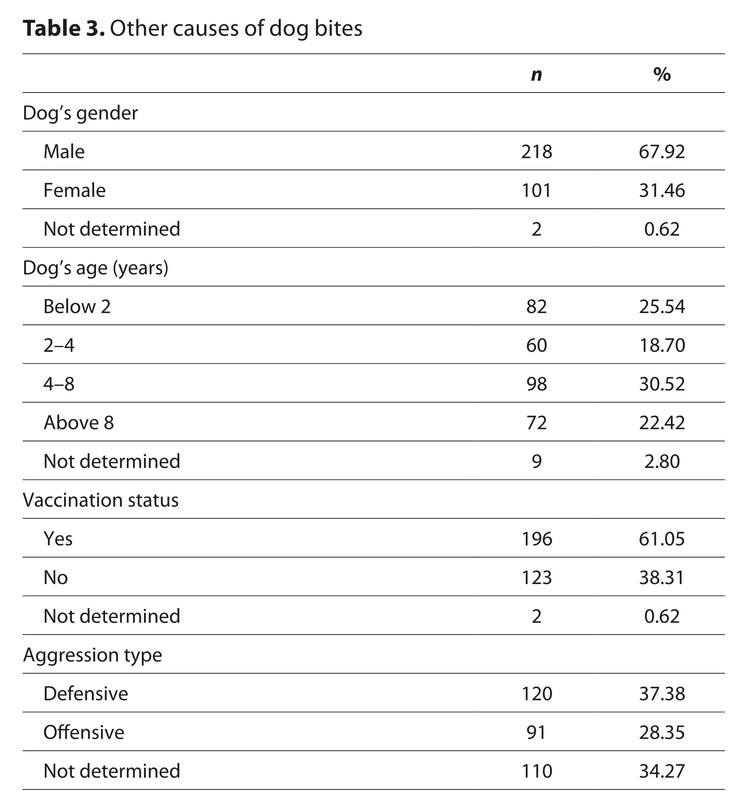
The most common perpetrators of bites were mixed breeds (52.00%) and German Shepherds (9.70%). Males bit more than twice as often as females, even though females are registered twice as often as males in the Polish Kennel Club. Adult dogs (4–8 years old) followed by the youngest individuals (< 2 years old) bit most frequently. Most bites occurred outside the property (52.60%), when the victim was near the dog (40.57%), and children accounted for 34.00% of all victims. The most common type of aggression was defensive (33.33%). Breed, age, and gender of the dog, as well as relationship with the victim, significantly influenced the occurrence of bites (p < 0.05).
Conclusions:
The results emphasize the importance of educating the public about preventive behaviour towards dogs in order to decrease the risk of dangerous incidents.
One of the most frequently described risks associated with the relationship between humans and dogs is dog bites which, according to the WHO, remain a global public health problem. The aim of the study is to analyze dog bite cases recorded by the District Veterinary Inspectorate in Szczecin between 2021–2023.
Material and methods:
A total of 321 cases were studied, including breed, age, gender, and vaccination status of the dog, as well as the age of the victims and their relationship with the dog. In addition, aggression type, incident location and circumstances were taken into account.
Results:
The most common perpetrators of bites were mixed breeds (52.00%) and German Shepherds (9.70%). Males bit more than twice as often as females, even though females are registered twice as often as males in the Polish Kennel Club. Adult dogs (4–8 years old) followed by the youngest individuals (< 2 years old) bit most frequently. Most bites occurred outside the property (52.60%), when the victim was near the dog (40.57%), and children accounted for 34.00% of all victims. The most common type of aggression was defensive (33.33%). Breed, age, and gender of the dog, as well as relationship with the victim, significantly influenced the occurrence of bites (p < 0.05).
Conclusions:
The results emphasize the importance of educating the public about preventive behaviour towards dogs in order to decrease the risk of dangerous incidents.
PEER REVIEW INFORMATION
Article has been screened for originality
REFERENCES (26)
1.
Benz-Schwarzburg J, Monsó S, Huber L. How dogs perceive humans and how humans should treat their pet dogs: Linking cognition with ethics. Front Psychol. 2020;11:584037. https://doi.org/10.3389/fpsyg.....
2.
Pet’ková B, Skurková L, Florian M, et al. Variations in Canine Behavioural Characteristics across Conventional Breed Clusters and Most Common Breed-Based Public Stereotypes. Animals (Basel). 2024;14(18):2695. https://doi.org/10.3390/ani141....
3.
Dougas G, Gkova M, Mellou K. Public health implications of dog bite injuries in Greece. Discov Public Health. 2025;22(1):371. https://doi.org/10.1186/s12982....
4.
Westgarth C, Provazza S, Nicholas J, et al. Review of psychological effects of dog bites in children. BMJ Paediatr Open. 2024;8(1):e000922. https://doi.org/10.1136/bmjpo-....
5.
Boruta A, Fiszdon K. Pokąsania ludzi przez psy. Kwartalnik Policyjny. 2016;(3):49–55.
6.
Cianciara D, Goryński P, Seroka W. Hospitalization for dog bites in Poland between 2006–2020. Ann Agric Environ Med. 2022;29(4):538–542. https://doi.org/10.26444/aaem/....
7.
Nilson F, Damsager J, Lauritsen J, et al. The effect of breed-specific dog legislation on hospital treated dog bites in Odense, Denmark—A time series intervention study. PLoS One. 2018;13(12):e0208393. https://doi.org/10.1371/journa....
8.
Gobbo E, Zupan Šemrov M. Risk factors for dog bites involving children. Vet Arh. 2022;92(5):609–616. https://doi.org/10.24099/vet.a....
9.
Mikkola S, Salonen M, Puurunen J, et al. Aggressive behaviour is affected by demographic, environmental and behavioural factors in purebred dogs. Sci Rep. 2021;11(1):9433. https://doi.org/10.1038/s41598....
10.
Duncan-Sutherland N, Lissaman AC, Shepherd M, et al. Systematic review of dog bite prevention strategies. Inj Prev. 2022;28(3):288–297. http://dx.doi.org/10.1136/inju....
11.
Salonen M, Sulkama S, Mikkola S, et al. Prevalence, comorbidity, and breed differences in canine anxiety in 13,700 Finnish pet dogs. Sci Rep. 2020;10(1):2962. https://doi.org/10.1038/s41598....
12.
Watanangura A, Meller S, Suchodolski JS, et al. The effect of phenobarbital treatment on behavioral comorbidities and on the composition and function of the fecal microbiome in dogs with idiopathic epilepsy. Front Vet Sci. 2022;9:933905. https://doi.org/10.3389/fvets.....
13.
Törnqvist H, Höller H, Vsetecka K, et al. Matters of development and experience: Evaluation of dog and human emotional expressions by children and adults. PLoS One. 2023;18(7):e0288137. https://doi.org/10.1371/journa....
14.
Bailey CM, Hinchcliff KM, Moore Z, et al. Dog bites in the United States from 1971 to 2018: a systematic review of the peer-reviewed literature. Plast Reconstr Surg. 2020;146(5):1166–1176. https://doi.org/10.1097/PRS.00....
15.
Zaborski D, Kavetska KM, Sabatowicz K. Analysis of cases of dog bites in Stargard, Poland. Sci Papers Ser D, Anim Sci. 2024;67(1):346–352.
16.
Morrill K, Hekman J, Li X, et al. Ancestry-inclusive dog genomics challenges popular breed stereotypes. Science. 2022;376(6592):eabk0639. https://doi.org/10.1126/scienc....
17.
Hammond A, Rowland T, Mills DS, et al. Comparison of behavioural tendencies between “dangerous dogs” and other domestic dog breeds – Evolutionary context and practical implications. Evol Appl. 2022;15(11):1806–1819. https://doi.org/10.1111/eva.13....
18.
Wallis LJ, Szabó D, Kubinyi E. Cross-sectional age differences in canine personality traits; influence of breed, sex, previous trauma, and dog obedience tasks. Front Vet Sci. 2020;6:493. https://doi.org/10.3389/fvets.....
19.
Scandurra A, Alterisio A, Di Cosmo A, et al. Behavioral and perceptual differences between sexes in dogs: An overview. Animals (Basel). 2018;8(9):151. https://doi.org/10.3390/ani809....
20.
Wójcik A, Powierża K. The influence of breed, sex, origin and housing conditions on undesirable behaviors in ancient dog breeds. Animals (Basel). 2021;11(5):1435. https://doi.org/10.3390/ani110....
21.
McGreevy PD, Wilson B, Starling MJ, et al. Behavioural risks in male dogs with minimal lifetime exposure to gonadal hormones may complicate population-control benefits of desexing. PLoS One. 2018;13(5):e0196284. https://doi.org/10.1371/journa....
22.
Niazy AF, Bawish BM, Matoock MY. Age, breed and sex are strongly correlated with personality traits in dogs. J Adv Vet Res. 2024;14(4):579–585.
23.
Sun N, Xie L, Chao J, et al. Study on the Correlation Between Aggressive Behavior and Gut Microbiota and Serum Serotonin (5-HT) in Working Dogs. Vet Sci. 2025;12(6):526. https://doi.org/10.3390/vetsci....
24.
Tiira K, Sulkama S, Lohi H. Prevalence, comorbidity, and behavioral variation in canine anxiety. J Vet Behav. 2016;16:36–44. doi:https://doi.org/10.1016/j.jveb....
25.
Oxley JA, Christley R, Westgarth C. Contexts and consequences of dog bite incidents. J Vet Behav. 2018;23:33–39. https://doi.org/10.1016/j.jveb....
26.
Westgarth C, Brooke M, Christley RM. How many people have been bitten by dogs? A cross-sectional survey of prevalence, incidence and factors associated with dog bites in a UK community. J Epidemiol Community Health. 2018;72(4):331–336. https://doi.org/10.1136/jech-2....
Share
RELATED ARTICLE
| eISSN: | 1898-2263 |
| ISSN: | 1232-1966 |


Generation of the DOI (Digital Object Identifier) - task financed under the agreement No NrRCN/SP/0532/2021/1 by the Minister of Science and Higher
© 2006-2026 Journal hosting platform by Bentus
We process personal data collected when visiting the website. The function of obtaining information about users and their behavior is carried out by voluntarily entered information in forms and saving cookies in end devices. Data, including cookies, are used to provide services, improve the user experience and to analyze the traffic in accordance with the Privacy policy. Data are also collected and processed by Google Analytics tool (more).
You can change cookies settings in your browser. Restricted use of cookies in the browser configuration may affect some functionalities of the website.
You can change cookies settings in your browser. Restricted use of cookies in the browser configuration may affect some functionalities of the website.