Online first
Current issue
Archive
Special Issues
About the Journal
Publication Ethics
Anti-Plagiarism system
Instructions for Authors
Instructions for Reviewers
Editorial Board
Editorial Office
Contact
Reviewers
All Reviewers
2025
2024
2023
2022
2021
2020
2019
2018
2017
2016
General Data Protection Regulation (RODO)

RESEARCH PAPER
Do Aloe vera, Bryophyllum pinnatum, Callisia fragrans, and Pelargonium graveolens, used in folk medicine to treat skin diseases, exhibit antioxidant activity?
1
Department of Medical Chemistry, Medical University, Lublin, Poland
2
Department of Human Physiology, Medical University, Lublin, Poland
3
Department of Experimental Immunology, Medical University, Lublin, Poland
4
Institute of Rural Health, Lublin, Poland
Corresponding author
Ann Agric Environ Med. 2026;33(3):347-352
KEYWORDS
medicinal plantsAloe veraPelargonium graveolensBryophyllum pinnatumCallisia fragransoxidative stress in skin
TOPICS
ABSTRACT
Introduction and objective:
Aloe vera, Bryophyllum pinnatum, Callisia fragrans and Pelargonium graveolens are medicinal plants traditionally used in folk medicine to treat a variety of diseases. The aim of the study is to evaluate the antioxidant properties of Callisia fragrans, and to the best of the authors’ knowledge is the first such study on the topic.
Material and methods:
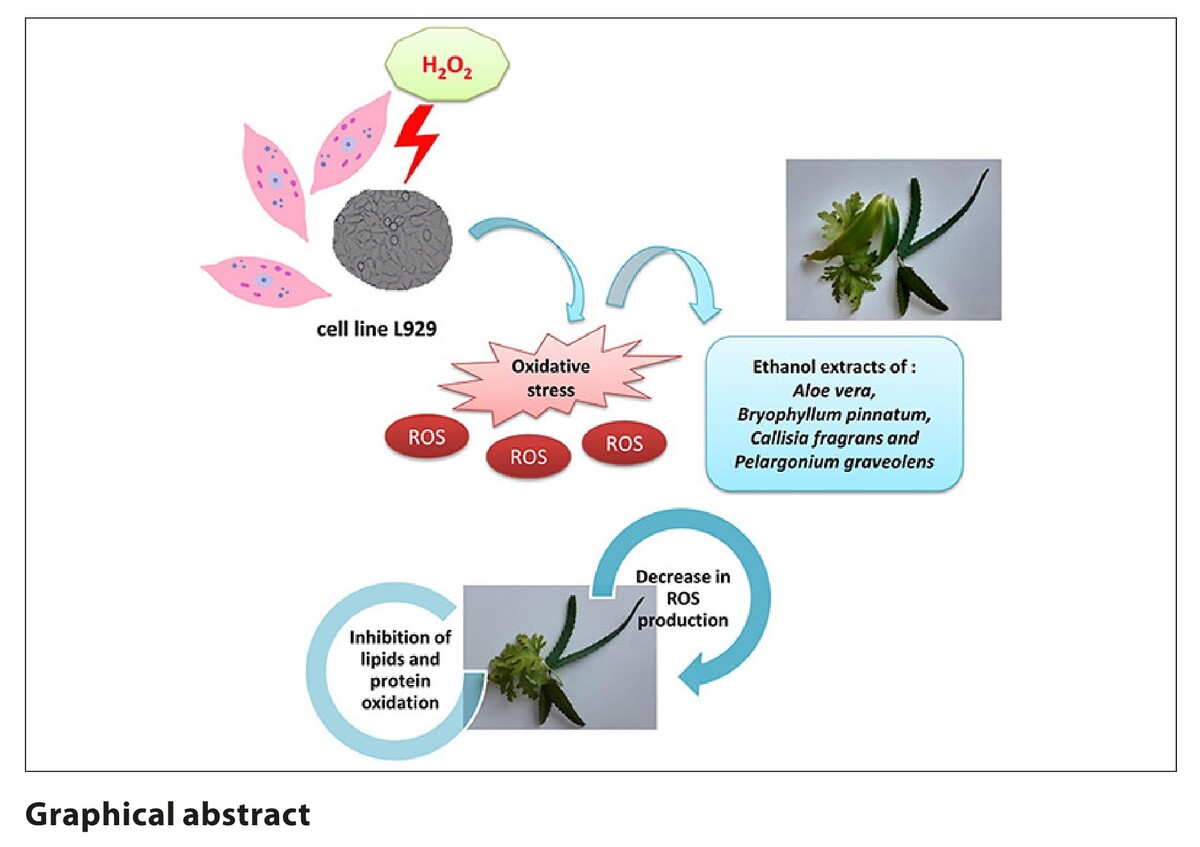
The focus of the study was on the antioxidant activities of plant ethanol extracts in an in vitro model of the mouse L929 fibroblastic cell line, in which oxidative stress was induced by hydrogen peroxide (H2O2). Extracts were obtained from biennial plants? Fibroblasts were first stimulated with 100 µM H2O2 for 3 h and subsequently incubated with various concentrations of plant extracts: 3.5 g/ml (extract 1); 1.75 g/ml (extract 2); and 0.875 g/ml (extract 3) for 24 h.
Results:
A significant decrease in ferric reducing antioxidant power (FRAP) and malondialdehyde (MDA) were observed in cell lysates treated with Aloe vera, Bryophyllum pinnatum and Pelargonium graveolens extracts. The concentration of carbonyl groups was statistically lower in cell lysates treated with Aloe vera and Pelargonium graveolens extracts. Significant increase in protein carbonyl groups concentration was observed in cell lysates treated with Callisia fragrans, but no significant changes were noticed in MDA and FRAP concentrations.
Conclusions:
The results obtained confirmed antioxidant activities of Aloe vera, Bryophyllum pinnatum and Pelargonium graveolens, which may contribute to their protective effects in cutaneous diseases. They also have the ability to protect fibroblasts in skin by a decrease in ROS production, and by the inhibition of lipid and protein oxidation. Therefore, they can be used in dermatology for the treatment of cutaneous diseases in the form of external skin care products. Callisia fragrans, however, showed the opposite trend, indicating a possible pro-oxidant behaviour requiring further investigation.
Aloe vera, Bryophyllum pinnatum, Callisia fragrans and Pelargonium graveolens are medicinal plants traditionally used in folk medicine to treat a variety of diseases. The aim of the study is to evaluate the antioxidant properties of Callisia fragrans, and to the best of the authors’ knowledge is the first such study on the topic.
Material and methods:
The focus of the study was on the antioxidant activities of plant ethanol extracts in an in vitro model of the mouse L929 fibroblastic cell line, in which oxidative stress was induced by hydrogen peroxide (H2O2). Extracts were obtained from biennial plants? Fibroblasts were first stimulated with 100 µM H2O2 for 3 h and subsequently incubated with various concentrations of plant extracts: 3.5 g/ml (extract 1); 1.75 g/ml (extract 2); and 0.875 g/ml (extract 3) for 24 h.
Results:
A significant decrease in ferric reducing antioxidant power (FRAP) and malondialdehyde (MDA) were observed in cell lysates treated with Aloe vera, Bryophyllum pinnatum and Pelargonium graveolens extracts. The concentration of carbonyl groups was statistically lower in cell lysates treated with Aloe vera and Pelargonium graveolens extracts. Significant increase in protein carbonyl groups concentration was observed in cell lysates treated with Callisia fragrans, but no significant changes were noticed in MDA and FRAP concentrations.
Conclusions:
The results obtained confirmed antioxidant activities of Aloe vera, Bryophyllum pinnatum and Pelargonium graveolens, which may contribute to their protective effects in cutaneous diseases. They also have the ability to protect fibroblasts in skin by a decrease in ROS production, and by the inhibition of lipid and protein oxidation. Therefore, they can be used in dermatology for the treatment of cutaneous diseases in the form of external skin care products. Callisia fragrans, however, showed the opposite trend, indicating a possible pro-oxidant behaviour requiring further investigation.
PEER REVIEW INFORMATION
Article has been screened for originality
REFERENCES (29)
1.
Hormozi M, Assaei R, Boroujeni MB. The effect of aloe vera on the expression of wound healing factors (TGFβ1 and bFGF) in mouse embryonic fibroblast cell: In vitro study. Biomed Pharmacother. 2017;88:610–616. doi:10.1016/j.biopha.2017.01.095.
2.
Ojewole JA. Antinociceptive, anti-inflammatory and antidiabetic effects of Bryophyllum pinnatum (Crassulaceae) leaf aqueous extract. J Ethnopharmacol. 2005;13;99(1):13–9. doi:10.1016/j.jep.2005.01.025.
3.
Mahboubi M, Taghizadeh M, Khamechian T, et al. The Wound Healing Effects of Herbal Cream Containing Oliveria Decumbens and Pelargonium Graveolens Essential Oils in Diabetic Foot Ulcer Model. World J Plast Surg. 2018;7(1):45–50.
4.
Yarmolinsky L, Zaccai M, Ben-Shabat S, et al. Anti-Herpetic Activity of Callissia fragrans and Simmondsia chinensis Leaf Extracts In Vitro. Open Virol J. 2010;11;4:57–62. doi:10.2174/1874357901004010057.
5.
Sharma G, Jangra A, Sihag S, et al. Bryophyllum pinnatum (Lam.) Oken: unravelling therapeutic potential and navigating toxicity. Physiol Mol Biol Plants. 2024;30(9):1413–1427. doi:10.1007/s12298-024-01509-7.
6.
Shen J, Wei T, Li M, et al. Aloe vera-derived extracellular vesicle-like particles suppress pancreatic carcinoma progression through triggering pyroptosis via ROS-GSDMD/E signaling pathway. Chin Med. 2025;2;20:101. doi:10.1186/s13020-025-01153-7.
7.
Gansukh E, Gopal J, Paul D, et al. Ultrasound mediated accelerated Anti-influenza activity of Aloe vera. Sci Rep. 2018;12;8(1):17782. doi:10.1038/s41598-018-35935-x.
8.
Maan AA, Nazir A, Khan MKI, et al. The therapeutic properties and applications of Aloe vera: A review. J Herb Med. 2018;12:1–10. doi:10.1016/j.hermed.2018.01.002.
9.
Surjushe A, Vasani R, Saple DG. Aloe vera: a short review. Indian J Dermatol. 2008;53(4):163–6. doi:10.4103/0019-5154.44785.
10.
Onoja SO, Ihejirika GQ, Nwankudu ON, et al. Antidiarrheal and Antioxidant Activities of Methanol Extract of Bryophyllum pinnatum Leaf Harvested from South-Eastern Nigeria in Mice. J Pharm. 2018:6810620. doi:10.1155/2018/6810620.
11.
Martins CAF, Campos ML, Irioda AC, et al. Anti-Inflammatory Effect of Malva sylvestris, Sida cordifolia, and Pelargonium graveolens Is Related to Inhibition of Prostanoid Production. Molecules. 2017;22(11):1883. doi:10.3390/molecules22111883.
12.
Le XT, Thi Nguyen LT, Nguyen PT, et al. Anti-hypertensive effects of Callisia fragrans extract on Reno-vascular hypertensive rats. Clin Exp Hypertens. 2022;44(5):411–418. doi:10.1080/10641963.2022.2065286.
13.
Rinnerthaler M, Bischof J, Streubel MK, et al. Oxidative stress in aging human skin. Biomolecules. 2015;5(2):545–89. doi:10.3390/biom5020545.
14.
Sen T, Samanta SK. Medicinal plants, human health and biodiversity: a broad review. Adv Biochem Eng Biotechnol. 2015:147:59–110. doi:10.1007/10_2014_273.
15.
Park MY, Kwon HJ, Sung MK. Evaluation of aloin and aloe-emodin as anti-inflammatory agents in aloe by using murine macrophages. Biosci Biotechnol Biochem. 2009;23;73(4):828–32. doi:10.1271/bbb.80714.
16.
Wahedi HM, Jeong M, Chae JK, et al. Aloesin from Aloe vera accelerates skin wound healing by modulating MAPK/Rho and Smad signaling pathways in vitro and in vivo. Phytomedicine. 201728:19–26. doi:10.1016/j.phymed.2017.02.005.
17.
Vijayalakshmi D, Dhandapani R, Jayaveni S, et al. In vitro anti-inflammatory activity of Aloe vera by down regulation of MMP-9 in peripheral blood mononuclear cells. J Ethnopharmacol. 2012;141(1):542–6. doi:10.1016/j.jep.2012.02.040.
18.
Gucwa K, Milewski S, Dymerski T, et al. Investigation of the Antifungal Activity and Mode of Action of Thymus vulgaris, Citrus limonum, Pelargonium graveolens, Cinnamomum cassia, Ocimum basilicum, and Eugenia caryophyllus Essential Oils. Molecules. 2018;8;23(5):1116. doi:10.3390/molecules23051116.
19.
Xuesheng H, Cody B, Stevens N. Chemical composition analysis and in vitro biological activities of ten essential oils in human skin cells. Biochim Open. 2017;26:5:1–7. doi:10.1016/j.biopen.2017.04.001.
20.
Simões BM, Kohler B, Clarke RB, et al. Estrogenicity of essential oils is not required to relieve symptoms of urogenital atrophy in breast cancer survivors. Ther Adv Med Oncol. 2018;10:1758835918766189. doi:10.1177/1758835918766189.
21.
Benzie IFF, Strain JJ. The Ferric Reducing Ability of Plasma (FRAP) as a Measure of ‘‘Antioxidant Power’’: The FRAP Assay. Anal Biochem. 1996;239(1):70–6. doi:10.1006/abio.1996.0292.
22.
Ledwożyw A, Michalak J, Stępień A, et al. The relationships between plasma triglycerides, cholesterol, total lipids and lipid peroxidation products during human atherosclerosis. Clin Chim Acta. 1986;155(3):275–83. doi:10.1016/0009-8981(86)90247-0.
23.
Mesquita CS, Oliveira R, Bento F, et al. Simplified 2,4-dinitrophenyl-hydrazine spectrophotometric assay for quantification of carbonyls in oxidized proteins. Anal Biochem. 2014;1:458:69–71. doi:10.1016/j.ab.2014.04.034.
24.
Kruk J, Duchnik E. Oxidative stress and skin diseases: possible role of physical activity. Asian Pac J Cancer Prev. 2014;15(2):561–8. doi:10.7314/apjcp.2014.15.2.561.
25.
Monteiro e Silva SA, Michniak-Kohn B, Leonardi GR. An overview about oxidation in clinical practice of skin aging. An Bras Dermatol. 2017;92(3):367–374. doi:10.1590/abd1806-4841.20175481.
26.
Chen X, Guo C, Kong J. Oxidative stress in neurodegenerative diseases. Neural Regen Res. 2012;15;7(5):376–85. doi:10.3969/j.issn.1673-5374.2012.05.009.
27.
Koselski M, Olszewska A, Hordyjewska A, et al. Three Types of Ion Channels in the Cell Membrane of Mouse Fibroblasts. Physiol Res. 2017;66(1):63–73. doi:10.33549/physiolres.933358.
28.
Eghbaliferiz S, Iranshahi M. Prooxidant Activity of Polyphenols, Flavonoids, Anthocyanins and Carotenoids: Updated Review of Mechanisms and Catalyzing Metals. Phytother Res. 2016;9:1379–1391. doi:10.1002/ptr.5643.
29.
Tatsimo SJ, Tamokou JD, Havyarimana L, et al. Antimicrobial and antioxidant activity of kaempferol rhamnoside derivatives from Bryophyllum pinnatum. BMC Res Notes. 2012;5:158. doi:10.1186/1756-0500-5-158.
| eISSN: | 1898-2263 |
| ISSN: | 1232-1966 |


Generation of the DOI (Digital Object Identifier) - task financed under the agreement No NrRCN/SP/0532/2021/1 by the Minister of Science and Higher
© 2006-2026 Journal hosting platform by Bentus
We process personal data collected when visiting the website. The function of obtaining information about users and their behavior is carried out by voluntarily entered information in forms and saving cookies in end devices. Data, including cookies, are used to provide services, improve the user experience and to analyze the traffic in accordance with the Privacy policy. Data are also collected and processed by Google Analytics tool (more).
You can change cookies settings in your browser. Restricted use of cookies in the browser configuration may affect some functionalities of the website.
You can change cookies settings in your browser. Restricted use of cookies in the browser configuration may affect some functionalities of the website.