Online first
Current issue
Archive
Special Issues
About the Journal
Publication Ethics
Anti-Plagiarism system
Instructions for Authors
Instructions for Reviewers
Editorial Board
Editorial Office
Contact
Reviewers
All Reviewers
2025
2024
2023
2022
2021
2020
2019
2018
2017
2016
General Data Protection Regulation (RODO)

RESEARCH PAPER
Toxicological profile of sodium lauryl sulfate – insights into cytotoxic, cardiotoxic, developmental and antimicrobial effects across biological models
1
Department of Dental Emergency, Medical University of Lublin, Poland
2
Chair and Department of Medical Microbiology, Medical University of Lublin, Poland
3
Independent Laboratory of Behavioral Studies, Medical University of Lublin, Poland
4
Department of Medical Chemistry, Medical University of Lublin, Poland
5
Preclinical Dentistry Lab, Medical University of Lublin, Poland
6
Department of Environmental Physicochemistry, Faculty of Chemistry, Adam Mickiewicz University, Poznań, Poland
Corresponding author
Piotr Stachurski
Department of Dental Emergency, Medical University of Lublin, Chodźki, 20-950, Lublin, Poland
Department of Dental Emergency, Medical University of Lublin, Chodźki, 20-950, Lublin, Poland
KEYWORDS
TOPICS
- Health effects of chemical pollutants in agricultural areas , including occupational and non-occupational effects of agricultural chemicals (pesticides, fertilizers) and effects of industrial disposal (heavy metals, sulphur, etc.) contaminating the atmosphere, soil and water
- State of the health of rural communities depending on various factors: social factors, accessibility of medical care, etc.
ABSTRACT
Introduction and objective:
Sodium lauryl sulfate (SLS) is a widely used surfactant present in many personal care products. Despite its broad application, increasing evidence suggests potential cytotoxic and ecotoxic effects. The aim of the study is to evaluate SLS toxicity using in vivo, in vitro and microbiological models to assess risks to health and the environment.
Material and methods:
Toxic effects were assessed in zebrafish (Danio rerio) embryos (OECD 236) and mammalian cell lines: human fibroblasts (BJ) and rat cardiomyoblasts (H9C2). Cell viability was measured by MTT assay after exposure to SLS (1–200 µg/mL). Zebrafish embryos were observed for mortality, developmental changes and hatching rate after 96-hour exposure. Antimicrobial and antibiofilm activities were tested against Streptococcus mutans and Enterococcus faecalis using microdilution and biofilm assays.
Results:
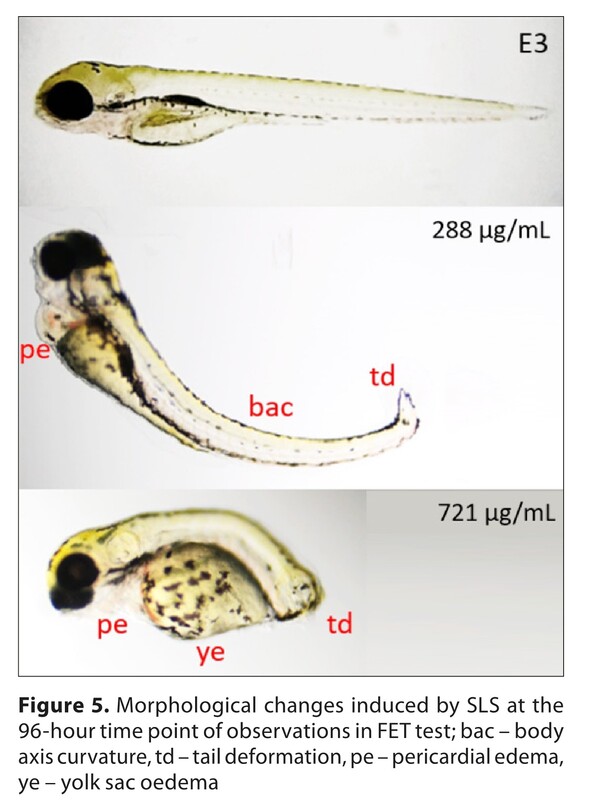
SLS showed marked cytotoxic and cardiotoxic activity (LC₅₀: 38.46 µg/mL for BJ and 36.97 µg/mL for H9C2 cells). In zebrafish, developmental delay and morphological alterations occurred with LC₅₀ = 2.654 mM, indicating moderate acute toxicity. No significant changes in heart rate or locomotor activity were detected at sublethal doses. Antimicrobial effects were strain-dependent: S. mutans showed moderate sensitivity (MIC = 50 µg/mL), while E. faecalis remained resistant. Biofilm assays confirmed limited antibiofilm potential.
Conclusions:
SLS exhibits considerable cytotoxicity and moderate developmental toxicity, implying potential health and environmental risks. Limited antimicrobial and antibiofilm effects question its safety and efficacy in oral hygiene formulations, supporting the need for stricter evaluation of its use.
Sodium lauryl sulfate (SLS) is a widely used surfactant present in many personal care products. Despite its broad application, increasing evidence suggests potential cytotoxic and ecotoxic effects. The aim of the study is to evaluate SLS toxicity using in vivo, in vitro and microbiological models to assess risks to health and the environment.
Material and methods:
Toxic effects were assessed in zebrafish (Danio rerio) embryos (OECD 236) and mammalian cell lines: human fibroblasts (BJ) and rat cardiomyoblasts (H9C2). Cell viability was measured by MTT assay after exposure to SLS (1–200 µg/mL). Zebrafish embryos were observed for mortality, developmental changes and hatching rate after 96-hour exposure. Antimicrobial and antibiofilm activities were tested against Streptococcus mutans and Enterococcus faecalis using microdilution and biofilm assays.
Results:
SLS showed marked cytotoxic and cardiotoxic activity (LC₅₀: 38.46 µg/mL for BJ and 36.97 µg/mL for H9C2 cells). In zebrafish, developmental delay and morphological alterations occurred with LC₅₀ = 2.654 mM, indicating moderate acute toxicity. No significant changes in heart rate or locomotor activity were detected at sublethal doses. Antimicrobial effects were strain-dependent: S. mutans showed moderate sensitivity (MIC = 50 µg/mL), while E. faecalis remained resistant. Biofilm assays confirmed limited antibiofilm potential.
Conclusions:
SLS exhibits considerable cytotoxicity and moderate developmental toxicity, implying potential health and environmental risks. Limited antimicrobial and antibiofilm effects question its safety and efficacy in oral hygiene formulations, supporting the need for stricter evaluation of its use.
PEER REVIEW INFORMATION
Article has been screened for originality
REFERENCES (26)
1.
DrugBank. DrugBank ID DB00815. An ingredient derived from coconut or palm oil used in cosmetics and medicine to keep ingredients well mixed or to create a foaming effect. https://go.drugbank.com/drugs/....
2.
Sutariyono. Studi Pembuatan Surfaktan Fatty Alcohol Sulphate (FAS) Dengan Reaksi Hidrogenasi Virgin Coconut Oil (VCO) Pada Tekanan Atmosferik Menggunakan Katalis Nikel. Undergraduate Thesis. Universitas Indonesia; 2009.
3.
Sabri H, Derakhshan Barjoei MM, Azarm A, et al. The Yin and Yang of Sodium Lauryl Sulfate Use for Oral and Periodontal Health: A Literature Review. J Dent (Shiraz). 2023;24(3):262–276. doi:10.30476/dentjods.2022.95108.1836.
4.
Asio JRG, Yahaya MS, Usman M, et al. Sodium lauryl sulfate and its potential impacts on the environment and health. Environ Sci Pollut Res. 2023;30:1–14. doi:10.1016/j.emcon.2023.100205.
5.
Freitas R, Silvestro S, Coppola F, et al. Toxic impacts induced by Sodium lauryl sulfate in Mytilus galloprovincialis. Comp Biochem Physiol A Mol Integr Physiol. 2020;242:110656.
6.
Dhruv D. The Study of Sodium Lauryl Sulfate (SLS) Toxicity. J Clin Toxicol. 2023;13:542. doi: 10.35248/2161-0495.23.13.542.
7.
De Jongh CM, Verberk MM, Spiekstra SW, et al. Cytokines at different stratum corneum levels in normal and sodium lauryl sulphate–irritated skin. Skin Res Technol. 2007;13(4):390–398. doi:10.1111/j.1600-0846.2007.00242.x.
8.
Cosmetic Ingredient Review Expert Panel. Final report on the safety assessment of sodium lauryl sulfate and ammonium lauryl sulfate. Int J Toxicol. 2005;24(S1):1–102. doi:10.1080/10915810590953816.
9.
Shipley RS. The Effects of Sodium Lauryl Sulfate on the Abundance of Producers and Grazers in Aquatic Communities Using Freshwater Microcosms. University Honors Program Theses. 2014;Paper 27. https://www.docin.com/p-147499....
10.
Zicarelli G, Impellitteri F, Faggio C, et al. Effects of a common surfactant sodium lauryl sulfate on early life stages of two fish and one amphibian species. Water Air Soil Pollut. 2024;235(12):807.
11.
Multisanti C R, Riolo K, Impellitteri F, et al. Bergamot (Citrus bergamia) as a potential anti-stress agent: Counteracting cellular and physiological changes by sodium lauryl sulphate in Mytilus galloprovincialis. Environ Pollut. 2025;371:125939.
12.
Freitas R, Arrigo F, Coppola F, et al. Combined effects of temperature rise and sodium lauryl sulfate in the Mediterranean mussel. Environ Toxicol Pharmacol. 2023;100: 104132.
13.
Fedeila M, Hachaïchi-Sadouk Z, Bautista LF, et al. Biodegradation of anionic surfactants by Alcaligenes faecalis, Enterobacter cloacae and Serratia marcescens strains isolated from industrial wastewater. Ecotoxicol Environ Saf. 2018;163:629–635. doi:10.1016/j.ecoenv.2018.07.123.
14.
Bambino K, Chu J. Zebrafish in toxicology and environmental health. Curr Top Dev Biol. 2017;124:331–367. doi:10.1016/bs.ctdb.2016.10.007.
15.
Impellitteri F, Robea M A, Plavan G, et al. Evaluation of the effects of sodium lauryl sulfate on the health status of Danio rerio: a study on swimming performance and sociability. J Biol Res. 2025;98(2).
16.
Faggio C, Piccione G, Marafioti S, et al. Metabolic response to monthly variations of Sparus aurata reared in Mediterranean on-shore tanks. Turk J Fish Aquat Sci. 2014;14(2):567–574.
17.
Faggio C, Fedele G, Arfuso F, et al. Haematological and biochemical response of Mugil cephalus after acclimation to captivity. Cahiers de Biologie Marine. 2014;55(1): 31–36.
18.
Cui G, Zhang H, Gou Q, et al. Oxidative stress–mediated mitochondrial pathway–dependent apoptosis is induced by silica nanoparticles in H9C2 cardiomyocytes. Toxicol Mech Methods. 2020;30(9):646–655. doi:10.1080/15376516.2020.1786915.
19.
Leoty-Okombi S, Gillaizeau F, Leuillet S, et al. Effect of sodium lauryl sulfate (SLS) applied as a patch on human skin physiology and its microbiota. Cosmetics. 2021;8(1):6. doi:10.3390/cosmetics8010006.
20.
Aydın N, Süloğlu AK, İdil N, et al. Examination of cytotoxic and antimicrobial effect of whitening toothpastes: an in vitro study. Acta Odontol Scand. 2024;83:327–333. doi:10.2340/aos.v83.40774.
21.
OECD. Test No. 236: Fish Embryo Acute Toxicity (FET) Test. OECD Guidelines for the Testing of Chemicals, Section 2. Paris: OECD Publishing; 2013. doi:10.1787/9789264203709-en.
22.
Tabatabaei MH, Mahounak FS, Asgari N, et al. Cytotoxicity of ingredients of commonly used toothpastes and mouthwashes on human gingival fibroblasts. Front Dent. 2019;16:450–457. doi:10.18502/fid.v16i6.3444.
23.
Shen Y, Li P, Chen X, et al. Activity of sodium lauryl sulfate, rhamnolipids, and N-acetylcysteine against biofilms of five common pathogens. Microb Drug Resist. 2020;26(3):290–299. doi:10.1089/mdr.2019.0207.
24.
Kreth J, Merritt J, Shi W, et al. Competition and interaction between Streptococcus mutans, Streptococcus sanguinis and Enterococcus faecalis in biofilm growth. Mol Oral Microbiol. 2005;20(3):253–260. doi:10.1111/j.1399-302X.2005.00143.x.
25.
Gondil VS, Subhadra B. Biofilms and their role in diseases. BMC Microbiol. 2023;23:203. doi:10.1186/s12866-023-02954-2.
26.
Simões M, Simões LC, Pereira MO, et al. Sodium dodecyl sulfate allows the persistence and recovery of biofilms of Pseudomonas fluorescens formed under different hydrodynamic conditions. Biofouling. 2008;24(1):35–44. doi:10.1080/08927010701730311.
Share
RELATED ARTICLE
| eISSN: | 1898-2263 |
| ISSN: | 1232-1966 |


Generation of the DOI (Digital Object Identifier) - task financed under the agreement No NrRCN/SP/0532/2021/1 by the Minister of Science and Higher
© 2006-2026 Journal hosting platform by Bentus
We process personal data collected when visiting the website. The function of obtaining information about users and their behavior is carried out by voluntarily entered information in forms and saving cookies in end devices. Data, including cookies, are used to provide services, improve the user experience and to analyze the traffic in accordance with the Privacy policy. Data are also collected and processed by Google Analytics tool (more).
You can change cookies settings in your browser. Restricted use of cookies in the browser configuration may affect some functionalities of the website.
You can change cookies settings in your browser. Restricted use of cookies in the browser configuration may affect some functionalities of the website.