Online first
Current issue
Archive
Special Issues
About the Journal
Publication Ethics
Anti-Plagiarism system
Instructions for Authors
Instructions for Reviewers
Editorial Board
Editorial Office
Contact
Reviewers
All Reviewers
2025
2024
2023
2022
2021
2020
2019
2018
2017
2016
General Data Protection Regulation (RODO)

RESEARCH PAPER
Impact of sodium bicarbonate, boric, medium mineralization highly carbonated water and ciprofloxacin combination on the some upper respiratory tract microbiota biofilm architecture
1
Ukrainian State Centre for Standardization and Quality Control of Natural and Performed Means of State Non-profit Enterprise, Ukrainian Research Institute of Rehabilitation and Balneology of the Ministry of Health of Ukraine, Odesa, Ukraine
2
Department of Microbiology, Virology and Biotechnology, I.I. Mechnikov National University, Odesa, Ukraine
3
Department of Experimental Research, State Non-profit Enterprise, Ukrainian Research Institute of Rehabilitation and Balneology of the Ministry of Health of Ukraine, Odesa, Ukraine
4
Command, Military Clinical Hospital No. 1 with Polyclinic, Independent Public Health Care Unit, Lublin, Poland
5
Faculty of Health Sciences, Radom Higher School, Radom, Poland
6
Department of Otorhinolaryngology, Odesa National Medical University, Odesa, Ukraine
These authors had equal contribution to this work
Corresponding author
Lidia Sierpińska
Command, Military Clinical Hospital No. 1 with Polyclinic, Independent Public Health Care Unit, Lublin, Poland
Command, Military Clinical Hospital No. 1 with Polyclinic, Independent Public Health Care Unit, Lublin, Poland
KEYWORDS
TOPICS
- Biological agents posing occupational risk in agriculture, forestry, food industry and wood industry and diseases caused by these agents (zoonoses, allergic and immunotoxic diseases)
- State of the health of rural communities depending on various factors: social factors, accessibility of medical care, etc.
ABSTRACT
Introduction and objective:
The use of irrigation therapy as an adjunctive treatment for upper respiratory tract infections is attracting interest. This is particularly notable when the effectiveness of conventional antibiotic therapy is reduced. The aim of this study is investigation of effects of sodium bicarbonate, boric, medium mineralization highly carbonated water, alone and in combination with Ciprofloxacin, on the architecture and intensity of biofilm formation by representative upper respiratory tract microbiota.
Material and methods:
Multispecies biofilms consisting of Lactobacillus sporogenes co-cultured with Escherichia coli ATCC 25922 or Staphylococcus aureus ATCC 25923 were used as experimental models. Biofilm formation was quantified using crystal violet staining and spectrophotometric analysis, while structural characteristics were assessed by light microscopy and morphometric image analysis.
Results:
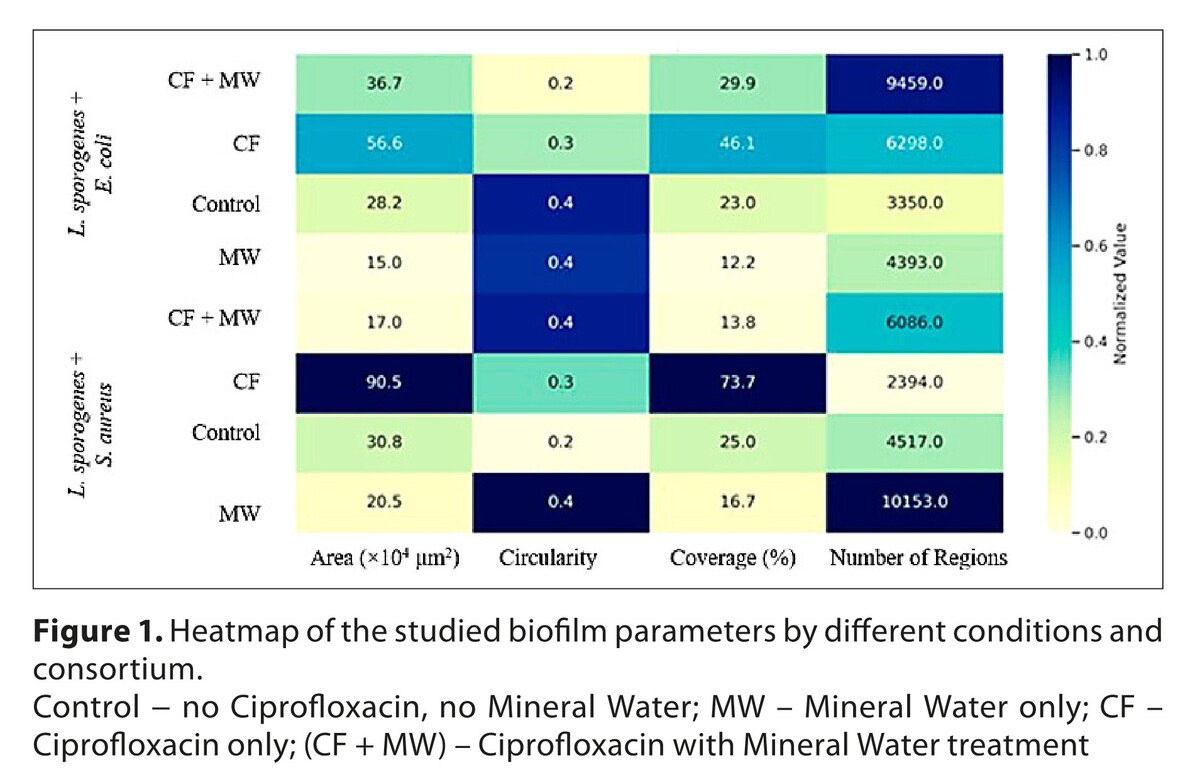
Ciprofloxacin at minimum inhibitory concentrations significantly increased biofilm biomass and coverage in both microbial consortia, indicating antibiotic-induced biofilm enhancement. Treatment with mineral water alone reduced total biofilm area and coverage, but promoted fragmentation into a greater number of discrete microcolonies.
Conclusions:
Mineral water modulates biofilm cohesion and spatial organization rather than solely reducing microbial viability. The study demonstrates the potential of mineral water as an adjunctive agent to enhance antibiofilm efficacy in the management of antibiotics in upper respiratory tract infection.
The use of irrigation therapy as an adjunctive treatment for upper respiratory tract infections is attracting interest. This is particularly notable when the effectiveness of conventional antibiotic therapy is reduced. The aim of this study is investigation of effects of sodium bicarbonate, boric, medium mineralization highly carbonated water, alone and in combination with Ciprofloxacin, on the architecture and intensity of biofilm formation by representative upper respiratory tract microbiota.
Material and methods:
Multispecies biofilms consisting of Lactobacillus sporogenes co-cultured with Escherichia coli ATCC 25922 or Staphylococcus aureus ATCC 25923 were used as experimental models. Biofilm formation was quantified using crystal violet staining and spectrophotometric analysis, while structural characteristics were assessed by light microscopy and morphometric image analysis.
Results:
Ciprofloxacin at minimum inhibitory concentrations significantly increased biofilm biomass and coverage in both microbial consortia, indicating antibiotic-induced biofilm enhancement. Treatment with mineral water alone reduced total biofilm area and coverage, but promoted fragmentation into a greater number of discrete microcolonies.
Conclusions:
Mineral water modulates biofilm cohesion and spatial organization rather than solely reducing microbial viability. The study demonstrates the potential of mineral water as an adjunctive agent to enhance antibiofilm efficacy in the management of antibiotics in upper respiratory tract infection.
PEER REVIEW INFORMATION
Article has been screened for originality
REFERENCES (25)
1.
Zhao L, Luo JL, Ali MK, et al. The Human Respiratory Microbiome: Current Understandings and Future Directions. Am J Respir Cell Mol Biol. 2023;68(3):245–255. https://doi.org/10.1165/rcmb.2....
2.
Sîrbu AE, Gradisteanu Pircalabioru G, Deaconu DM, et al. The pediatric nasal microbiome and its role in chronic ENT disorders: a narrative review. Front Immunol. 2026;16:1699707. https://doi.org/10.3389/fimmu.....
3.
Horn KJ, Jaberi Vivar AC, Arenas V, et al. Corynebacterium Species Inhibit Streptococcus pneumoniae Colonization and Infection of the Mouse Airway. Front Microbiol. 2022;12:804935. https://doi.org/10.3389/fmicb.....
4.
Brugger SD, Eslami SM, Pettigrew MM, et al. Dolosigranulum pigrum Cooperation and Competition in Human Nasal Microbiota. mSphere. 2020;5(5):e00852–20. https://doi.org/10.1128/mSpher....
5.
Cortés M, Olate P, Rodriguez R, et al. uman Microbiome as an Immunoregulatory Axis: Mechanisms, Dysbiosis, and Therapeutic Modulation. Microorganisms. 2025;13(9):2147. https://doi.org/10.3390/microo....
6.
Yang, Z, Chen Z, Lin, X, et al. Rural environment reduces allergic inflammation by modulating the gut microbiota. Gut Microbes. 2022;14(1). https://doi.org/10.1080/194909....
7.
Long L, Xu XL, Duan YF, et al. Extracellular Vesicles Are Prevalent and Effective Carriers of Environmental Allergens in Indoor Dust. Environ Sci Technol. 2025;59(4):1969–1983. https://doi.org/10.1021/acs.es....
8.
Zhou Z, Zhao X, Sun S, et al. Smoking-induced microbial dysbiosis: a key driver of systemic diseases and emerging therapeutic opportunities. Cell Death Discov. 2025;12(1):35. https://doi.org/10.1038/s41420....
9.
Tian C, Li X, Yuan X, et al. Link between respiratory microbiota and asthma: an emerging therapeutic approach. Am J Transl Res. 2024;16(11):6289–6302. https://doi.org/10.62347/OSNZ1....
10.
Jotic A, Cirkovic I, Jovicic N, et al. Biofilm Formation and Its Relationship with the Microbiome in Pediatric Otitis Media. Microorganisms. 2025;13(12):2760. https://doi.org/10.3390/microo....
11.
Liu HY, Prentice EL, Webber MA. Mechanisms of antimicrobial resistance in biofilms. NPJ Antimicrob Resist. 2024;2(1):27. https://doi.org/10.1038/s44259....
12.
Bair KL, Campagnari AA. Moraxella catarrhalis Promotes Stable Polymicrobial Biofilms With the Major Otopathogens. Front Microbiol. 2020;10:3006. https://doi.org/10.3389/fmicb.....
13.
Touaitia R, Mairi A, Ibrahim NA, Basher NS, et al. Staphylococcus aureus: A Review of the Pathogenesis and Virulence Mechanisms. Antibiotics. 2025;14(5):470. https://doi.org/10.3390/antibi....
14.
Abbas SН, Kiani HS, Gohar F, et al. Understanding the Role of Bacterial Biofilm in Antibiotic Resistance: Defensive Strategies and Clinical Challenges. Exploring Bacterial Biofilms. IntechOpen. 2025. pp. 256. https://doi.org/10.5772/intech....
15.
Pecoraro L, Di Muri E, Lezzi G, et al. Nasal Irrigations: A 360-Degree View in Clinical Practice. Medicina. 2025;61(8):1402. https://doi.org/10.3390/medici....
16.
Di Martino P. Strategies developed by bacteria to resist cleansing and disinfection. Int J Mol Sci. 2018;19(12):3808. https://doi.org/10.3390/ijms19....
17.
Rusakova M, Gushcha S, Sierpińska LE, et al. Influence of the combination of mineral water and ciprofloxacin on the interaction form of individual representatives of the upper respiratory tract mucosa microbiota in vitro. Ann Agric Environ Med. 2024;31(4):492–496. https://doi.org/10.26444/aaem/....
18.
Angoshtari R, Scribner K, Marsh T. The Effects of Antibiotics, Metals, and Biotic Interactions on the Assembly of Taxonomically Diverse Single and Mixed Species Biofilms. Adv Microbiol. 2020;10:623–646. https://doi.org/10.4236/aim.20....
19.
Penesyan A, Paulsen IT, Gillings MR, et al. Secondary effects of antibiotics on microbial biofilms. Front Microbiol. 2020;11:2109. https://doi.org/10.3389/fmicb.....
20.
Castilla-Sedano AJ, Zapana-García J, Valdivia-Del Águila E, et al. Quantification of early biofilm growth in microtiter plates through a novel image analysis software. J Microbiol Methods. 2024;223:106979. https://doi.org/10.1016/j.mime....
21.
Briandet R, Cerca N. Editorial: Methods in biofilms: 2022. Front Cell Infect Microbiol. 2023;13:1264849. https://doi.org/10.3389/fcimb.....
22.
Díaz De Rienzo MA, StevensonР, Marchant R, et al. Antibacterial properties of biosurfactants against selected Gram-positive and negative bacteria. FEMS Microbiol Letters. 2016;363(2):224. https://doi.org/10.1093/femsle....
23.
Cleaver L, Garnett JA. How to study biofilms: technological advancements in clinical biofilm research. Front Cell Infect Microbiol. 2023;13:1335389. https://doi.org/10.3389/fcimb.....
24.
Haney EF, Trimble MJ, Cheng JT, et al. Critical Assessment of Methods to Quantify Biofilm Growth and Evaluate Antibiofilm Activity of Host Defence Peptides. Biomolecules. 2018;8(2):29. https://doi.org/10.3390/biom80....
25.
Rumbaugh KP, Bjarnsholt T. Microbial Primer: In vivo biofilm. Microbiology (Reading). 2023;169(12):001407. https://doi.org/10.1099/mic.0.....
Share
RELATED ARTICLE
| eISSN: | 1898-2263 |
| ISSN: | 1232-1966 |


Generation of the DOI (Digital Object Identifier) - task financed under the agreement No NrRCN/SP/0532/2021/1 by the Minister of Science and Higher
© 2006-2026 Journal hosting platform by Bentus
We process personal data collected when visiting the website. The function of obtaining information about users and their behavior is carried out by voluntarily entered information in forms and saving cookies in end devices. Data, including cookies, are used to provide services, improve the user experience and to analyze the traffic in accordance with the Privacy policy. Data are also collected and processed by Google Analytics tool (more).
You can change cookies settings in your browser. Restricted use of cookies in the browser configuration may affect some functionalities of the website.
You can change cookies settings in your browser. Restricted use of cookies in the browser configuration may affect some functionalities of the website.