Online first
Current issue
Archive
Special Issues
About the Journal
Publication Ethics
Anti-Plagiarism system
Instructions for Authors
Instructions for Reviewers
Editorial Board
Editorial Office
Contact
Reviewers
All Reviewers
2025
2024
2023
2022
2021
2020
2019
2018
2017
2016
General Data Protection Regulation (RODO)

RESEARCH PAPER
The miR-877-3p polymorphism rs1264440 is associated with susceptibility to breast cancer
1
Outpatient Department, Maternity and Child Care Center of Qinhuangdao, China
2
Department of Breast Surgery, Maternity and Child Care Center of Qinhuangdao, China
3
Department of Breast Surgery, Shanxi Bethune Hospital, Shanxi Academy of Medical Sciences, Third Hospital of Shanxi Medical University, Tongji Shanxi Hospital, China
4
General Department, Shanxi Bethune Hospital, Shanxi Academy of Medical Sciences, Third Hospital of Shanxi Medical University, Tongji Shanxi Hospital, China
5
Department of Breast and Thyroid Surgery, Ganzhou Hospital-Nanfang Hospital, Southern Medical University (Ganzhou People’s Hospital), China
Corresponding author
Xiaoyun Mao
Department of Breast and Thyroid Surgery, Ganzhou Hospital-Nanfang Hospital, Southern Medical University (Ganzhou People's Hospital), China
Department of Breast and Thyroid Surgery, Ganzhou Hospital-Nanfang Hospital, Southern Medical University (Ganzhou People's Hospital), China
Ann Agric Environ Med. 2026;33(3):446-452
KEYWORDS
TOPICS
ABSTRACT
Introduction and objective:
Breast cancer (BC) remains the most common malignant tumour among females. Dysregulated microRNAs (miRNAs) are key regulators in carcinogenesis, and single nucleotide polymorphisms (SNPs) represent their most prevalent genetic alterations. The aim of the study is to investigate the influence of rs1264440 on miR-877-3p expression and its subsequent effects on BC cell proliferation and migration.
Material and methods:
Both 160 female BC patients and 160 healthy control (HC) subjects in Maternity and Child Care Center of Qinhuangdao, China, were selected as case and control groups, respectively. Genotyping for the SNP rs1264440 was performed using a TaqMan probe-based RT-qPCR assay. The Cell Counting Kit-8 (CCK-8) assay was used to determine cell viability. Analysis of cell migration and invasion was conducted by transwell assays.
Results:
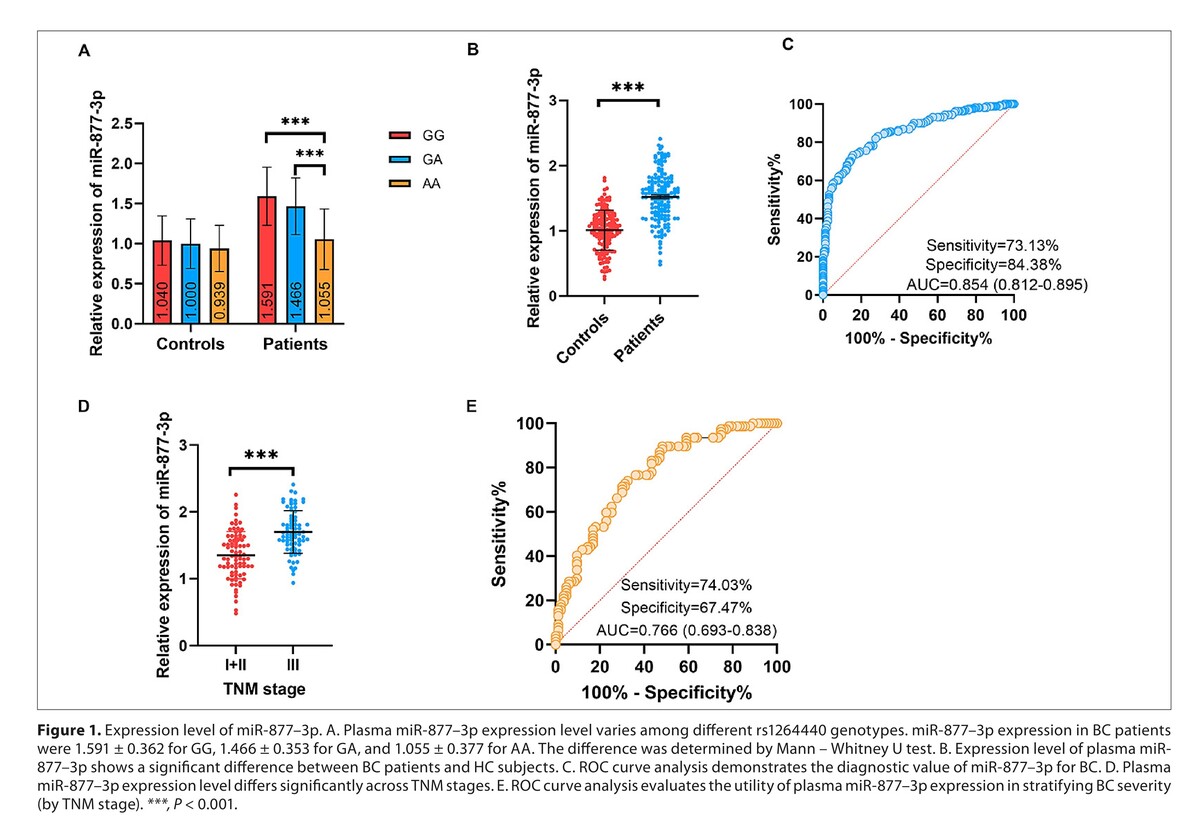
rs1264440 AA genotype (P = 0.006, OR = 0.308, 95% CI=0.129–0.739), A allele (P = 0.003, OR = 0.586, 95% CI = 0.413–0.832) significantly correlated with BC susceptibility. The rs1264440 AA genotype was associated with decreased miR-877-3p levels. High miR-877-3p level could distinguish BC patients from controls with an area under the curve (AUC) of 0.854 (sensitivity=73.13%, specificity=84.38%). Inhibition of miR-877-3p suppressed the proliferative, migratory, and invasive capacities of BC cells in vitro.
Conclusions:
The miR-877-3p rs1264440 is a risk predictor for BC, being implicated in miR-877-3p dysregulation and the promotion of cell viability and motility.
Breast cancer (BC) remains the most common malignant tumour among females. Dysregulated microRNAs (miRNAs) are key regulators in carcinogenesis, and single nucleotide polymorphisms (SNPs) represent their most prevalent genetic alterations. The aim of the study is to investigate the influence of rs1264440 on miR-877-3p expression and its subsequent effects on BC cell proliferation and migration.
Material and methods:
Both 160 female BC patients and 160 healthy control (HC) subjects in Maternity and Child Care Center of Qinhuangdao, China, were selected as case and control groups, respectively. Genotyping for the SNP rs1264440 was performed using a TaqMan probe-based RT-qPCR assay. The Cell Counting Kit-8 (CCK-8) assay was used to determine cell viability. Analysis of cell migration and invasion was conducted by transwell assays.
Results:
rs1264440 AA genotype (P = 0.006, OR = 0.308, 95% CI=0.129–0.739), A allele (P = 0.003, OR = 0.586, 95% CI = 0.413–0.832) significantly correlated with BC susceptibility. The rs1264440 AA genotype was associated with decreased miR-877-3p levels. High miR-877-3p level could distinguish BC patients from controls with an area under the curve (AUC) of 0.854 (sensitivity=73.13%, specificity=84.38%). Inhibition of miR-877-3p suppressed the proliferative, migratory, and invasive capacities of BC cells in vitro.
Conclusions:
The miR-877-3p rs1264440 is a risk predictor for BC, being implicated in miR-877-3p dysregulation and the promotion of cell viability and motility.
ABBREVIATIONS
BC – Breast cancer; SNPs – Single-nucleotide polymorphisms; miRNAs – microRNAs; SCCC – Squamous cell cervical carcinoma; OS – Osteosarcoma; HCC – Hepatocellular carcinoma; HC – Healthy control; BMI – Body mass index; NC – Negative control; SD – Standard deviation; HWE – Hardy-Weinberg equilibrium; ORs – Odds ratios; CIs – Confidence intervals; ROC curve – Receiver operating characteristic curve; ER – Estrogen receptor; PR – Progesterone receptor; HER2 – Human epidermal growth factor receptor 2
PEER REVIEW INFORMATION
Article has been screened for originality
REFERENCES (27)
1.
Wilkinson L, Gathani T. Understanding breast cancer as a global health concern. Br J Radiol. 2022;95(1130):20211033.
2.
Xu Y, Gong M, Wang Y, et al. Global trends and forecasts of breast cancer incidence and deaths. Sci Data. 2023;10(1):334.
3.
Katsura C, Ogunmwonyi I, Kankam HK, Saha S. Breast cancer: presentation, investigation and management. Br J Hosp Med (Lond). 2022;83(2):1–7.
4.
Xiong X, Zheng LW, Ding Y, et al. Breast cancer: pathogenesis and treatments. Signal Transduct Target Ther. 2025;10(1):49.
5.
Jiang B, Bao L, He S, et al. Deep learning applications in breast cancer histopathological imaging: diagnosis, treatment, and prognosis. Breast Cancer Res. 2024;26(1):137.
6.
Bahreini F, Rayzan E, Rezaei N. microRNA-related single-nucleotide polymorphisms and breast cancer. J Cell Physiol. 2021;236(3):1593–605.
7.
Du R, Flynn MJ, Mahe K, et al. miRNA modules for precise, tunable control of gene expression. Mol Cell. 2026;86(1):194–212 e7.
8.
Jelski W, Okrasinska S, Mroczko B. microRNAs as Biomarkers of Breast Cancer. Int J Mol Sci. 2025;26(9).
9.
Lameirinhas A, Torres-Ruiz S, Garrido-Cano I, et al. Involvement of microRNAs-449/FASN axis in response to trastuzumab therapy in HER2-positive breast cancer. Mol Med. 2025;31(1):116.
10.
Sirek T, Sirek A, Zmarzly N, et al. Impact of MiRNAs on Wnt-related gene activity in breast cancer. Sci Rep. 2025;15(1):16211.
11.
Ghanbari M, Karari K, Altalebi SAR, et al. The role of microRNAs in breast cancer: Diagnostic and therapeutic implications. Int J Biol Macromol. 2025;321(Pt 4):146386.
12.
Gao H, Zhang C. miR-3133 is an unfavorable prognosis factor and tumor suppressor in colon cancer. Funct Integr Genomics. 2023;23(2):132.
13.
Lin Y, Wang YY, Xu ZB, et al. miRNAs Associated with Axillary Lymph Node Metastasis in Breast Cancer: A Systematic Review and Meta-Analysis. Ann Surg Oncol. 2025.
14.
Khadka VS, Nasu M, Deng Y, et al. Circulating microRNA Biomarker for Detecting Breast Cancer in High-Risk Benign Breast Tumors. Int J Mol Sci. 2023;24(8).
15.
Watters M, Walker CA, Murray AA, et al. Uterine miR-877-3p and let-7a-5p are increased during simulated menstruation in a mouse model. Reprod Fertil. 2022;3(1):L3–l5.
16.
Mendaza S, Fernández-Irigoyen J, Santamaría E, et al. Understanding the Molecular Mechanism of miR-877-3p Could Provide Potential Biomarkers and Therapeutic Targets in Squamous Cell Carcinoma of the Cervix. Cancers (Basel). 2021;13(7).
17.
Chen M, Li Z, Cao L, et al. miR-877-3p inhibits tumor growth and angiogenesis of osteosarcoma through fibroblast growth factor 2 signaling. Bioengineered. 2022;13(4):8174-86.
18.
Miao Y, Liang X, Chen J, et al. Transfer of miR-877-3p via extracellular vesicles derived from dental pulp stem cells attenuates neuronal apoptosis and facilitates early neurological functional recovery after cerebral ischemia-reperfusion injury through the Bclaf1/P53 signaling pathway. Pharmacol Res. 2024;206:107266.
19.
Wang H, Wang B, Wang T, Fan R. A genetic variant in the promoter region of miR-877 is associated with an increased risk of hepatocellular carcinoma. Clin Res Hepatol Gastroenterol. 2020;44(5):692-8.
20.
Yang C, Liu Y, Gai L, et al. Artesunate regulates malignant progression of breast cancer cells via lncRNA TUG1/miR-145-5p/HOXA5 axis. PLoS One. 2025;20(8):e0329490.
21.
Arancibia T, Morales-Pison S, Maldonado E, Jara L. Association between single-nucleotide polymorphisms in miRNA and breast cancer risk: an updated review. Biol Res. 2021;54(1):26.
22.
Morales-Gonzalez S, Calaf GM, Acuna M, et al. The miR-146a Single Nucleotide Polymorphism rs2910164 Promotes Proliferation, Chemoresistance, Migration, Invasion, and Apoptosis Suppression in Breast Cancer Cells. Cells. 2025;14(8).
23.
Polcaro G, Liguori L, Manzo V, et al. rs10204525 binding to miR-4717-3p modulates PD-1 expression and predicts the development of immune-related adverse events in patients with advanced cancer treated with anti-PD-1/PD-L1 therapy. J Immunother Cancer. 2025;13(12).
24.
Li S, Zhu Y, Liang Z, et al. Up-regulation of p16 by miR-877-3p inhibits proliferation of bladder cancer. Oncotarget. 2016;7(32):51773-83.
25.
Xiang X, Ma HZ, Chen YQ, et al. GM-CSF-miRNA-Jak2/Stat3 Signaling Mediates Chemotherapy-Induced Cancer Cell Stemness in Gastric Cancer. Front Pharmacol. 2022;13:855351.
26.
Fukuda T, Baba H, Okumura T, et al. miR-877-3p as a Potential Tumour Suppressor of Oesophageal Squamous Cell Carcinoma. Anticancer Res. 2023;43(1):35–43.
27.
Xie Z, Zhou Z, Wang S, et al. Platycodin D inhibits non-small cell lung cancer bone metastasis by inducing ferroptosis through miR-877-3P/PNMA5 regulatory axis. Phytomedicine. 2025;149:157534.
Share
RELATED ARTICLE
| eISSN: | 1898-2263 |
| ISSN: | 1232-1966 |


Generation of the DOI (Digital Object Identifier) - task financed under the agreement No NrRCN/SP/0532/2021/1 by the Minister of Science and Higher
© 2006-2026 Journal hosting platform by Bentus
We process personal data collected when visiting the website. The function of obtaining information about users and their behavior is carried out by voluntarily entered information in forms and saving cookies in end devices. Data, including cookies, are used to provide services, improve the user experience and to analyze the traffic in accordance with the Privacy policy. Data are also collected and processed by Google Analytics tool (more).
You can change cookies settings in your browser. Restricted use of cookies in the browser configuration may affect some functionalities of the website.
You can change cookies settings in your browser. Restricted use of cookies in the browser configuration may affect some functionalities of the website.