Online first
Current issue
Archive
Special Issues
About the Journal
Publication Ethics
Anti-Plagiarism system
Instructions for Authors
Instructions for Reviewers
Editorial Board
Editorial Office
Contact
Reviewers
All Reviewers
2025
2024
2023
2022
2021
2020
2019
2018
2017
2016
General Data Protection Regulation (RODO)

RESEARCH PAPER
Dental caries, oral hygiene and Streptococcus mutans serotypes in patients with inflammatory bowel disease
1
Chair and Department of Conservative Dentistry with Endodontics, Medical University of Lublin, Lublin, Poland
2
Department of Pharmaceutical Microbiology, Medical University of Lublin, Lublin, Poland
3
Faculty of Health Sciences and Psychology, Collegium Medicum, University of Rzeszów, Poland
4
University Center for Research and Development in Health Sciences, University of Rzeszów, Poland
5
Department of Gastroenterology with IBD Unit, St. Jadwiga Queen Hospital in Rzeszów, Poland
6
Faculty of Medicine, Collegium Medicum, University of Rzeszów, Rzeszów, Poland
Corresponding author
Małgorzata Strycharz-Dudziak
Chair and Department of Conservative Dentistry with Endodontics, Medical University of Lublin, Lublin, Poland
Chair and Department of Conservative Dentistry with Endodontics, Medical University of Lublin, Lublin, Poland
KEYWORDS
inflammatory bowel diseasedental cariesoral hygieneDMFTStreptococcus mutansCrohn`s diseaseulcerative colitisApproximal Plaque Index
TOPICS
ABSTRACT
Introduction and objective:
Inflammatory bowel disease (IBD), comprising Crohn’s disease (CD) and ulcerative colitis (UC), is a chronic inflammatory condition with systemic and extra-intestinal manifestations. Clinical findings in the oral cavity include, among others, a higher caries burden and microbiome dysbiosis linked to the oral-gut axis with Streptococcus mutans playing an important role.
Material and methods:
The study included 110 IBD patients in remission (73 CD, 37 UC) and 50 controls. Participants underwent oral cavity examination (DMFT, API) and completed a questionnaire on oral hygiene. Unstimulated saliva from IBD patients was analysed for S. mutans detection by PCR and serotyping by multiplex (c, e, f) and singleplex (k) PCR.
Results:
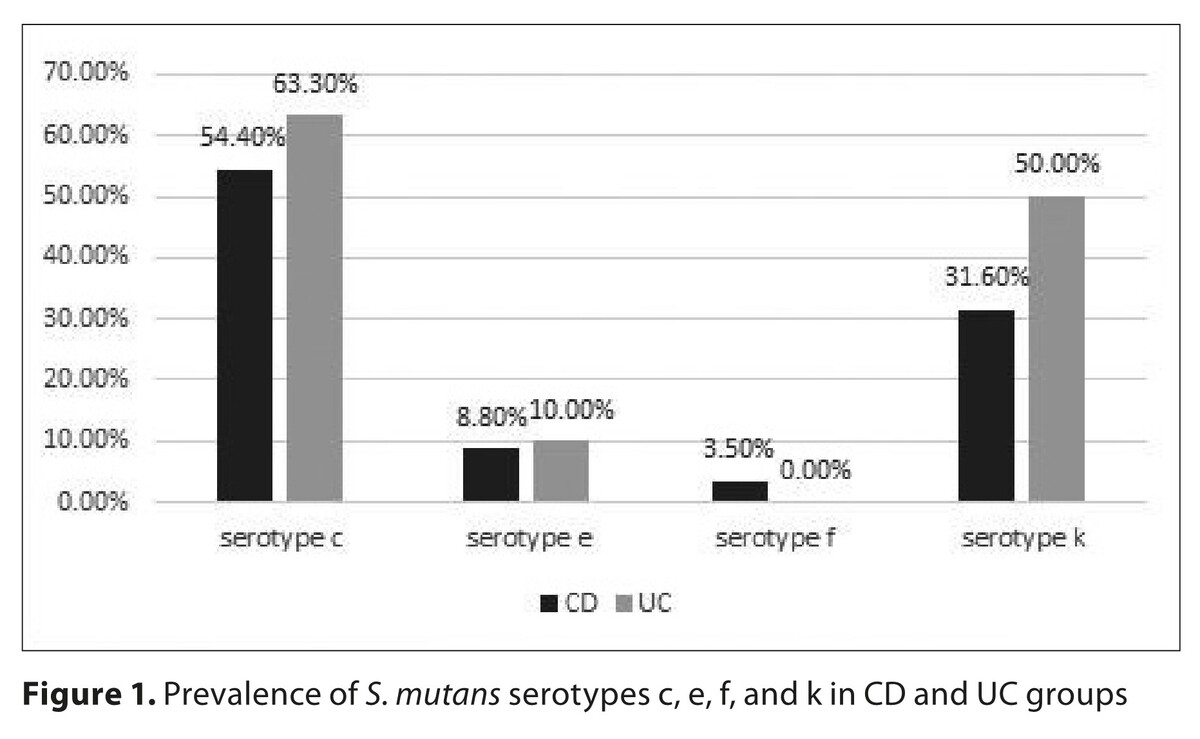
DMFT was higher in CD and UC patients (mean=19.08 and 19.51) than controls (mean=15.04; p=0.007), with elevated D (p<0.001) and M (p=0.011) components in CD group and no difference in F component. API was higher in CD group than in controls (mean=67.77 vs 53.03; p=0.020), with significant differences in API ranges for CD vs controls (p<0.001) and UC vs controls (p<0.05). Insufficient oral hygiene was noted in 49% of CD and 43% of UC patients, and average hygiene in 41% of CD and 46% of UC. Oral hygiene habits differed only in toothbrushing frequency, with CD patients brushing less frequently than controls (p=0.017). Higher D component counts and API were associated with increased IBD odds. CD and UC patients were 5.95- and 5.17-fold more likely to have insufficient or average oral hygiene. S. mutans was detected in 78% of IBD patients, with serotype k in 31%. In UC group, rural residence was linked to higher DMFT, with no such effect in CD patients.
Conclusions:
These findings underscore the importance of targeted oral hygiene education for IBD patients and support further research on the oral microbiome.
Inflammatory bowel disease (IBD), comprising Crohn’s disease (CD) and ulcerative colitis (UC), is a chronic inflammatory condition with systemic and extra-intestinal manifestations. Clinical findings in the oral cavity include, among others, a higher caries burden and microbiome dysbiosis linked to the oral-gut axis with Streptococcus mutans playing an important role.
Material and methods:
The study included 110 IBD patients in remission (73 CD, 37 UC) and 50 controls. Participants underwent oral cavity examination (DMFT, API) and completed a questionnaire on oral hygiene. Unstimulated saliva from IBD patients was analysed for S. mutans detection by PCR and serotyping by multiplex (c, e, f) and singleplex (k) PCR.
Results:
DMFT was higher in CD and UC patients (mean=19.08 and 19.51) than controls (mean=15.04; p=0.007), with elevated D (p<0.001) and M (p=0.011) components in CD group and no difference in F component. API was higher in CD group than in controls (mean=67.77 vs 53.03; p=0.020), with significant differences in API ranges for CD vs controls (p<0.001) and UC vs controls (p<0.05). Insufficient oral hygiene was noted in 49% of CD and 43% of UC patients, and average hygiene in 41% of CD and 46% of UC. Oral hygiene habits differed only in toothbrushing frequency, with CD patients brushing less frequently than controls (p=0.017). Higher D component counts and API were associated with increased IBD odds. CD and UC patients were 5.95- and 5.17-fold more likely to have insufficient or average oral hygiene. S. mutans was detected in 78% of IBD patients, with serotype k in 31%. In UC group, rural residence was linked to higher DMFT, with no such effect in CD patients.
Conclusions:
These findings underscore the importance of targeted oral hygiene education for IBD patients and support further research on the oral microbiome.
PEER REVIEW INFORMATION
Article has been screened for originality
REFERENCES (36)
1.
Silaghi A, Constantin VD, Socea B, et al. Inflammatory Bowel Disease: Pathogenesis, Diagnosis and Current Therapeutic Approach. J Mind Med Sci. 2022; 9(1):56–77. https://doi.org/10.22543/7674.....
2.
Wang A, Zhai Z, Ding Y, et al. The oral-gut microbiome axis in inflammatory bowel disease: from inside to insight. Front Immunol. 2024;15:1430001. https://doi.org/10.3389/fimmu.....
3.
Heydari K, Rahnavard M, Ghahramani S, et al. Global prevalence and incidence of inflammatory bowel disease: a systematic review and meta-analysis of population-based studies. Gastroenterol Hepatol Bed Bench. 2025;18(2):132–146. https://doi.org/10.22037/ghfbb....
4.
Kumar A, Yassin N, Marley A, et al. Crossing barriers: the burden of inflammatory bowel disease across Western Europe. Therap Adv Gastroenterol. 2023;16:17562848231218615. doi:10.1177/17562848231218615.
5.
Zagórowicz E, Walkiewicz D, Kucha P, et al. Nationwide data on epidemiology of inflammatory bowel disease in Poland between 2009 and 2020. Pol Arch Intern Med. 2022;132(5):16194. https://doi.org/10.20452/pamw.....
6.
Kamel AY, Johnson ZD, Hernandez I, et al. Micronutrient deficiencies in inflammatory bowel disease: an incidence analysis. Eur J Gastroenterol Hepatol. 2024 Oct 1;36(10):1186–1192. https://doi.org/10.1097/MEG.00....
7.
Gordon H, Burisch J, Ellul P, et al. ECCO Guidelines on Extraintestinal Manifestations in Inflammatory Bowel Disease. J Crohns Colitis. 2024;18(1):1–37. doi:10.1093/ecco-jcc/jjad108.
8.
Lauritano D, Boccalari E, Di Stasio D, et al. Prevalence of oral lesions and correlation with intestinal symptoms of inflammatory bowel disease: a systematic review. Diagnostics (Basel). 2019;9(3):77. https://doi.org/10.3390/diagno....
9.
Papageorgiou SN, Hagner M, Nogueira AV, et al. Inflammatory bowel disease and oral health: systematic review and a meta-analysis. J Clin Periodontol. 2017;44(4):382–393. https://doi.org/10.1111/jcpe.1....
10.
Nijakowski K, Gruszczyński D, Surdacka A. Oral health status in patients with inflammatory bowel diseases: a systematic review. Int J Environ Res Public Health. 2021;18(21):11521. https://doi.org/10.3390/ijerph....
11.
Fejerskov O, Kidd E. Dental Caries. The Diseases and Clinical Management. 4th ed. Wiley-Blackwell; 2024. p. 3–15.
12.
Liu R, Liu Y, Yi J, et al. Imbalance of oral microbiome homeostasis: the relationship between microbiota and the occurrence of dental caries. BMC Microbiol. 2025;25(1):46. https://doi.org/10.1186/s12866....
13.
Saadeh M, Donohue S, Ailawadi S, et al. Oral microbiome and inflammatory bowel disease: New understanding and call to action. World J Gastroenterol. 2025;31(38):111210. https://doi.org/10.3748/wjg.v3....
14.
Brito F, de Barros FC, Zaltman C, et al. Prevalence of periodontitis and DMFT index in patients with Crohn’s disease and ulcerative colitis. J Clin Periodontol. 2008;35(6):555–560. https://doi.org/10.1111/j.1600....
15.
Grössner-Schreiber B, Fetter T, Hedderich J, et al. Prevalence of dental caries and periodontal disease in patients with inflammatory bowel disease: a case-control study. J Clin Periodontol. 2006;33(7):478–484. https://doi.org/10.1111/j.1600....
16.
Zhang L, Gao X, Zhou J, et al. Increased risks of dental caries and periodontal disease in Chinese patients with inflammatory bowel disease. Int Dent J. 2020;70(3):227–236. https://doi.org/10.1111/idj.12....
17.
Said HS, Suda W, Nakagome S, et al. Dysbiosis of salivary microbiota in inflammatory bowel disease and its association with oral immunological biomarkers. DNA Res. 2014;21(1):15–25. https://doi.org/10.1093/dnares....
18.
Han Y, Wang B, Gao H, et al. Insight into the relationship between oral microbiota and the inflammatory bowel disease. Microorganisms. 2022;10(9):1868. https://doi.org/10.3390/microo....
19.
Kucharski R, Sobocki BK, Stachowska E, et al. Dental problems and oral microbiome alterations in ulcerative colitis. Front Immunol. 2025;16:1502605. https://doi.org/10.3389/fimmu.....
20.
Fang Y, Chen X, Chu CH, et al. Roles of Streptococcus mutans in human health: beyond dental caries. Front Microbiol. 2024;15:1503657. https://doi.org/10.3389/fmicb.....
21.
World Health Organization. (2013). Oral Health Surveys: Basic Methods, 5th edition. Geneva, Switzerland: WHO. http://www.who.int/oral_health... (access: 2025.12.12).
22.
Lange DE, Plagmann HC, Eenboom A, et al. Klinische Bewertungs-verahren zur Objektivierung der Mundhygiene [Clinical methods for the objective evaluation of oral hygiene]. Dtsch Zahnarztl Z. 1977;32(1):44–47. PMID: 264444.
23.
Shibata Y, Ozaki K, Seki M, et al. Analysis of loci required for determination of serotype antigenicity in Streptococcus mutans and its clinical utilization. J Clin Microbiol. 2003;41(9):4107–4112. https://doi.org/10.1128/JCM.41....
24.
Nakano K, Nomura R, Shimizu N, et al. Development of a PCR method for rapid identification of new Streptococcus mutans serotype k strains. J Clin Microbiol. 2004;42(11):4925–4930. doi:10.1128/JCM.42.11.4925-4930.200.
25.
Marruganti C, Discepoli N, Gaeta C, et al. Dental caries occurrence in inflammatory bowel disease patients: a systematic review and meta-analysis. Caries Res. 2021;55(5):485–495. https://doi.org/10.1159/000519....
26.
Zhang Y, Bian C, Yu C, et al. Bidirectional association between oral diseases caused by plaque and the inflammatory bowel disease: A systematic review and meta-analysis. Jpn Dent Sci Rev. 2025;61:7–21. https://doi.org/10.1016/j.jdsr....
27.
Tan CXW, Brand HS, Kalender B, et al. Dental and periodontal disease in patients with inflammatory bowel disease. Clin Oral Investig. 2021;25(9):5273–5280. https://doi.org/10.1007/s00784....
28.
Koutsochristou V, Zellos A, Dimakou K, et al. Dental caries and periodontal disease in children and adolescents with inflammatory bowel disease: a case-control study. Inflamm Bowel Dis. 2015;21(8):1839–1846. https://doi.org/10.1097/MIB.00....
29.
Rodrigues E, Laranjeira N, Nunes G, et al. Are cariogenic bacteria the major risk factor to dental caries in patients with ulcerative colitis?. Arq Gastroenterol. 2019;56(2):118–123. https://doi.org/10.1590/S0004-....
30.
Szymanska S, Lördal M, Rathnayake N, et al. Dental caries, prevalence and risk factors in patients with Crohn’s disease. PLoS One. 2014;9(3):e91059. https://doi.org/10.1371/journa....
31.
Bertl K, Burisch J, Pandis N, et al. Patients with inflammatory bowel disease have more oral health problems and higher costs of professional dental care than healthy controls: The Periodontitis Prevalence in ulcerative Colitis and Crohn disease (PPCC) case-control study. J Periodontol. 2024;95(2):159–174. https://doi.org/10.1002/JPER.2....
32.
Singhal S, Dian D, Keshavarzian A, et al. The role of oral hygiene in inflammatory bowel disease. Dig Dis Sci. 2011;56(1):170–175. https://doi.org/10.1007/s10620....
33.
Yin W, Ludvigsson JF, Liu Z, et al. Inverse Association Between Poor Oral Health and Inflammatory Bowel Diseases. Clin Gastroenterol Hepatol. 2017 Apr;15(4):525–531. doi:10.1016/j.cgh.2016.06.024. Epub 2016 Jul 5. PMID: 27392757.
34.
Kojima A, Nakano K, Wada K, et al. Infection of specific strains of Streptococcus mutans, oral bacteria, confers a risk of ulcerative colitis. Sci Rep. 2012;2:332. https://doi.org/10.1038/srep00....
35.
Nakano K, Ooshima T. Serotype classification of Streptococcus mutans and its detection outside the oral cavity. Future Microbiol. 2009;4(7):891–902. https://doi.org/10.2217/fmb.09....
36.
Lapirattanakul J, Nakano K, Nomura R, et al. Detection of serotype k Streptococcus mutans in Thai subjects. Oral Microbiol Immunol. 2009;24(5):431–433. https://doi.org/10.1111/j.1399....
Share
RELATED ARTICLE
| eISSN: | 1898-2263 |
| ISSN: | 1232-1966 |


Generation of the DOI (Digital Object Identifier) - task financed under the agreement No NrRCN/SP/0532/2021/1 by the Minister of Science and Higher
© 2006-2026 Journal hosting platform by Bentus
We process personal data collected when visiting the website. The function of obtaining information about users and their behavior is carried out by voluntarily entered information in forms and saving cookies in end devices. Data, including cookies, are used to provide services, improve the user experience and to analyze the traffic in accordance with the Privacy policy. Data are also collected and processed by Google Analytics tool (more).
You can change cookies settings in your browser. Restricted use of cookies in the browser configuration may affect some functionalities of the website.
You can change cookies settings in your browser. Restricted use of cookies in the browser configuration may affect some functionalities of the website.