Online first
Current issue
Archive
Special Issues
About the Journal
Publication Ethics
Anti-Plagiarism system
Instructions for Authors
Instructions for Reviewers
Editorial Board
Editorial Office
Contact
Reviewers
All Reviewers
2025
2024
2023
2022
2021
2020
2019
2018
2017
2016
General Data Protection Regulation (RODO)

BRIEF COMMUNICATION
Screening of individuals potentially exposed to Encephalitozoon cuniculi infection
1
Department of Epizootiology and Clinic of Infectious Diseases, University of Life Sciences, Lublin, Poland
2
Chair and Department of Pharmaceutical Microbiology, Medical University, Lublin, Poland
3
Department of Laboratory Diagnostics, Medical University, Lublin, Poland
4
Department of Gynecology, Medical University, Lublin, Poland
5
Department of Animal Physiology, University of Life Sciences, Lublin, Poland
Corresponding author
Anna Wilczyńska
Department of Epizootiology and Clinic of Infectious Diseases, University of Life Sciences, Lublin, Poland
Department of Epizootiology and Clinic of Infectious Diseases, University of Life Sciences, Lublin, Poland
KEYWORDS
TOPICS
ABSTRACT
Introduction and Objective:
Encephalitozoon cuniculi is a species of fungus belonging to the phylum Microsporidia, potentially pathogenic to rodents, rabbits, dogs, cats, horses and humans. The aim of the study is to conduct preliminary serological and molecular monitoring of encephalitozoonosis among persons coming into contact with rabbits, i.e., a potential reservoir of E.cuniculi.
Material and Methods:
The study included 28 persons (Group 1), who had been in contact with rabbits (as the owners or veterinary staff), for a minimum of 2 years (from 2–20 years), and 20 persons who had had no such contact, who formed a control group (Group 2). Blood and serum samples were collected for molecular and serological testing for encephalitozoonosis from all the persons.
Results:
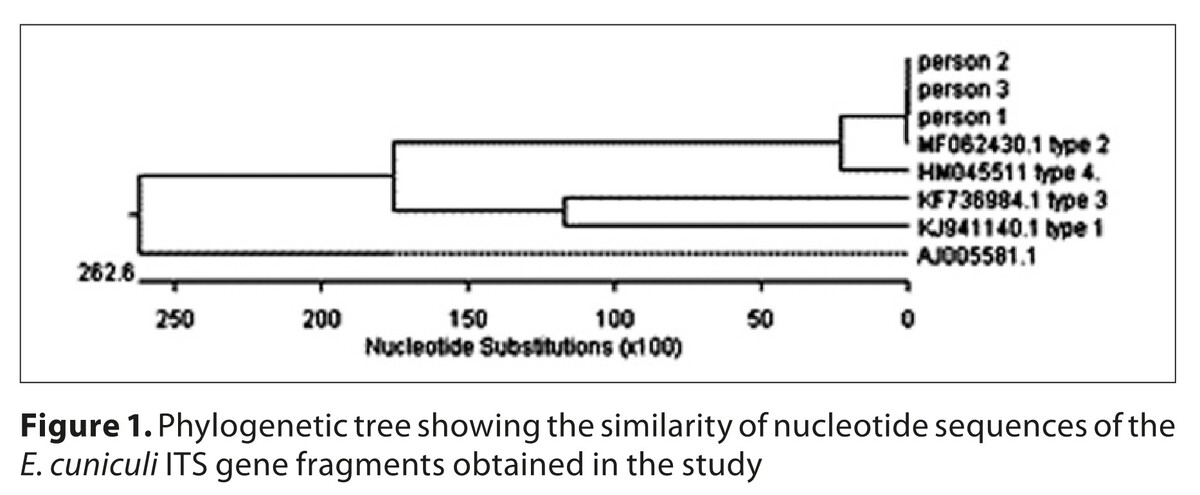
Using the Real-Time HRM PCR, the DNA of E. cuniculi was detected in blood samples obtained from 3 person in the study group, but was not detected in the control group. The presence of antibodies to E. cuniculi was demonstrated in the 4 samples of sera collected from persons who had been in constant contact with rabbits.
Conclusions:
The results obtained and the literature indicate that individuals working with animals are at increased risk of developing Encephalitozoon ciniculi, and that in the event of health problems, encephalitozoonosis should also be considered in the differential diagnosis.
Encephalitozoon cuniculi is a species of fungus belonging to the phylum Microsporidia, potentially pathogenic to rodents, rabbits, dogs, cats, horses and humans. The aim of the study is to conduct preliminary serological and molecular monitoring of encephalitozoonosis among persons coming into contact with rabbits, i.e., a potential reservoir of E.cuniculi.
Material and Methods:
The study included 28 persons (Group 1), who had been in contact with rabbits (as the owners or veterinary staff), for a minimum of 2 years (from 2–20 years), and 20 persons who had had no such contact, who formed a control group (Group 2). Blood and serum samples were collected for molecular and serological testing for encephalitozoonosis from all the persons.
Results:
Using the Real-Time HRM PCR, the DNA of E. cuniculi was detected in blood samples obtained from 3 person in the study group, but was not detected in the control group. The presence of antibodies to E. cuniculi was demonstrated in the 4 samples of sera collected from persons who had been in constant contact with rabbits.
Conclusions:
The results obtained and the literature indicate that individuals working with animals are at increased risk of developing Encephalitozoon ciniculi, and that in the event of health problems, encephalitozoonosis should also be considered in the differential diagnosis.
PEER REVIEW INFORMATION
Article has been screened for originality
REFERENCES (45)
1.
Bojko J, Reinke AW, Stentiford GD, et al. Microsporidia: a new taxonomic, evolutionary, and ecological synthesis. Trends Parasitol. 2022;38(8):642–659. doi:10.1016/j.pt.2022.05.0074.
2.
Han B, Takvorian PM, Weiss LM. The Function and Structure of the Microsporidia Polar Tube. Exp Suppl. 2022;114:179–213. doi:10.1007/978-3-030-93306-7_86.
3.
Barton CE, Phalen DN, Snowden KF. Prevalence of microsporidian spores shed by asymptomatic lovebirds: Evidence for a potential emerging zoonosis. J Avian Med Surg. 2003;17(4):197–202. https://doi.org/10.1647/2002-0....
4.
Dalboni LC, Alvares Saraiva AM, Konno FTC, et al. Encephalitozoon cuniculi takes advantage of efferocytosis to evade the immune response. PLoS One. 2021;16(3):e0247658. Published 2021 Mar 5. doi:10.1371/journal.pone.0247658.
5.
Sak B, Vecková T, Brdíčková K, et al. Experimental Encephalitozoon cuniculi infection acquired from fermented meat products. Foodborne Pathog Dis. 2019;16(6):394–398. https://doi.org/10.1089/fpd.20....
6.
Wang S, Yao Z, Li L, et al. Seroprevalence of Toxoplasma gondii and Encephalitozoon cuniculi among domestic rabbits in central China. Parasite. 2018;25(9):1–7. https://doi.org/10.1051/parasi....
7.
Sobottka I, Schwartz DA, Schottelius J, et al. Prevalence and clinical significance of intestinal microsporidiosis in human immunodeficiency virus-infected patients with and without diarrhea in Germany: A prospective coprodiagnostic study. Clin Infect Dis. 1998;26(2):475–480. https://doi.org/10.1086/516328.
8.
Han B, Weiss LM. Microsporidia: Obligate Intracellular Pathogens Within the Fungal Kingdom. Microbiol Spectr. 2017;5(2):10.1128/microbiolspec.funk-0018-2016. doi:10.1128/microbiolspec.FUNK-0018-2016.
9.
Künzel F, Fisher PG. Clinical signs, diagnosis, and treatment of Encephalitozoon cuniculi infection in rabbits. Vet Clin Exot Anim Pract. 2018;21(1):69–82. https://doi.org/10.1016/j.cvex....
10.
Li X, Palmer R, Trout JM, et al. Infectivity of microsporidia spores stored in seawater at environmental temperatures. J Parasitol. 2003;90(3):654–657. https://doi.org/10.1645/0022-3....
11.
Li J, Shi K, Sun F, et al. Identification of human pathogenic Enterocytozoon bieneusi, Cyclospora cayetanensis, and Cryptosporidium parvum on the surfaces of vegetables and fruits in Henan, China. Int J Food Microbiol. 2019;307:108292. doi:10.1016/j.ijfoodmicro.2019.108292.
12.
Javanmard E, Mirjalali H, Niyyati M, et al. Molecular and phylogenetic evidences of dispersion of human-infecting microsporidia to vegetable farms via irrigation with treated wastewater: One-year follow up. Int J Hyg Environ Health. 2018;221(4):642–651. doi:10.1016/j.ijheh.2018.03.007.
13.
Kváč M, Tomanová V, Samková E, et al. Encephalitozoon cuniculi in raw cow’s milk remains infectious after pasteurization. Foodborne Pathog Dis. 2016;13(2):77–79. https://doi.org/10.1089/fpd.20....
14.
Brdíčková K, Sak B, Holubová N, et al. Encephalitozoon cuniculi Genotype II Concentrates in Inflammation Foci. J Inflamm Res. 2020;13:583–593. Published 2020 Sep 25. doi:10.2147/JIR.S271628.
15.
Han B, Pan G, Weiss LM. Microsporidiosis in Humans. Clin Microbiol Rev. 2021;34(4):e0001020. doi:10.1128/CMR.00010-20.
16.
Doshi N, Thet Z, Han T, et al. A Case of Intestinal Microsporidiosis in a Renal Transplant Recipient. J Med Cases. 2019;10(8):229–233. doi:10.14740/jmc3340.
17.
Brown M, Longano A, Dendle C, et al. Confirmed microsporidial graft infection in a HIV-negative renal transplant recipient: A case report and review of the literature. Transpl Infect Dis. 2018;20(3):e12888. doi:10.1111/tid.12888.
18.
Shah S, Jacob SS, Mani R, et al. Renal Microsporidiosis in Pediatric Bone Marrow Transplant Recipients: A Case Series. Renal Microsporidiosis in Pediatric Bone Marrow Transplant Recipients: A Case Series. Turk Patoloji Derg. 2020;36(1):68–72. doi:10.5146/tjpath.2017.01416.
19.
Smith RM, Muehlenbachs A, Schaenmann J, et al. Three Cases of Neurologic Syndrome Caused by Donor-Derived Microsporidiosis. Emerg Infect Dis. 2017;23(3):387–395. doi:10.3201/eid2303.161580.
20.
Wesołowska M, Szetela B, Kicia M, et al. Dual infection of urinary tract with Enterocytozoon bieneusi and Encephalitozoon cuniculi in HIV/AIDS patients. Ann Parasitol. 2019;65(1):77–81. https://pubmed.ncbi.nlm.nih.go....
21.
Weiss LM. In Ryan ET, Hill DR, Solomon T, Aronson N, Endy TP (ed), Hunter’s tropical medicine and emerging infectious diseases. Elsevier, Amsterdam, Netherlands. 2020. Microsporidiosis, p 825–831.
22.
Sak B, Gottliebová P, Nyčová E, et al. Microsporidia (Encephalitozoon cuniculi) in patients with degenerative hip and knee disease, Czech Republic. Emerg Infect Dis. 2024;30(3):469–477. https://doi.org/10.3201/eid300....
23.
Ditrich O, Chrdle A, Sak B, et al. Encephalitozoon cuniculi genotype I as a causative agent of brain abscess in an immunocompetent patient. J Clin Microbiol. 2011;49(7):2769–2771. https://doi.org/10.1128/JCM.00....
24.
Stentiford GD, Becnel J, Weiss LM, et al. Microsporidia – Emergent Pathogens in the Global Food Chain. Trends Parasitol. 2016;32(4):336–348. doi:10.1016/j.pt.2015.12.004.
25.
Ruan Y, Xu X, He Q, et al. The largest meta-analysis on the global prevalence of microsporidia in mammals, avian and water provides insights into the epidemic features of these ubiquitous pathogens. Parasit Vectors. 2021;14(1):186. Published 2021 Apr 1. doi:10.1186/s13071-021-04700-x.
26.
Wilczyńska A, Komsta R, Szadkowski M, et al. Prevalence of Encephalitozoon cuniculi Infection in Guinea Pigs (Cavia porcellus) in Poland with Different Clinical Disorders-A Pilot Study. Animals (Basel). 2023;13(12):1992. Published 2023 Jun 14. doi:10.3390/ani13121992.
27.
Sak B, Fibigerová M, Mravcová K, et al. Tick-borne microsporidiosis: ticks as a neglected source of human microsporidian infections? Emerg Microbes Infect. 2024;13(1):1–3. https://doi.org/10.1080/222217....
28.
Keeble E, Kϋnzel F, Montiani-Ferreira F, et al. Encephalitozoonosis in Pet Rabbits: Epidemiology, Pathogenesis, Immunology and Consensus on Clinical Management. Animals (Basel). 2026;16(2):346. Published 2026 Jan 22. doi:10.3390/ani16020346.
29.
Matsubayashi H, Koike T, Mikata I, et al. A case of Encephalitozoon-like body infection in man. AMA Arch Pathol. 1959;67(2):181–187.
30.
Wang ZD, Liu Q, Liu HH, et al. Prevalence of Cryptosporidium, microsporidia and Isospora infection in HIV-infected people: a global systematic review and meta-analysis. Parasit Vectors. 2018;11(1):28. Published 2018 Jan 9. doi:10.1186/s13071-017-2558-x.
31.
Asghari A, Mohammadi MR, Norouzi R, et al. A global overview of microsporidia infection in HIV/AIDS patients: an updated systematic review and meta-analysis. Int Health. Published online January 28, 2026. doi:10.1093/inthealth/ihaf163.
32.
Ulusan Bagci O, Muftuoglu C, Guldaval F, et al. Molecular Prevalence of Microsporidia Infection in Patients with Lung Cancer. Am J Trop Med Hyg. 2023;108(5):895–900. Published 2023 Mar 20. doi:10.4269/ajtmh.22-0506.
33.
Seatamanoch N, Kongdachalert S, Sunantaraporn S, et al. Microsporidia, a Highly Adaptive Organism and Its Host Expansion to Humans. Front Cell Infect Microbiol. 2022;12:924007. 2022 Jun 16. doi:10.3389/fcimb.2022.924007.
34.
Pelin A, Moteshareie H, Sak B, et al. The genome of an Encephalitozoon cuniculi type III strain reveals insights into the genetic diversity and mode of reproduction of a ubiquitous vertebrate pathogen. Heredity (Edinb). 2016;116(5):458–465. doi:10.1038/hdy.2016.4.
35.
Panek J, Sendra K, Glenwright H, et al. Microsporidian obligate intracellular parasites subvert autophagy of infected mammalian cells to promote their own growth. MBio. 2025;(e01049–25):1–15. https://doi.org/10.1101/2022.0....
36.
Csokai J, Joachim A, Gruber A, et al. Diagnostic markers for encephalitozoonosis in pet rabbits. Vet Parasitol. 2009;163(1–2):18–26. doi:10.1016/j.vetpar.2009.03.057.
37.
Montiani-Ferreira F, Joachim A, Künzel F, et al. Encephalitozoon cuniculi Infection in Rabbits (Oryctolagus cuniculus): Data from an International Survey of Exotic and Small Animal Veterinarians. Animals (Basel). 2024;14(22):3295. Published 2024 Nov 15. doi:10.3390/ani14223295.
38.
Jordan CN, Zajac AM, Snowden KS, Lindsay DS. Direct agglutination test for Encephalitozoon cuniculi. Vet Parasitol. 2006;135(3–4):235–240. doi:10.1016/j.vetpar.2005.09.009.
39.
Ghosh K, Weiss LM. Molecular diagnostic tests for microsporidia. Interdiscip Perspect Infect Dis. 2009;2009:926521. doi:10.1155/2009/926521.
40.
Malčeková B, Valenčáková A, Molnár L, et al. First detection and genotyping of human-associated microsporidia in wild waterfowl of Slovakia. Acta Parasitol. 2013;58(1):13–17. https://doi.org/10.2478/s11686....
41.
Luptáková L, Petrovová E. The occurrence of microsporidial infections and toxoplasmosis in Slovak women. Epidemiol Microbiol Immunol. 2011;60(4):156–160. https://pubmed.ncbi.nlm.nih.go....
42.
Pan Y, Wang S, Liu X, et al. Seroprevalence of Encephalitozoon cuniculi in humans and rabbits in China. Iran J Parasitol. 2015;10(2):290–295. https://pubmed.ncbi.nlm.nih.go....
43.
Abu-Akkada SS, El Kerdany EDH, Mady RF, et al. Encephalitozoon cuniculi infection among immunocompromised and immunocompetent humans in Egypt. Iran J Parasitol. 2015;10(4):561–570. https://pubmed.ncbi.nlm.nih.go....
44.
Santaniello A, Cimmino I, Cimmino L, et al. Zoonotic risk of Encephalitozoon cuniculi in animal-assisted interventions: laboratory strategies for the diagnosis of infections in humans and animals. Int. J. Environ. Res. Public Health 2021;18(17): 9333. https://doi.org/10.3390/ijerph....
45.
Abdoli A, Olfatifar M, Zaki L, et al. The global prevalence of microsporidia infection in rabbits as a neglected public health concern: A systematic review and meta-analysis. Prev Vet Med. 2025;234:106380. doi:10.1016/j.prevetmed.2024.106380.
Share
RELATED ARTICLE
| eISSN: | 1898-2263 |
| ISSN: | 1232-1966 |


Generation of the DOI (Digital Object Identifier) - task financed under the agreement No NrRCN/SP/0532/2021/1 by the Minister of Science and Higher
© 2006-2026 Journal hosting platform by Bentus
We process personal data collected when visiting the website. The function of obtaining information about users and their behavior is carried out by voluntarily entered information in forms and saving cookies in end devices. Data, including cookies, are used to provide services, improve the user experience and to analyze the traffic in accordance with the Privacy policy. Data are also collected and processed by Google Analytics tool (more).
You can change cookies settings in your browser. Restricted use of cookies in the browser configuration may affect some functionalities of the website.
You can change cookies settings in your browser. Restricted use of cookies in the browser configuration may affect some functionalities of the website.