Online first
Current issue
Archive
Special Issues
About the Journal
Publication Ethics
Anti-Plagiarism system
Instructions for Authors
Instructions for Reviewers
Editorial Board
Editorial Office
Contact
Reviewers
All Reviewers
2025
2024
2023
2022
2021
2020
2019
2018
2017
2016
General Data Protection Regulation (RODO)

BRIEF COMMUNICATION
New records of Haemaphysalis concinna ticks on Usedom Island, NW Poland
1
Department of Medical and Molecular Biology, Faculty of Medical Sciences in Zabrze, Medical University of Silesia, Katowice, Poland
2
Department of Microbiology, Faculty of Pharmaceutical Sciences in Sosnowiec, Medical University of Silesia, Katowice, Poland
3
Sanitary Epidemiological Station, Świnoujście, Poland
4
Department of Forest Management Planning, University of Life Sciences, Poznań, Poland
5
Department of Biology and Parasitology, Faculty of Health Sciences, Medical University, Lublin, Poland
Corresponding author
Marek Asman
Department of Medical and Molecular Biology, Faculty of Medical Sciences in Zabrze, Medical University of Silesia in Katowice, Jordana 19, 41-808, Zabrze, Poland
Department of Medical and Molecular Biology, Faculty of Medical Sciences in Zabrze, Medical University of Silesia in Katowice, Jordana 19, 41-808, Zabrze, Poland
KEYWORDS
TOPICS
ABSTRACT
Introduction:
Haemaphysalis concinna (Acari: Ixodidae) is an important vector of tick-borne diseases in the Palearctic zone, constantly increasing its range of occurrence. Extensive data exist regarding the species distribution of throughout Eurasia, including countries adjacent to Poland; however, records of this species in Poland remain scarce.
Material and Methods:
Faunistic studies by flagging method were conducted in 2019, 2022 and 2025 in the recreational area of Usedom Island NW Poland.
Results:
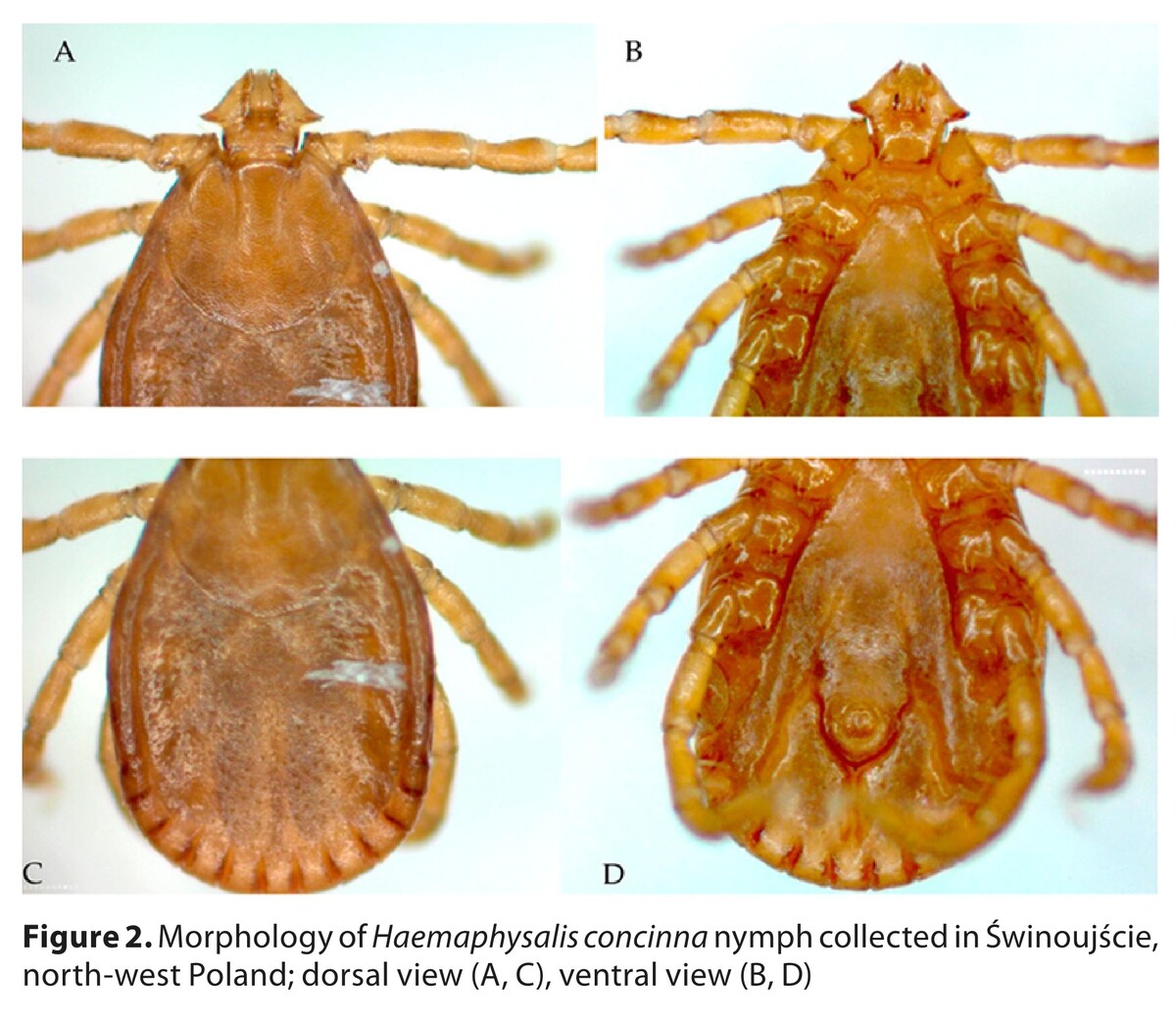
Of the 139 host-seeking ticks collected, Ixodes ricinus represented 98.5% (137/139), and H. concinna comprised 1.5% (2/139) of the specimens. Haemaphysalis concinna was noted twice – in 2019 and 2022.
Conclusions:
Considering that H. concinna is a proven vector for the tick-borne encephalitis virus and Francisella tularensis, and since its feeding on humans is documented, it remains essential to continually update information on its distribution and spread. The obtained data revealed that Usedom Island may be a potential new locality of H. concinna occurrence, but further extended studies are necessary to confirm its status in this location.
Haemaphysalis concinna (Acari: Ixodidae) is an important vector of tick-borne diseases in the Palearctic zone, constantly increasing its range of occurrence. Extensive data exist regarding the species distribution of throughout Eurasia, including countries adjacent to Poland; however, records of this species in Poland remain scarce.
Material and Methods:
Faunistic studies by flagging method were conducted in 2019, 2022 and 2025 in the recreational area of Usedom Island NW Poland.
Results:
Of the 139 host-seeking ticks collected, Ixodes ricinus represented 98.5% (137/139), and H. concinna comprised 1.5% (2/139) of the specimens. Haemaphysalis concinna was noted twice – in 2019 and 2022.
Conclusions:
Considering that H. concinna is a proven vector for the tick-borne encephalitis virus and Francisella tularensis, and since its feeding on humans is documented, it remains essential to continually update information on its distribution and spread. The obtained data revealed that Usedom Island may be a potential new locality of H. concinna occurrence, but further extended studies are necessary to confirm its status in this location.
FUNDING
This research was funded by a grant from the Medical
University of Silesia BNW-2-041/N/4/I.
PEER REVIEW INFORMATION
Article has been screened for originality
REFERENCES (32)
1.
Sormunen JJ, Sääksjärvi IE, Vesterinen EJ, et al. Crowdsourced tick observation data from across 60 years reveals major increases and northwards shifts in tick contact areas in Finland. Sci Rep. 2023;13(1):21274. https://doi.org/10.1038/s41598....
2.
Eisen RJ, Eisen L. Evaluation of the association between climate warming and the spread and proliferation of Ixodes scapularis in northern states in the Eastern United States. Ticks Tick Borne Dis. 2024;15(1):102286. https://doi.org/10.1016/j.ttbd....
3.
Nosek J. The ecology, bionomics and behaviour of Haemaphysalis (Haemaphysalis) concinna tick. Z Parasitenkd. 1971;36(3):233–241. https://doi.org/10.1007/BF0034....
4.
Nowak-Chmura M, Siuda K. Ticks of Poland. Review of contemporary issues and latest research. Ann Parasitol. 2012;58(3):125–155.
5.
Liu J, Han XY, Ye RZ, et al. An integrated data analysis reveals distribution, hosts, and pathogen diversity of Haemaphysalis concinna. Parasit Vectors. 2024;17(1):92. https://doi.org/10.1186/s13071....
6.
Briciu VT, Titilincu A, Tăţulescu DF, et al. First survey on hard ticks (Ixodidae) collected from humans in Romania: possible risks for tick-borne diseases. Exp Appl Acarol. 2011;54(2):199–204. https://doi.org/10.1007/s10493....
7.
Špitalská E, Boldišová E, Štefanidesová K, et al. Pathogenic microorganisms in ticks removed from Slovakian residents over the years 2008–2018. Ticks Tick Borne Dis. 2021;12(2):101626. https://doi.org/10.1016/j.ttbd....
8.
Xue J, Ren Q, Yang XL, et al. Human pathogens in ticks removed from humans in Hebei, China. Heliyon. 2023;9(3):e13859. https://doi.org/10.1016/j.heli....
9.
Kozuch O, Nosek J. Experimental transmission of tick-borne encephalitis (TBE) virus by Haemaphysalis concinna ticks. Acta Virol. 1980;24(5):377.
10.
Výrosteková V, Gurycová D, Kocianová E, Řeháček J. Ticks as important epidemiological indicators of natural foci of tularemia in Slovakia. Biol Brat. 2001;56 (Suppl. 9): 97–103.
12.
Dantas-Torres F, Lia RP, Capelli G, Otranto D. Efficiency of flagging and dragging for tick collection. Exp Appl Acarol. 2013;61(1):119–127. https://doi.org/10.1007/s10493....
13.
Nowak-Chmura M. Fauna of ticks (Ixodida) of Central Europe. Scientific Publishing house of the Pedagogical University of Cracow, 2013. (in Polish).
14.
Estrada-Peña A, Mihalca AD, Petney TN, editors. Ticks of Europe and North Africa. A guide to species identification. New York: Springer; 2017.
15.
Supergan M, Karbowiak G. The estimation scale of endangerment with tick attacks on recreational towns areas. Przegl Epidemiol. 2009;63(1):67–71.
16.
Buczek AM, Buczek W, Buczek A, et al. The Potential Role of Migratory Birds in the Rapid Spread of Ticks and Tick-Borne Pathogens in the Changing Climatic and Environmental Conditions in Europe. Int J Environ Res Public Health. 2020;17(6):2117. https://doi.org/10.3390/ijerph....
17.
Hornok S, Kováts D, Csörgő T, et al. Birds as potential reservoirs of tick-borne pathogens: first evidence of bacteraemia with Rickettsia helvetica. Parasit Vectors. 2014;7:128. https://doi.org/10.1186/1756-3....
18.
Hornok S, Flaisz B, Takács N, et al. Bird ticks in Hungary reflect western, southern, eastern flyway connections and two genetic lineages of Ixodes frontalis and Haemaphysalis concinna. Parasit Vectors. 2016;9:101. https://doi.org/10.1186/s13071....
19.
Flaisz B, Sulyok KM, Kováts D, et al. Babesia genotypes in Haemaphysalis concinna collected from birds in Hungary reflect phylogeographic connections with Siberia and the Far East. Ticks Tick Borne Dis. 2017;8(4):666–670. https://doi.org/10.1016/j.ttbd....
20.
Lachmajer J, Skierska B, Wegner Z. Ticks of the genus Haemaphysalis Koch (Ixodidae) found in Poland. Biul Inst Med Morsk Gdansk. 1956;7:189–195 (In Polish).
21.
Dwużnik D, Mierzejewska EJ, Alsarraf M, et al. A new focus of the tick Haemaphysalis concinna in Western Poland. Exp Appl Acarol. 2019;78(1):93–112. doi:10.1007/s10493-019-00371-7.
22.
Kiewra D, Czułowska A, Dyczko D, et al. First record of Haemaphysalis concinna (Acari: Ixodidae) in Lower Silesia, SW Poland. Exp Appl Acarol. 2019;77(3):449–454. https://doi.org/10.1007/s10493....
23.
Zięba P, Nowakiewicz A, Michalski A, et al. A new locality of the Haemaphysalis concinna tick (Koch, 1844) in Poland and its role as a potential vector of infectious diseases. Ann Parasitol. 2019;65(3):281–286. https://doi.org/10.17420/ap650....
24.
Dyczko D, Hałupka L, Czyż B, et al. Ticks on migrating birds in southwestern Poland: occurrence of Ixodes ricinus and the first Polish record of Haemaphysalis concinna on birds. Exp Appl Acarol. 2025;95(4):46. Published 2025 Oct 20. doi:10.1007/s10493-025-01070-2.
25.
Dwużnik-Szarek D, Mierzejewska EJ, Alsarraf M, et al. Pathogens detected in the tick Haemaphysalis concinna in Western Poland: known and unknown threats. Exp Appl Acarol. 2021;84(4):769–783. doi:10.1007/s10493-021-00647-x.
26.
Hornok S, Meli ML, Gönczi E, et al. Occurrence of ticks and prevalence of Anaplasma phagocytophilum and Borrelia burgdorferi s.l. in three types of urban biotopes: forests, parks and cemeteries. Ticks Tick Borne Dis. 2014;5(6):785–789. https://doi.org/10.1016/j.ttbd....
27.
Kazimírová M, Hamšíková Z, Kocianová E, et al. Relative density of host-seeking ticks in different habitat types of south-western Slovakia. Exp Appl Acarol. 2016;69(2):205–224. https://doi.org/10.1007/s10493....
28.
Rybarova M, Honsova M, Papousek I, et al. Variability of species of Babesia Starcovici, 1893 in three sympatric ticks (Ixodes ricinus, Dermacentor reticulatus and Haemaphysalis concinna) at the edge of Pannonia in the Czech Republic and Slovakia. Folia Parasitol (Praha). 2017;64:2017.028. https://doi.org/10.14411/fp.20....
29.
Vogelgesang JR, Walter M, Kahl O, et al. Long-term monitoring of the seasonal density of questing ixodid ticks in Vienna (Austria): setup and first results. Exp Appl Acarol. 2020;81(3):409–420. https://doi.org/10.1007/s10493....
30.
Rubel F, Dautel H, Nijhof AM, et al. Ticks in the metropolitan area of Berlin, Germany. Ticks Tick Borne Dis. 2022;13(6):102029. https://doi.org/10.1016/j.ttbd....
31.
Buczek A, Buczek W. Importation of Ticks on Companion Animals and the Risk of Spread of Tick-Borne Diseases to Non-Endemic Regions in Europe. Animals (Basel). 2020;11(1):6. https://doi.org/10.3390/ani110....
32.
Răileanu C, Tauchmann O, Silaghi C. Sympatric occurrence of Ixodes ricinus with Dermacentor reticulatus and Haemaphysalis concinna and the associated tick-borne pathogens near the German Baltic coast. Parasit Vectors. 2022;15(1):65. https://doi.org/10.1186/s13071....
Share
RELATED ARTICLE
| eISSN: | 1898-2263 |
| ISSN: | 1232-1966 |


Generation of the DOI (Digital Object Identifier) - task financed under the agreement No NrRCN/SP/0532/2021/1 by the Minister of Science and Higher
© 2006-2026 Journal hosting platform by Bentus
We process personal data collected when visiting the website. The function of obtaining information about users and their behavior is carried out by voluntarily entered information in forms and saving cookies in end devices. Data, including cookies, are used to provide services, improve the user experience and to analyze the traffic in accordance with the Privacy policy. Data are also collected and processed by Google Analytics tool (more).
You can change cookies settings in your browser. Restricted use of cookies in the browser configuration may affect some functionalities of the website.
You can change cookies settings in your browser. Restricted use of cookies in the browser configuration may affect some functionalities of the website.