Online first
Current issue
Archive
Special Issues
About the Journal
Publication Ethics
Anti-Plagiarism system
Instructions for Authors
Instructions for Reviewers
Editorial Board
Editorial Office
Contact
Reviewers
All Reviewers
2025
2024
2023
2022
2021
2020
2019
2018
2017
2016
General Data Protection Regulation (RODO)

RESEARCH PAPER
Nationwide autumn-winter survey of Giardia duodenalis in Polish dogs – diagnostic comparison and PCR-RFLP characterization
1
Department of Infectious and Invasive Diseases and Veterinary Administration, Institute of Veterinary Medicine, Faculty of Biological and Veterinary Sciences, Nicolaus Copernicus University, Toruń, Poland
2
Department of Parasitology and Molecular Biology, Animallab Veterinary Laboratory, Warsaw, Poland
3
Department of Animal Environment Biology, Institute of Animal Sciences, Warsaw, Poland
Corresponding author
Dawid Jańczak
Department of Infectious and Invasive Diseases and Veterinary Administration, Institute of Veterinary Medicine, Faculty of Biological and Veterinary Sciences, Nicolaus Copernicus University, Lwowska 1, 87-100, Toruń, Poland
Department of Infectious and Invasive Diseases and Veterinary Administration, Institute of Veterinary Medicine, Faculty of Biological and Veterinary Sciences, Nicolaus Copernicus University, Lwowska 1, 87-100, Toruń, Poland
KEYWORDS
prevalencePCR-RFLPGiardia duodenalisglutamate dehydrogenaseassemblagescanine giardiasiszinc sulfate flotationrapid immunochromatographic assaybeta-giardin
TOPICS
ABSTRACT
Introduction and objective:
Giardia duodenalis is an important intestinal protozoan of dogs and a potential environmental and zoonotic concern. The aim of the study is to determine the occurrence of G. duodenalis in Polish dogs, assess selected host factors associated with infection, compare microscopy and rapid immunochromatographic assay, and characterise positive Giardia isolates by PCR-RFLP.
Material and methods:
Between October – December 2025, 2,251 dogs in Poland were examined using 3-day faecal sample sets. Microscopy was performed by zinc sulfate flotation. A subset of 818 sample sets was additionally tested with a rapid immunochromatographic coproantigen assay. Microscopy-positive samples were subjected to PCR-RFLP targetting the gdh and beta-giardin loci.
Results:
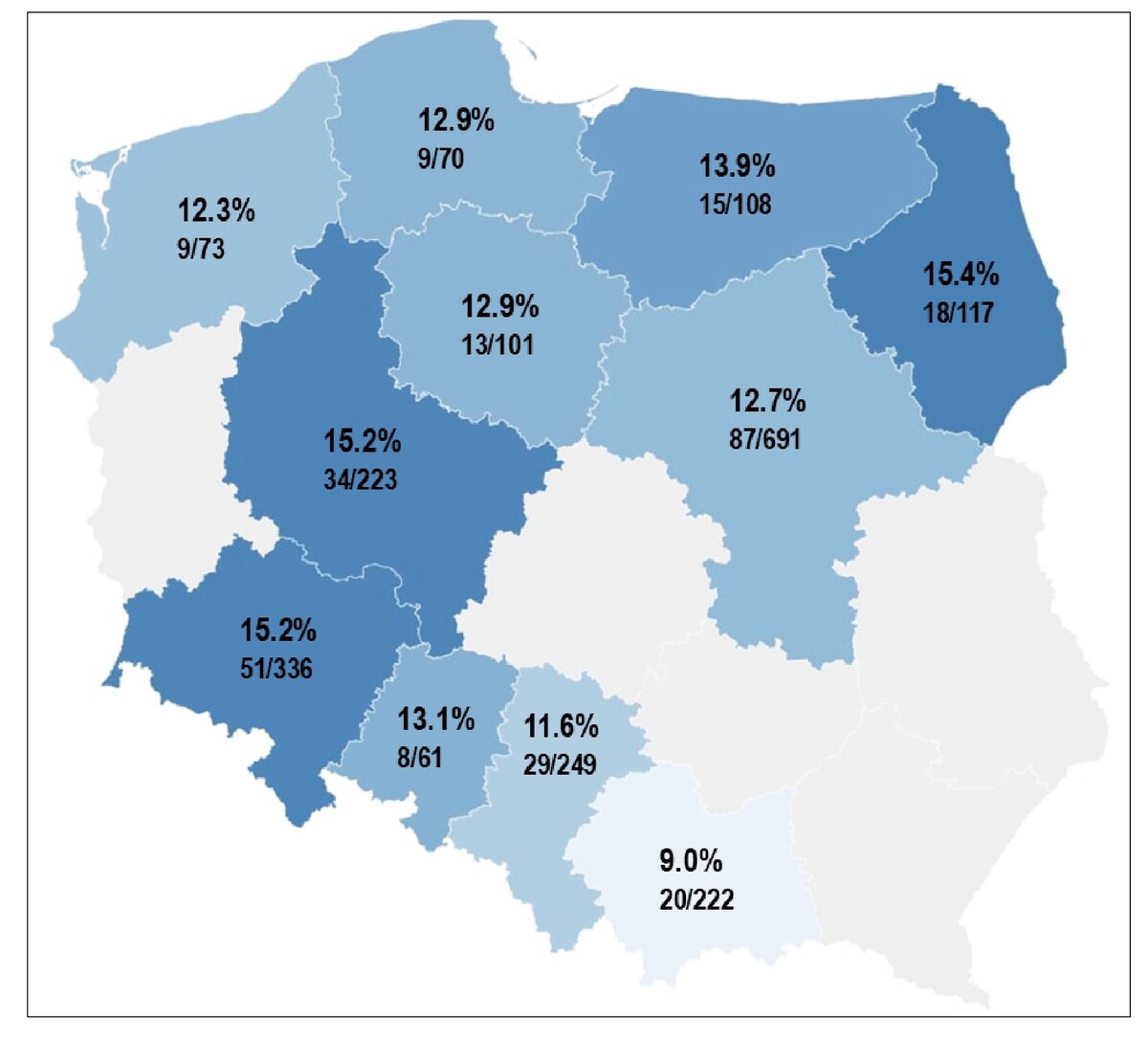
Microscopy-based prevalence was 13.06% (294/2,251; 95% CI: 11.73–14.52). Infection was strongly associated with age, with the highest prevalence in dogs aged <1 year (26.86%). The immunochromatographic assay showed 98.18% sensitivity and 96.78% specificity relative to microscopy. At least one molecular marker was detected in 241/294 microscopy-positive samples (81.97%). Assemblages D and C predominated, accounting for 48.96% and 48.13% of genotyped samples, respectively, whereas assemblages B (2.07%) and A (0.83%) were rare.
Conclusions:
Giardia duodenalis is common in dogs in Poland, especially in young animals. Canine-adapted assemblages C and D were the most prevalent, while potentially zoonotic assemblages A and B were only occasionally detected. Combined use of microscopy and immunochromatographic testing may improve routine diagnosis.
Giardia duodenalis is an important intestinal protozoan of dogs and a potential environmental and zoonotic concern. The aim of the study is to determine the occurrence of G. duodenalis in Polish dogs, assess selected host factors associated with infection, compare microscopy and rapid immunochromatographic assay, and characterise positive Giardia isolates by PCR-RFLP.
Material and methods:
Between October – December 2025, 2,251 dogs in Poland were examined using 3-day faecal sample sets. Microscopy was performed by zinc sulfate flotation. A subset of 818 sample sets was additionally tested with a rapid immunochromatographic coproantigen assay. Microscopy-positive samples were subjected to PCR-RFLP targetting the gdh and beta-giardin loci.
Results:
Microscopy-based prevalence was 13.06% (294/2,251; 95% CI: 11.73–14.52). Infection was strongly associated with age, with the highest prevalence in dogs aged <1 year (26.86%). The immunochromatographic assay showed 98.18% sensitivity and 96.78% specificity relative to microscopy. At least one molecular marker was detected in 241/294 microscopy-positive samples (81.97%). Assemblages D and C predominated, accounting for 48.96% and 48.13% of genotyped samples, respectively, whereas assemblages B (2.07%) and A (0.83%) were rare.
Conclusions:
Giardia duodenalis is common in dogs in Poland, especially in young animals. Canine-adapted assemblages C and D were the most prevalent, while potentially zoonotic assemblages A and B were only occasionally detected. Combined use of microscopy and immunochromatographic testing may improve routine diagnosis.
PEER REVIEW INFORMATION
Article has been screened for originality
REFERENCES (27)
1.
Cai W, Ryan U, Xiao L, et al. Zoonotic giardiasis: an update. Parasitol Res. 2021;120(12):4199–4218. doi:10.1007/s00436-021-07325-2.
2.
Dixon BR. Giardia duodenalis in humans and animals—transmission and disease. Res Vet Sci. 2021;135:283–289. doi:10.1016/j.rvsc.2020.09.034.
3.
Piekarska J, Bajzert J, Gorczykowski M, et al. Molecular identification of Giardia duodenalis isolates from domestic dogs and cats in Wroclaw, Poland. Ann Agric Environ Med. 2016;23(3):410–415. doi:10.5604/12321966.1219178.
4.
Piekara-Stępińska A, Piekarska J, Gorczykowski M, et al. Genotypes of Giardia duodenalis in household dogs and cats from Poland. Acta Parasitol. 2021;66(2):428–435. doi:10.1007/s11686-020-00292-1.
5.
Jańczak D, Olszewski J, Maj AK, et al. Prevalence of Giardia duodenalis genetic assemblages isolated from dogs and cats in Poland. J Vet Res. 2025;69(3):447–455. doi:10.2478/jvetres-2025-0043.
6.
Bartosik J, Łojek J, Puchała M, et al. Prevalence of intestinal parasites detected in routine coproscopic methods in dogs and cats from the Masovian voivodeship in 2012–2015. Med Weter. 2019;75(5):293–297. doi:10.21521/mw.6153.
7.
Kaduková M, Schreiberová A, Štrkolcová G. Comparison of the efficiency of diagnostic tests used to prove giardiasis in terms of their practicality and use in the veterinary clinical practice. Folia Vet. 2023;67(3):49–56. doi:10.2478/fv-2023-0027.
8.
Sun J, Qin Z, Fu Y, et al. Assessment of potential zoonotic transmission of Giardia duodenalis from dogs and cats. One Health. 2023;17:100651. doi:10.1016/j.onehlt.2023.100651.
9.
Myjak P, Nahorski WL, Pancewicz SA, et al. Rekomendacje dotyczące badań parazytologicznych w diagnostyce chorób pasożytniczych [Recommendations for parasitological diagnostics in parasitic diseases]. Przegl Epidemiol. 2014;68(2):283–291.
10.
Read CM, Monis PT, Thompson RCA. Discrimination of all genotypes of Giardia duodenalis at the glutamate dehydrogenase locus using PCR-RFLP. Infect Genet Evol. 2004;4(2):125–130. doi:10.1016/j.meegid.2004.02.001.
11.
Lalle M, Pozio E, Capelli G, et al. Genetic heterogeneity at the beta-giardin locus among human and animal isolates of Giardia duodenalis and identification of potentially zoonotic subgenotypes. Int J Parasitol. 2005;35(2):207–213. doi:10.1016/j.ijpara.2004.10.022.
12.
Tamura K, Stecher G, Peterson D, Filipski A, Kumar S. MEGA6: Molecular Evolutionary Genetics Analysis version 6.0. Mol Biol Evol. 2013;30(12):2725–2729. doi:10.1093/molbev/mst197.
13.
Agresti A, Berrilli F, Maestrini M, et al. Prevalence, risk factors and genotypes of Giardia duodenalis in sheltered dogs in Tuscany, Central Italy. Pathogens. 2022;11(1):12. doi:10.3390/pathogens11010012.
14.
Šmit I, Beck A, Kiš D, et al. The influence of Giardia duodenalis on the occurrence of clinical signs in dogs. Vet Sci. 2023;10(12):694. doi:10.3390/vetsci10120694.
15.
Kurnosova OP, Panova OA, Arisov MV. Prevalence of Giardia duodenalis in dogs and cats: age-related predisposition, symptomatic, and asymptomatic cyst shedding. Vet World. 2024;17(2):379–383. doi:10.14202/vetworld.2024.379-383.
16.
Uiterwijk M, Mughini-Gras L, Nijsse R, et al. Giardia duodenalis multi-locus genotypes in dogs with different levels of synanthropism and clinical signs. Parasit Vectors. 2020;13(1):605. doi:10.1186/s13071-020-04496-2.
17.
Csokai J, Heusinger A, Müller E. Outcome of parasitological examinations in dogs in Germany: a retrospective survey. Parasitol Res. 2024;123(3):160. doi:10.1007/s00436-024-08181-6.
18.
Ktenas S, Roeber F, Meggiolaro MN, et al. Comparison of Giardia duodenalis point-of-care antigen faecal tests to reference laboratory assays in non-symptomatic dogs. Vet Parasitol. 2024;327:110139. doi:10.1016/j.vetpar.2024.110139.
19.
Barrera JP, Miró G, Nachum-Biala Y, et al. Enhancing diagnostic accuracy: direct immunofluorescence assay as the gold standard for detecting Giardia duodenalis and Cryptosporidium spp. in canine and feline fecal samples. BMC Vet Res. 2024;20(1):445. doi:10.1186/s12917-024-04297-0.
20.
Symeonidou I, Gelasakis AI, Miliotou AN, et al. Rapid on-site diagnosis of canine giardiosis: time versus performance. Parasit Vectors. 2020;13(1):544. doi:10.1186/s13071-020-04422-6.
21.
Burton KW, Michael H, Drake C. The utility of coproantigen testing in screening populations. Vet Parasitol. 2025;336:110459. doi:10.1016/j.vetpar.2025.110459.
22.
Ryan UM, Feng Y, Fayer R, et al. Taxonomy and molecular epidemiology of Cryptosporidium and Giardia — a 50 year perspective, 1971–2021. Int J Parasitol. 2021;51(13–14):1099–1119. doi:10.1016/j.ijpara.2021.08.007.
23.
Mravcová K, Štrkolcová G, Goldová M. The prevalence and assemblages of Giardia duodenalis in dogs: a systematic review in Europe. Folia Vet. 2019;63(4):38–45. doi:10.2478/fv-2019-0036.
24.
Hatam-Nahavandi K, Ahmadpour E, Rezaeian M, et al. Occurrence and assemblage distribution of Giardia duodenalis in symptomatic and asymptomatic patients in southeastern Iran, 2019–2022. Gut Pathog. 2024;16(1):68. doi:10.1186/s13099-024-00666-0.
25.
Tipu JH, Tabassum A, Klotz C, et al. Diversity of domestic and imported assemblages of Giardia in Norway and multi-locus sequence typing of domestic assemblage A isolates. Int J Parasitol. 2026;56(3):104730. doi:10.1016/j.ijpara.2025.08.018.
26.
Liu S, Li R, Li Z, et al. Prevalence and assemblage distribution of Giardia intestinalis in farmed mink, foxes, and raccoon dogs in northern China. Front Vet Sci. 2025;12:1514525. doi:10.3389/fvets.2025.1514525.
27.
Kotepui M, Popruk S, Kotepui KU, et al. Prevalence and genotyping of Giardia duodenalis infections in humans in Thailand: a systematic review and meta-analysis. BMC Infect Dis. 2025;26:131. doi:10.1186/s12879-025-12372-6.
Share
RELATED ARTICLE
| eISSN: | 1898-2263 |
| ISSN: | 1232-1966 |


Generation of the DOI (Digital Object Identifier) - task financed under the agreement No NrRCN/SP/0532/2021/1 by the Minister of Science and Higher
© 2006-2026 Journal hosting platform by Bentus
We process personal data collected when visiting the website. The function of obtaining information about users and their behavior is carried out by voluntarily entered information in forms and saving cookies in end devices. Data, including cookies, are used to provide services, improve the user experience and to analyze the traffic in accordance with the Privacy policy. Data are also collected and processed by Google Analytics tool (more).
You can change cookies settings in your browser. Restricted use of cookies in the browser configuration may affect some functionalities of the website.
You can change cookies settings in your browser. Restricted use of cookies in the browser configuration may affect some functionalities of the website.