Online first
Current issue
Archive
Special Issues
About the Journal
Publication Ethics
Anti-Plagiarism system
Instructions for Authors
Instructions for Reviewers
Editorial Board
Editorial Office
Contact
Reviewers
All Reviewers
2025
2024
2023
2022
2021
2020
2019
2018
2017
2016
General Data Protection Regulation (RODO)

RESEARCH PAPER
Longitudinal analysis of Covid-19 vaccine hesitancy and its determinants in Poland
1
Department of Population Medicine and Lifestyle Diseases Prevention, Medical University, Białystok, Poland
2
Society and Cognition Unit, University of Bialystok, Poland
3
Department of Endocrinology, Diabetology and Internal Medicine, Medical University, Białystok, Poland
4
Clinical Research Centre, Medical University, Białystok, Poland
5
Department of Infectious Diseases and Neuroinfections, Medical University, Białystok, Poland
6
Department of Epidemiology and Biostatistics, Institute of Rural Health, Lublin, Poland
7
Department of Cardiology, University Hospital, Białystok, Poland
These authors had equal contribution to this work
Corresponding author
Pawel Sowa
Department of Population Medicine and Lifestyle Diseases Prevention, Medical University of Bialystok, Poland
Department of Population Medicine and Lifestyle Diseases Prevention, Medical University of Bialystok, Poland
KEYWORDS
TOPICS
ABSTRACT
Introduction and objective:
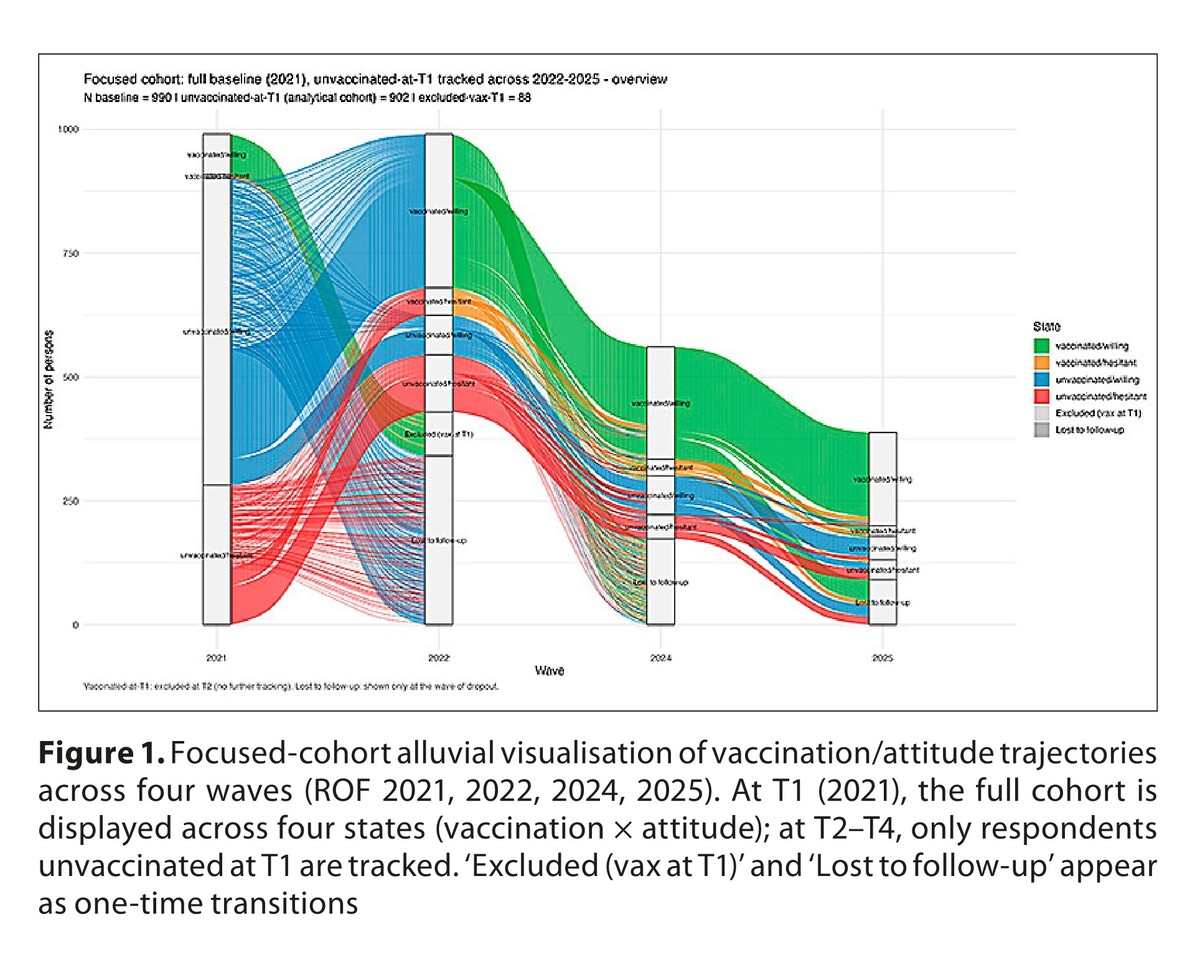
Vaccine hesitancy is dynamic, with longitudinal evidence beyond two waves scarce. The aim of the study is to characterise, across a four-wave Polish panel (2021–2025), how stated vaccination intentions translate into actual vaccination, and to identify modifiable determinants of persistent non-vaccination versus delayed conversion.
Material and methods:
4,205 wave records from 2,559 unique Polish adults (Rise or Fall [ROF] panel, 2021/2022/2024/2025) were harmonised. The analytical cohort (n=859, ≥2 waves) was classified into five trajectory classes: Baseline vaccinated, Early convert, Late convert, Persistent unvax willing (PuW), and Persistent unvax hesitant (PuH; reference). Predictors were identified by Multinomial logistic regression and discrete-time hazard models.
Results:
By 2025, 83.4% of baseline-willing respondents were vaccinated vs. 38.9% of baseline-hesitant – a 44.5-percentage-point gap nearly identical to 2022 (45.7 pp). Persistent non-vaccination tracked higher fear of side-effects (hazard OR=0.63 per point; p<0.001) and conspiracy beliefs (OR=0.79; p<0.001); a Bachelor’s degree raised the conversion hazard 2.6-fold (p<0.001). Low fear emerged as a strong predictor of Baseline vaccinated (OR=6.0) and Early convert (OR=3.0). PuW had the highest mean HLS-Q12 (3.04; omnibus p=0.040), with a borderline multinomial association (OR=1.56; p=0.077); HLS-Q12 robustly predicted lower vaccination hazard (OR=0.58; p=0.001).
Conclusions:
Vaccine hesitancy in Poland is durable; the willing/hesitant behavioural gap persists. Post-rollout strategy should combine safety-centred dialogue targetting fear of side-effects with structural facilitators for the willing-but-unvaccinated subgroup.
Vaccine hesitancy is dynamic, with longitudinal evidence beyond two waves scarce. The aim of the study is to characterise, across a four-wave Polish panel (2021–2025), how stated vaccination intentions translate into actual vaccination, and to identify modifiable determinants of persistent non-vaccination versus delayed conversion.
Material and methods:
4,205 wave records from 2,559 unique Polish adults (Rise or Fall [ROF] panel, 2021/2022/2024/2025) were harmonised. The analytical cohort (n=859, ≥2 waves) was classified into five trajectory classes: Baseline vaccinated, Early convert, Late convert, Persistent unvax willing (PuW), and Persistent unvax hesitant (PuH; reference). Predictors were identified by Multinomial logistic regression and discrete-time hazard models.
Results:
By 2025, 83.4% of baseline-willing respondents were vaccinated vs. 38.9% of baseline-hesitant – a 44.5-percentage-point gap nearly identical to 2022 (45.7 pp). Persistent non-vaccination tracked higher fear of side-effects (hazard OR=0.63 per point; p<0.001) and conspiracy beliefs (OR=0.79; p<0.001); a Bachelor’s degree raised the conversion hazard 2.6-fold (p<0.001). Low fear emerged as a strong predictor of Baseline vaccinated (OR=6.0) and Early convert (OR=3.0). PuW had the highest mean HLS-Q12 (3.04; omnibus p=0.040), with a borderline multinomial association (OR=1.56; p=0.077); HLS-Q12 robustly predicted lower vaccination hazard (OR=0.58; p=0.001).
Conclusions:
Vaccine hesitancy in Poland is durable; the willing/hesitant behavioural gap persists. Post-rollout strategy should combine safety-centred dialogue targetting fear of side-effects with structural facilitators for the willing-but-unvaccinated subgroup.
FUNDING
The Rise or Fall (ROF) project was funded by
the National Science Centre, Poland (OPUS-19 grant no.
2020/37/B/NZ7/03380). The funder had no role in study
design or in the decision to submit for publication. The
article processing charge (APC) for open-access publication
was covered by the Minister of Science under the “Regional
Initiative of Excellence” (RID) programme (agreement no.
RID/SP/0043/2024/01).
ETHICAL APPROVAL
The study was approved by the Bioethical Committee
of the Medical University of Bialystok (approval no.
APK.002.346.2020). Informed consent was obtained from
all participants.
REFERENCES (29)
1.
MacDonald NE. Vaccine hesitancy: Definition, scope and determinants. Vaccine. 2015;33(34):4161–4.
2.
World Health Organization. Understanding the behavioural and social drivers of vaccine uptake – WHO position paper, May 2022. Wkly Epidemiol Rec. 2022;97:209–24.
3.
Betsch C, Schmid P, Heinemeier D, et al. Beyond confidence: Development of a measure assessing the 5C psychological antecedents of vaccination. PLoS ONE. 2018;13(12):e0208601.
4.
Lièvre G, Sicsic J, Galmiche S, et al. Are the 7C psychological antecedents associated with COVID-19 vaccine behaviours beyond intentions? Vaccine. 2024;42(14):3288–99.
5.
Oudin Doglioni D, Gagneux-Brunon A, Gauchet A, et al. Psychometric validation of a 7C-model of antecedents of vaccine acceptance among healthcare workers, parents and adolescents in France. Sci Rep. 2023;13(1):19895.
6.
Kisa A, Kisa S. Health conspiracy theories: a scoping review of drivers, impacts, and countermeasures. Int J Equity Health. 2025;24(1):93.
7.
Simione L, Vagni M, Maiorano T, et al. Paranoia affected COVID-19 vaccine refusal by increasing beliefs in conspiracy theories and mistrust of science. Front Psychol. 2025;16:1718763.
8.
Larson HJ, Clarke RM, Jarrett C, et al. Measuring trust in vaccination: A systematic review. Hum Vaccin Immunother. 2018;14(7):1599–1609.
9.
Ministerstwo Zdrowia. Raport szczepień przeciwko COVID-19 w Polsce. Available at: https://www.gov.pl/web/szczepi... (accessed 24 Oct 2023).
10.
Pizzato M, Gerli AG, La Vecchia C, et al. Impact of COVID-19 on total excess mortality and geographic disparities in Europe, 2020–2023. Lancet Reg Health Eur. 2024;44:100996.
11.
Wróblewski M, Bartnicki M, Stankowska J, et al. Sukces czy porażka? Społeczna ewaluacja Narodowego Programu Szczepień przeciwko COVID-19. Warszawa: Łukasiewicz-ORGMASZ; 2022.
12.
Schernhammer E, Weitzer J, Laubichler MD, et al. Correlates of COVID-19 vaccine hesitancy in Austria: trust and the government. J Public Health. 2022;44(1):e106–16.
13.
Loomba S, De Figueiredo A, Piatek SJ, et al. Measuring the impact of COVID-19 vaccine misinformation on vaccination intent in the UK and USA. Nat Hum Behav. 2021;5(3):337–48.
14.
Lazarus JV, Wyka K, White TM, et al. Revisiting COVID-19 vaccine hesitancy around the world using data from 23 countries in 2021. Nat Commun. 2022;13(1):3801.
15.
Lazarus JV, Wyka K, White TM, et al. A survey of COVID-19 vaccine acceptance across 23 countries in 2022. Nat Med. 2023;29(2):366–75.
16.
Sabat I, Neumann-Böhme S, Barros PP, et al. Vaccine hesitancy comes in waves: Longitudinal evidence on willingness to vaccinate against COVID-19 from seven European countries. Vaccine. 2023;41(36):5304–12.
17.
Phillips R, Gillespie D, Hallingberg B, et al. Perceived threat of COVID-19, attitudes towards vaccination, and vaccine hesitancy: A prospective longitudinal study in the UK. Br J Health Psychol. 2022;27(4):1354–81.
18.
Oleksy T, Wnuk A, Gambin M, et al. Barriers and facilitators of willingness to vaccinate against COVID-19: A four-wave longitudinal study. Pers Individ Dif. 2022;190:111524.
19.
Sowa P, Kiszkiel Ł, Laskowski PP, et al. COVID-19 Vaccine Hesitancy in Poland – Multifactorial Impact Trajectories. Vaccines. 2021;9(8):876.
20.
R Core Team. R: A language and environment for statistical computing. Vienna: R Foundation; 2024.
21.
Dai J, Xie Y, Wang Y, et al. Profiles of Hesitancy Toward the Herpes Zoster Vaccine Among Older Adults in China: A Latent Profile Analysis. Vaccines. 2026;14(4):331.
22.
Gwadz M, Robinson JA, Serrano FGB, et al. Perspectives on COVID-19 Vaccination Among Unvaccinated and Under-Vaccinated African American/Black and Latine Frontline Essential Workers: A Qualitative Exploration. AIDS Behav. 2025;29(8):2461–82.
23.
Vasiliadis S, Cook J, Nissan K, et al. Vaccine misinformation among Arabic-speakers in Australia and the audience and appetite for a game-based intervention. Vaccine. 2025;62:127599.
24.
Raciborski F, Tomaszewska A, Rakocy K, et al. The multidimensional nature of attitudes towards preventive vaccinations – a cross-sectional survey among Poles aged 15–39 years. Int J Occup Med Environ Health. 2023;36(2):214–28.
25.
Młoźniak I, Zwierczyk U, Rzepecka E, et al. Manifestation of Health Denialism in Attitudes toward COVID-19 Vaccination: A Qualitative Study. Vaccines. 2023;11(12):1822.
26.
Chlabicz M, Nabożny A, Koszelew J, et al. Medical Misinformation in Polish on the World Wide Web During the COVID-19 Pandemic Period: Infodemiology Study. J Med Internet Res. 2024;26:e48130.
27.
Bayrak F, Kayatepe E, Özman N, et al. Can reflection mitigate COVID-19 vaccine conspiracy beliefs and hesitancy? Psychol Health. 2025;1–32.
28.
Yang L, Xing C, Yu X, et al. Coverage of HPV Vaccination and Influencing Factors Among Female College Students in Northern China. Vaccines. 2025;13(6):598.
29.
Rahbeni TA, Satapathy P, Itumalla R, et al. COVID-19 Vaccine Hesitancy: Umbrella Review of Systematic Reviews and Meta-Analysis. JMIR Public Health Surveill. 2024;10:e54769.
Share
RELATED ARTICLE
| eISSN: | 1898-2263 |
| ISSN: | 1232-1966 |


Generation of the DOI (Digital Object Identifier) - task financed under the agreement No NrRCN/SP/0532/2021/1 by the Minister of Science and Higher
© 2006-2026 Journal hosting platform by Bentus
We process personal data collected when visiting the website. The function of obtaining information about users and their behavior is carried out by voluntarily entered information in forms and saving cookies in end devices. Data, including cookies, are used to provide services, improve the user experience and to analyze the traffic in accordance with the Privacy policy. Data are also collected and processed by Google Analytics tool (more).
You can change cookies settings in your browser. Restricted use of cookies in the browser configuration may affect some functionalities of the website.
You can change cookies settings in your browser. Restricted use of cookies in the browser configuration may affect some functionalities of the website.