Online first
Current issue
Archive
Special Issues
About the Journal
Publication Ethics
Anti-Plagiarism system
Instructions for Authors
Instructions for Reviewers
Editorial Board
Editorial Office
Contact
Reviewers
All Reviewers
2025
2024
2023
2022
2021
2020
2019
2018
2017
2016
General Data Protection Regulation (RODO)

RESEARCH PAPER
Age-associated carriage of intestinal parasites among adults in north-eastern Poland – a cross-sectional study
1
Department of Epidemiology and Tropical Medicine, Military Institute of Medicine – National Research Institute, Warsaw, Poland
2
Department of Infectious Diseases and Neuroinfections, Medical University, Białystok, Poland
3
Department of Paediatrics, Gastroenterology, Hepatology, Nutrition, Allergology and Pulmunology, Medical University, Białystok, Poland
4
Department of Children’s Observation and Infectious Diseases, Medical University, Białystok, Poland
Corresponding author
Krzysztof Korzeniewski
Department of Epidemiology and Tropical Medicine, Military Institute of Medicine - National Research Institute, Szaserów 128, 04-141, Warsaw, Poland
Department of Epidemiology and Tropical Medicine, Military Institute of Medicine - National Research Institute, Szaserów 128, 04-141, Warsaw, Poland
KEYWORDS
TOPICS
ABSTRACT
Introduction and objective:
Data concerning the occurrence of intestinal parasites among the Polish population remain limited. The aim of the study is to assess the carriage of intestinal parasites among adults from north-eastern Poland and to identify demographic and clinical factors associated with their detection.
Material and methods:
A cross-sectional study was conducted among 118 adults from the Podlaskie Province in north-eastern Poland. Stool samples were examined microscopically for the presence of intestinal parasites and other intestinal eukaryotic organisms. In addition, molecular assays targetting selected clinically relevant intestinal parasites were performed. Demographic characteristics and gastrointestinal symptoms were collected using a structured questionnaire. Associations between organism detection and demographic or clinical variables were assessed statistically.
Results:
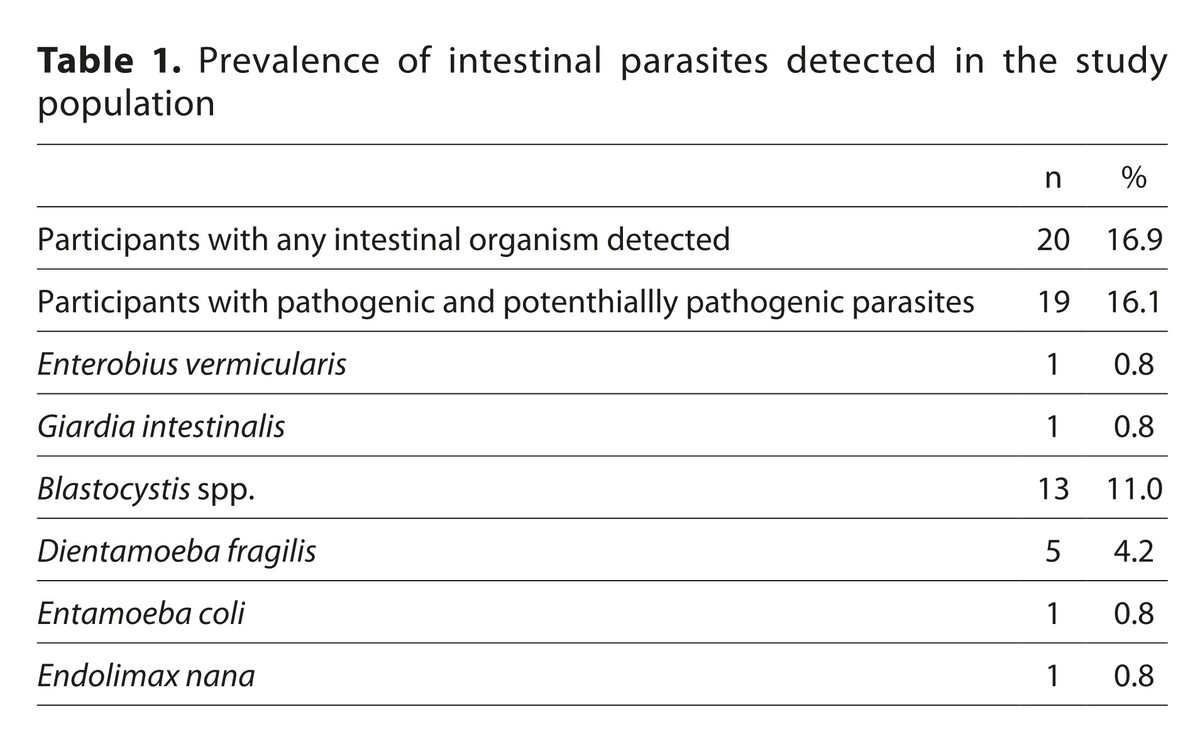
Intestinal organisms were detected in 20/118 participants (16.9%), including 19 (16.1%) harbouring pathogenic or potentially pathogenic species. The most frequently identified organisms were Blastocystis spp. (n = 13) and Dientamoeba fragilis (n = 5). Single cases of Giardia intestinalis, Enterobius vermicularis, Entamoeba coli, and Endolimax nana were observed. Increasing age was significantly associated with the presence of intestinal organisms (p = 0.016).
Conclusions:
The prevalence of intestinal parasites among adults in north-eastern Poland was low and was largely driven by the detection of Blastocystis spp. and Dientamoeba fragilis. Pathogenic parasites were rare, whereas older age was associated with a higher likelihood of intestinal organism detection. Intestinal parasites, particularly Blastocystis spp. and intestinal protists, remain an important component of adult gut ecology and epidemiology despite the low burden of clinically significant parasitic infections.
Data concerning the occurrence of intestinal parasites among the Polish population remain limited. The aim of the study is to assess the carriage of intestinal parasites among adults from north-eastern Poland and to identify demographic and clinical factors associated with their detection.
Material and methods:
A cross-sectional study was conducted among 118 adults from the Podlaskie Province in north-eastern Poland. Stool samples were examined microscopically for the presence of intestinal parasites and other intestinal eukaryotic organisms. In addition, molecular assays targetting selected clinically relevant intestinal parasites were performed. Demographic characteristics and gastrointestinal symptoms were collected using a structured questionnaire. Associations between organism detection and demographic or clinical variables were assessed statistically.
Results:
Intestinal organisms were detected in 20/118 participants (16.9%), including 19 (16.1%) harbouring pathogenic or potentially pathogenic species. The most frequently identified organisms were Blastocystis spp. (n = 13) and Dientamoeba fragilis (n = 5). Single cases of Giardia intestinalis, Enterobius vermicularis, Entamoeba coli, and Endolimax nana were observed. Increasing age was significantly associated with the presence of intestinal organisms (p = 0.016).
Conclusions:
The prevalence of intestinal parasites among adults in north-eastern Poland was low and was largely driven by the detection of Blastocystis spp. and Dientamoeba fragilis. Pathogenic parasites were rare, whereas older age was associated with a higher likelihood of intestinal organism detection. Intestinal parasites, particularly Blastocystis spp. and intestinal protists, remain an important component of adult gut ecology and epidemiology despite the low burden of clinically significant parasitic infections.
PEER REVIEW INFORMATION
Article has been screened for originality
REFERENCES (19)
1.
Moniot M, Nourrsson C, Bailly E, et al. Current status of intestinal parasitosis and microsporidiosis in industrialized countries: results from a prospective study in France and Luxembourg. PLoS Negl Trop Dis. 2024;18:e0012145. https://doi.org/10.1371/journa....
2.
Fletcher SM, Stark D, Harkness J, et al. Enteric protozoa in the developed world: a public health perspective. Clin Microbiol Rev. 2012;25:420–449. https://doi.org/10.1128/CMR.05....
3.
Ihnacik L, Šmigová J, Papajová I. Identification of risk factors and high-risk areas for transmission of intestinal parasites in model locality in Slovakia. Sci Rep. 2025;15:1234. https://doi.org/10.1038/s41598....
4.
Bradbury RS, Sapp SGH, Potters I, et al. Where have all the diagnostic morphological parasitologists gone? J Clin Microbiol. 2022;60:e0098622. https://doi.org/10.1128/jcm.00....
5.
Cacciò SM, Ryan U. Molecular epidemiology of giardiasis. Mol Biochem Parasitol. 2008;160:75–80. https://doi.org/10.1016/j.molb....
6.
Stark D, Barratt J, Chan D, et al. Dientamoeba fragilis, the neglected trichomonad of the human bowel. Clin Microbiol Rev. 2016; 29: 553–580. https://doi.org/10.1128/CMR.00....
7.
Piperni E, Nguyen LH, Manghi P, et al. Intestinal Blastocystis is linked to healthier diets and more favorable cardiometabolic outcomes in 56,989 individuals from 32 countries. Cell. 2024;187: 4554–4570. https://doi.org/10.1016/j.cell....
8.
Audebert C, Even G, Cian A, et al. Colonization with the enteric protozoa Blastocystis is associated with increased diversity of human gut bacterial microbiota. Sci Rep. 2016;6:25255. https://doi.org/10.1038/srep25....
9.
Yousfi S, et al. Epidemiology and temporal trends of intestinal parasitic infections in Tizi-Ouzou, North-central Algeria: a 7-year retrospective hospital-based study. Asian Pac J Trop Med. 2026;19:196–204. https://doi.org/10.4103/apjtm.....
10.
Coman V, Vodnar DC. Gut microbiota and old age: modulating factors and interventions for healthy longevity. Exp Gerontol. 2020;141:111095. https://doi.org/10.1016/j.exge....
11.
Korzeniewski K, Shkilna M, Richert W, et al. Intestinal parasite infections among internal war refugees and inhabitants of the Ternopil region, Western Ukraine. Int Marit Health. 2023;74:272–277. https://doi.org/10.5603/IMH.20....
12.
Żukiewicz M, Kaczmarski M, Topczewska M, et al. Epidemiological and clinical picture of parasitic infections in the group of children and adolescents from north-east region of Poland. Wiad Parazytol. 2011;57:179–187.
13.
Kowalewska B, Rudzińska M, Zarudzka D, Kotłowski A. An evaluation of the intensity of intestinal parasitic infections among patients of Out-patient Division of Maitime and Tropical Medicine in Gdynia over last 30 years. Diagn Lab. 2013;49:9–15.
14.
Korzeniewski K, Richert W. Intestinal parasitic infections in officers of the Border Guard in East Poland. Int Marit Health. 2023;74(3):175–179. doi:10.5603/imh.97185. PMID: 37781943.
15.
Tchamwa Bamini G, Charpentier E, Guemas E, et al. No evidence of pathogenicity of Dientamoeba fragilis following detection in stools: a case-control study. Parasite. 2024;31:40. https://doi.org/10.1051/parasi....
16.
Singh R, Zogg H, Ghoshal UC, Ro S. Current treatment options and therapeutic insights for gastrointestinal dysmotility and functional gastrointestinal disorders. Front Pharmacol. 2022;13:808195. https://doi.org/10.3389/fphar.....
17.
Sperber AD, Bangdiwala SI, Drossman DA, et al. Worldwide prevalence and burden of functional gastrointestinal disorders. Gastroenterology. 2021;160:99–114. https://doi.org/10.1053/j.gast....
18.
Stensvold CR, Clark CG. Current status of Blastocystis: a personal view. Parasitol Int. 2016;65:763–771. https://doi.org/10.1016/j.pari....
19.
Bednarska M, et al. Intestinal parasitic infections in the Polish population. Ann Agric Environ Med. 2018;25:599–605. https://doi.org/10.26444/aaem/....
Share
RELATED ARTICLE
| eISSN: | 1898-2263 |
| ISSN: | 1232-1966 |


Generation of the DOI (Digital Object Identifier) - task financed under the agreement No NrRCN/SP/0532/2021/1 by the Minister of Science and Higher
© 2006-2026 Journal hosting platform by Bentus
We process personal data collected when visiting the website. The function of obtaining information about users and their behavior is carried out by voluntarily entered information in forms and saving cookies in end devices. Data, including cookies, are used to provide services, improve the user experience and to analyze the traffic in accordance with the Privacy policy. Data are also collected and processed by Google Analytics tool (more).
You can change cookies settings in your browser. Restricted use of cookies in the browser configuration may affect some functionalities of the website.
You can change cookies settings in your browser. Restricted use of cookies in the browser configuration may affect some functionalities of the website.