Online first
Current issue
Archive
Special Issues
About the Journal
Publication Ethics
Anti-Plagiarism system
Instructions for Authors
Instructions for Reviewers
Editorial Board
Editorial Office
Contact
Reviewers
All Reviewers
2025
2024
2023
2022
2021
2020
2019
2018
2017
2016
General Data Protection Regulation (RODO)

RESEARCH PAPER
Physicochemical and microbial quality of veggie burgers with fermented rapeseed meal as a potential protein source
1
Department of Food Quality, Prof. Waclaw Dabrowski Institute of Agricultural and Food Biotechnology- State Research Institute, Warsaw, Poland
2
Department of Sugar Industry and Food Safety Management, Lodz University of Technology, Faculty of Biotechnology and Food Sciences, Lodz, Poland
Corresponding author
Anna Maria Szosland-Fałtyn
Department of Food Quality, Prof. Waclaw Dabrowski Institute of Agricultural and Food Biotechnology- State Research Institute, Piłsudskiego, 92-202, Łódź, Poland
Department of Food Quality, Prof. Waclaw Dabrowski Institute of Agricultural and Food Biotechnology- State Research Institute, Piłsudskiego, 92-202, Łódź, Poland
KEYWORDS
TOPICS
- Biological agents posing occupational risk in agriculture, forestry, food industry and wood industry and diseases caused by these agents (zoonoses, allergic and immunotoxic diseases)
- Health effects of chemical pollutants in agricultural areas , including occupational and non-occupational effects of agricultural chemicals (pesticides, fertilizers) and effects of industrial disposal (heavy metals, sulphur, etc.) contaminating the atmosphere, soil and water
ABSTRACT
Introduction and objective:
Rapeseed meal (RSM), a by-product of oil extraction, is rich in protein and holds potential as a replacement for animal-derived ingredients. However, its direct use in human nutrition is limited due to the presence of antinutritional compounds such as glucosinolates and phytic acid. Fermentation is a promising method to improve RSM’s nutritional and functional properties by reducing these compounds and enhancing protein digestibility. The aim of this study is to evaluate the physicochemical and microbial quality of fermented rapeseed meal and assess its suitability for use in novel food applications.
Material and methods:
Three variants of veggie burgers with varying amounts of fermented dried meal (10g – 20 g), underwent microbiological and physicochemical analyses according to ISO standards.
Results:
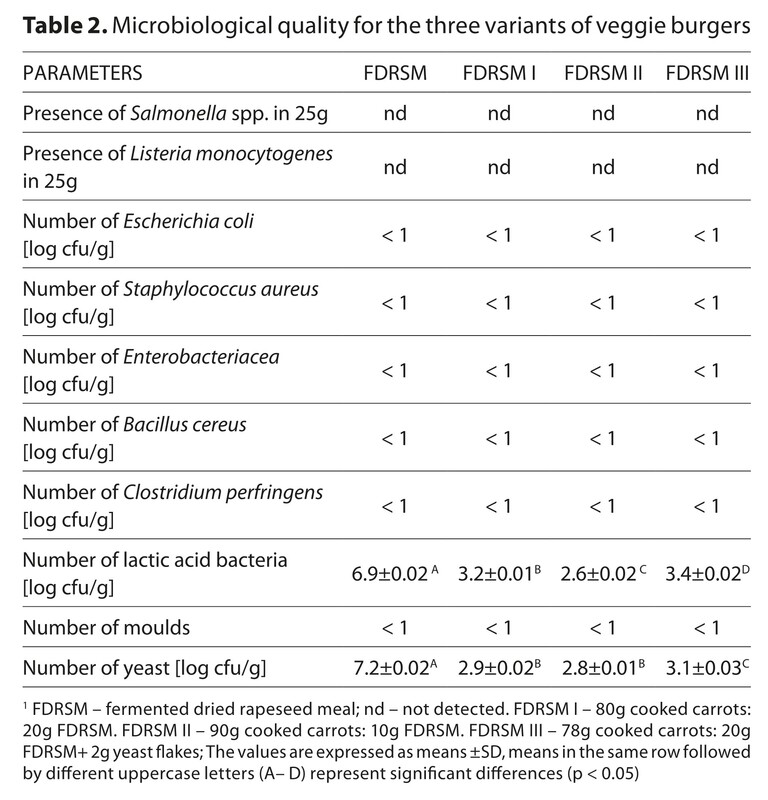
The raw burgers had high counts of lactic acid bacteria and yeast (approx. 7 log CFU/g) with no pathogens. The burger with 20 g meal contained almost 8% protein. Fermented rapeseed meal integrated effectively with other ingredients (carrot and nutritional yeast flakes) improving texture and binding. The fermentation process applied reduced the content of antinutritional substances in rapeseed meal.
Conclusions:
The study provides valuable insights into the physicochemical and microbial quality of veggie burgers enriched with fermented rapeseed meal, demonstrating its potential as a safe and functional alternative source of protein. The burgers developed comply with consumer health and safety requirements, further supporting the feasibility of incorporating fermented rapeseed meal into the human diet; nevertheless, additional investigations are warranted. These findings may facilitate the development of novel food products and contribute to considerations of food safety.
Rapeseed meal (RSM), a by-product of oil extraction, is rich in protein and holds potential as a replacement for animal-derived ingredients. However, its direct use in human nutrition is limited due to the presence of antinutritional compounds such as glucosinolates and phytic acid. Fermentation is a promising method to improve RSM’s nutritional and functional properties by reducing these compounds and enhancing protein digestibility. The aim of this study is to evaluate the physicochemical and microbial quality of fermented rapeseed meal and assess its suitability for use in novel food applications.
Material and methods:
Three variants of veggie burgers with varying amounts of fermented dried meal (10g – 20 g), underwent microbiological and physicochemical analyses according to ISO standards.
Results:
The raw burgers had high counts of lactic acid bacteria and yeast (approx. 7 log CFU/g) with no pathogens. The burger with 20 g meal contained almost 8% protein. Fermented rapeseed meal integrated effectively with other ingredients (carrot and nutritional yeast flakes) improving texture and binding. The fermentation process applied reduced the content of antinutritional substances in rapeseed meal.
Conclusions:
The study provides valuable insights into the physicochemical and microbial quality of veggie burgers enriched with fermented rapeseed meal, demonstrating its potential as a safe and functional alternative source of protein. The burgers developed comply with consumer health and safety requirements, further supporting the feasibility of incorporating fermented rapeseed meal into the human diet; nevertheless, additional investigations are warranted. These findings may facilitate the development of novel food products and contribute to considerations of food safety.
PEER REVIEW INFORMATION
Article has been screened for originality
REFERENCES (25)
1.
Elhalis H, See XY, Osen R, et al. Significance of Fermentation in Plant-Based Meat Analogs: A Critical Review of Nutrition, and Safety-Related Aspects. Foods. 2023;12(17):3222. https://doi:10.3390/foods12173....
2.
Nolden AA, Forde CG. The Nutritional Quality of Plant-Based Foods. Sustainability. 2023;15(4):3324. https://doi:10.3390/su15043324.
3.
Boukid F, Hassoun A, Zouari A, et al. Fermentation for Designing Innovative Plant-Based Meat and Dairy Alternatives. Foods. 2023;12(5):1005. https://doi:10.3390/foods12051....
4.
Sá AGA, Moreno YMF, Carciofi BAM. Plant proteins as high-quality nutritional source for human diet. Trends Food Sci Technol. 2020;97:170–184. https://doi:10.1016/j.tifs.202....
5.
Niwińska B, Szymczyk B, Szczurek W. Perspektywy krajowej produkcji pasz dla zwierząt gospodarskich oraz żywności pochodzenia zwierzęcego bez GMO. Wiadomości Zootechniczne. 2019;57(4):107–120.
6.
Van Der Spiegel M, Noordam MY, Van Der Fels-Klerx HJ. Safety of Novel Protein Sources (Insects, Microalgae, Seaweed, Duckweed, and Rapeseed) and Legislative Aspects for Their Application in Food and Feed Production. Comp Rev Food Sci Food Safe. 2013;12(6):662–678. https://doi:10.1111/1541-4337.....
7.
Wongsirichot P, Gonzalez-Miquel M, Winterburn J. Recent advances in rapeseed meal as alternative feedstock for industrial biotechnology. Biochem. Eng. J. 2022;180:108373. https://doi:10.1016/j.bej.2022....
8.
Hao Y, Wang Z, Zou Y, et al. Effect of static-state fermentation on volatile composition in rapeseed meal. J Sci Food Agric. 2020;100(5):2145–2152. https://doi:10.1002/jsfa.10238.
9.
Szosland-Fałtyn A, Bartodziejska B, Dolatowski Z. Możliwość zastąpienia śruty sojowej rzepakową w żywieniu trzody chlewnej. Zagadnienia Doradztwa Rolniczego. 2022;108(2):22–31.
10.
Buratti S, Cappa C, Benedetti S, Giovanelli G. Influence of Cooking Conditions on Nutritional Properties and Sensory Characteristics Interpreted by E-Senses: Case-Study on Selected Vegetables. Foods. 2020;9(5):607. https://doi:10.3390/foods90506....
11.
Sęczkowska O, Bartodziejska B, Maciejewska N, et al. Effect of drying process on survival of environmental starter culture and nutritional value. Med Weter. 2024;80(08):6903–2024. https://doi:10.21521/mw.6903.
12.
Rzymski P, Tomczyk K, Rzymski P, et al. Impact of heavy metals on the female reproductive system. Ann Agric Environ Med. 2015;22(2):259–264. https://doi:10.5604/12321966.1....
13.
izzolo-Brime L, Orta-Ramirez A, Puyol Martin Y, Jakszyn P. Nutritional Assessment of Plant-Based Meat Alternatives: A Comparison of Nutritional Information of Plant-Based Meat Alternatives in Spanish Supermarkets. Nutrients. 2023;15(6):1325. https://doi:10.3390/nu15061325.
14.
Bartkiene E, Gruzauskas R, Ruzauskas M, et al. Changes in the Microbial Community and Biogenic Amine Content in Rapeseed Meal during Fermentation with an Antimicrobial Combination of Lactic Acid Bacteria Strains. Fermentation. 2022;8(4):136. https://doi:10.3390/fermentati....
15.
Mora-Villalobos JA, Montero-Zamora J, Barboza N, et al. Multi-Product Lactic Acid Bacteria Fermentations: A Review. Fermentation. 2020;6(1):23. https://doi:10.3390/fermentati....
16.
Kyrylenko A, Eijlander RT, Alliney G, et al. Levels and types of microbial contaminants in different plant-based ingredients used in dairy alternatives. Int J Food Microbiol. 2023;407:110392. https://doi:10.1016/j.ijfoodmi....
17.
Rebellato AP, Fioravanti MIA, Milani RF, Morgano MA. Inorganic Contaminants in Plant-Based Yogurts Commercialized in Brazil. IJERPH. 2023;20(4):3707. https://doi:10.3390/ijerph2004....
18.
Willis C, Startin C, Jorgensen F, et al. Microbiological quality of vegan alternatives to dairy and meat products in England during 2022–3. J Appl Microbiol. 2024;135(10):lxae245. https://doi:10.1093/jambio/lxa....
19.
Kowalska J, Maćkiw E, Korsak D, Postupolski J. Prevalence of Bacillus cereus in food products in Poland. Ann Agric Environ Med. 2024;31(1):8–12. https://doi:10.26444/aaem/1685....
20.
Kowalczewski PŁ, Wróbel MM, Smarzyński K, et al. Potato Protein-Based Vegan Burgers Enriched with Different Sources of Iron and Fibre: Nutrition, Sensory Characteristics, and Antioxidants before and after In Vitro Digestion. Foods. 2024;13(19):3060. https://doi:10.3390/foods13193....
21.
Suresh A, Shobna, Salaria M, et al. Dietary fibre: an unmatched food component for sustainable health. Food Agric Immunol. 2024;35(1):2384420. https://doi:10.1080/09540105.2....
22.
Patil S, Gavandi T, Karuppayil SM, Jadhav A. Glucosinolate derivatives as antifungals: A review. Phytother Res. 2024;38(11):5052–5066. https://doi:10.1002/ptr.8307.
23.
Cheng H, Liu X, Xiao Q, et al. Rapeseed Meal and Its Application in Pig Diet: A Review. Agriculture. 2022;12(6):849. https://doi:10.3390/agricultur....
24.
Zhang Z, Wen M, Chang Y. Degradation of glucosinolates in rapeseed meal by Lactobacillus delbrueckii and Bacillus subtilis. Grain Oil Sci. Technol. 2020;3(2):70–76. https://doi:10.1016/j.gaost.20....
25.
Abdel-Massih RM, Debs E, Othman L, Attieh J, Cabrerizo FM. Glucosinolates, a natural chemical arsenal: More to tell than the myrosinase story. Front Microbiol. 2023;14:1130208. https://doi:10.3389/fmicb.2023....
Share
RELATED ARTICLE
| eISSN: | 1898-2263 |
| ISSN: | 1232-1966 |


Generation of the DOI (Digital Object Identifier) - task financed under the agreement No NrRCN/SP/0532/2021/1 by the Minister of Science and Higher
© 2006-2026 Journal hosting platform by Bentus
We process personal data collected when visiting the website. The function of obtaining information about users and their behavior is carried out by voluntarily entered information in forms and saving cookies in end devices. Data, including cookies, are used to provide services, improve the user experience and to analyze the traffic in accordance with the Privacy policy. Data are also collected and processed by Google Analytics tool (more).
You can change cookies settings in your browser. Restricted use of cookies in the browser configuration may affect some functionalities of the website.
You can change cookies settings in your browser. Restricted use of cookies in the browser configuration may affect some functionalities of the website.