Online first
Current issue
Archive
Special Issues
About the Journal
Publication Ethics
Anti-Plagiarism system
Instructions for Authors
Instructions for Reviewers
Editorial Board
Editorial Office
Contact
Reviewers
All Reviewers
2025
2024
2023
2022
2021
2020
2019
2018
2017
2016
General Data Protection Regulation (RODO)

RESEARCH PAPER
Prevalence and characteristics of abnormal eating behaviours among young judo athletes in Poland – an analysis of sex differences
1
Department of Psychophysiological Measurements and Human Factor Research, Military Institute of Aviation Medicine, Warsaw, Poland
2
Faculty of Medicine and Health Sciences, University of Applied Sciences, Tarnów, Poland
3
Department of Ergonomics, Central Institute for Labour Protection – National Research Institute, Warsaw, Poland
4
Institute of Psychology, John Paul II Catholic University, Lublin, Poland
Corresponding author
Paulina Baran
Department of Psychophysiological Measurements and Human Factor Research, Military Institute of Aviation Medicine, Krasińskiego Street 54/56, 01-755, Warsaw, Poland
Department of Psychophysiological Measurements and Human Factor Research, Military Institute of Aviation Medicine, Krasińskiego Street 54/56, 01-755, Warsaw, Poland
KEYWORDS
eating disordersadolescentssex differencescombat sportsemotional eatingjudo athletesabnormal eating behaviours
TOPICS
ABSTRACT
Introduction and objective:
Young matial arts sports athletes may be particularly vulnerable to developing abnormal eating behaviours. To date, no studies on eating disorders among young judo athletes have been conducted in Poland. The aim of the study is to assess the prevalence of abnormal eating behaviours among young judo athletes, with emphasis on dietary restraint, uncontrolled eating, and emotional eating.
Material and methods:
A cross-sectional study was conducted among 150 judo athletes aged 12–17 years (70 girls, 80 boys). Participants completed a demographic questionnaire, the TSJ Questionnaire assessing emotional eating and eating in response to external stimuli, and the TFEQ-13 assessing dietary restraint, uncontrolled eating, and emotional eating.
Results:
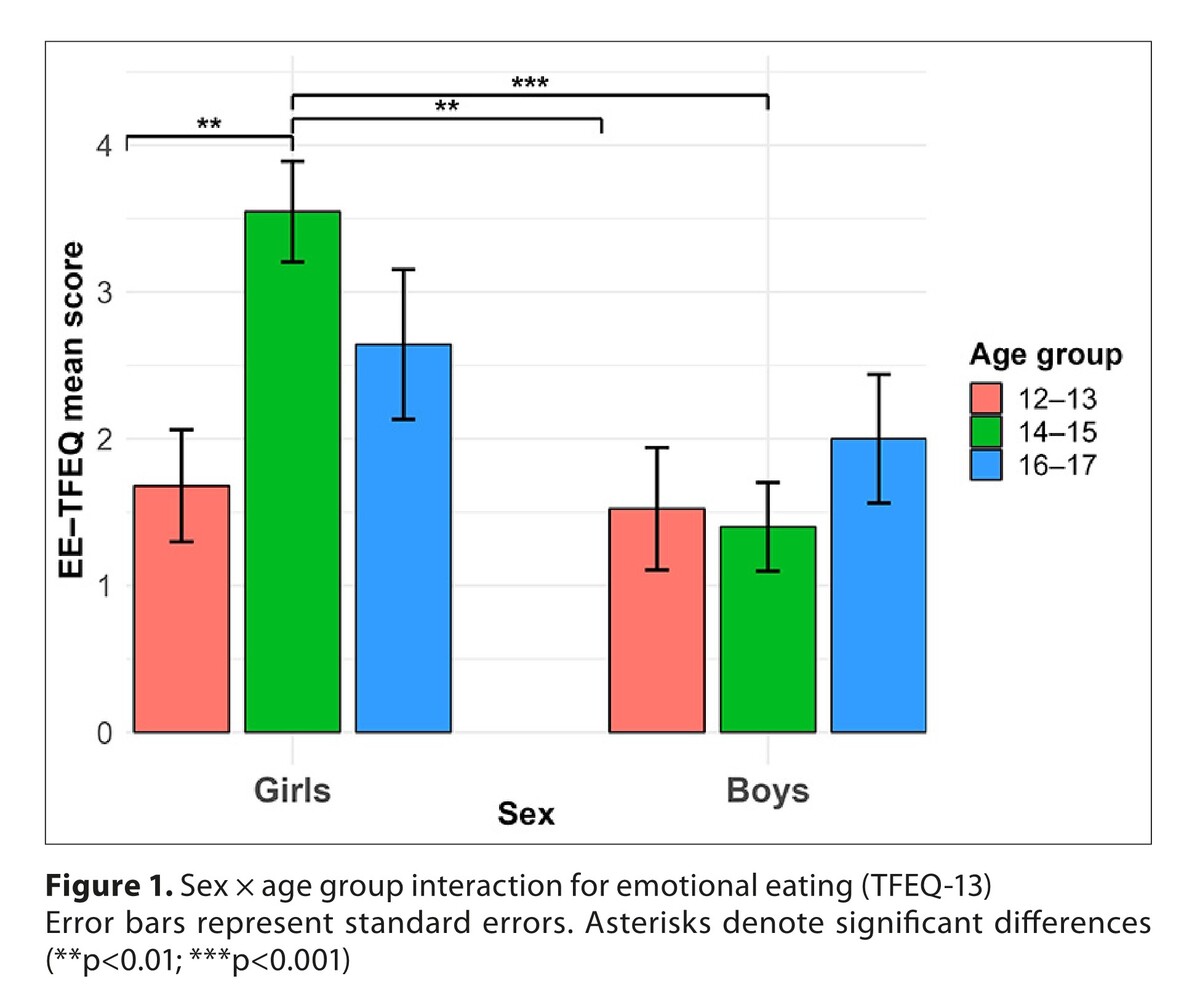
Girls showed higher emotional eating than boys on both measures (TFEQ-13: d=0.57, p<.001; TSJ: d=0.45; p=0.007). Using the 75th percentile cutoff, 31.4% of girls versus 12.5% of boys exceeded the threshold for elevated emotional eating on the TFEQ-13 (p=0.005). A sex × age interaction (p=0.017) revealed elevated emotional eating in girls aged 14–15 years (M=3.55) versus boys (M=1.40, d=1.13). No sex differences were observed in dietary restraint, uncontrolled eating, or external eating. Dietary restraint did not correlate with other behaviours (r≤0.10). Despite equivalent weight control (75%) and competition participation (97%), girls reported greater body dissatisfaction (p=0.015) and lower multi-sport participation (21% vs 46%, p=0.001), suggesting that sex differences reflect divergent psychological responses to shared sport pressures.
Conclusions:
Emotional eating is the primary vulnerability among young judo athletes, with marked sex differences and peak risk at ages 14–15 for girls. Findings support sex-specific prevention targeting emotion regulation and body image resilience.
Young matial arts sports athletes may be particularly vulnerable to developing abnormal eating behaviours. To date, no studies on eating disorders among young judo athletes have been conducted in Poland. The aim of the study is to assess the prevalence of abnormal eating behaviours among young judo athletes, with emphasis on dietary restraint, uncontrolled eating, and emotional eating.
Material and methods:
A cross-sectional study was conducted among 150 judo athletes aged 12–17 years (70 girls, 80 boys). Participants completed a demographic questionnaire, the TSJ Questionnaire assessing emotional eating and eating in response to external stimuli, and the TFEQ-13 assessing dietary restraint, uncontrolled eating, and emotional eating.
Results:
Girls showed higher emotional eating than boys on both measures (TFEQ-13: d=0.57, p<.001; TSJ: d=0.45; p=0.007). Using the 75th percentile cutoff, 31.4% of girls versus 12.5% of boys exceeded the threshold for elevated emotional eating on the TFEQ-13 (p=0.005). A sex × age interaction (p=0.017) revealed elevated emotional eating in girls aged 14–15 years (M=3.55) versus boys (M=1.40, d=1.13). No sex differences were observed in dietary restraint, uncontrolled eating, or external eating. Dietary restraint did not correlate with other behaviours (r≤0.10). Despite equivalent weight control (75%) and competition participation (97%), girls reported greater body dissatisfaction (p=0.015) and lower multi-sport participation (21% vs 46%, p=0.001), suggesting that sex differences reflect divergent psychological responses to shared sport pressures.
Conclusions:
Emotional eating is the primary vulnerability among young judo athletes, with marked sex differences and peak risk at ages 14–15 for girls. Findings support sex-specific prevention targeting emotion regulation and body image resilience.
ACKNOWLEDGEMENTS
The authors express their sincere gratitude to the young judo competitors who participated in the study, as well as their guardians and coaches, for supporting the research.
PEER REVIEW INFORMATION
Article has been screened for originality
REFERENCES (21)
1.
Murayama Y, Ito H, Hamada M, et al. Examining simultaneous associations of four emotion regulation strategies with abnormal eating behaviors/attitudes in early adolescents. Eat Behav. 2021;40:101449. https://doi.org/10.1016/j.eatb....
2.
Dzielska A, Mazur J, Małkowska-Szkutnik A, et al. Adaptation of the Three-Factor Eating Questionnaire (TFEQ-13) for school-aged adolescents in a population study. Probl Hig Epidemiol. 2009;90(3):362–369.
3.
Góra D. Unhealthy nutrition among teenagers in the city of Bielsko-Biała. Pediatr Med Rodz. 2022;18(4):371–375. https://doi.org/10.15557/PiMR.....
4.
Boguszewski D, Ochal A, Islami F, et al. Assessment of health-related behaviours in women practising judo and ju-jitsu. Pol J Sports Med. 2022;38(3):145–151. https://doi.org/10.5604/01.300....
5.
Vorozheikin A, Hassoon A, Kurbanbaeva N, et al. Formation of motivation for judo classes in 9–10-year-old children. J Phys Educ Sport. 2025;25(4):842–849. https://doi.org/10.7752/jpes.2....
6.
Arslan Kabasakal S, Güvendi B, Kaya S, Keskin B. Emotional eating and social physique anxiety in weight-class athletes. Electr J Soc Sci. 2024;23(91):1069–1084.
7.
Espinoza-Barrón SP, Cantú-Berrueto A, Castejón MÁ, et al. Emotional regulation and risk of eating disorders in adolescent athletes. Eur J Investig Health Psychol Educ. 2025;15(9):188. https://doi.org/10.3390/ejihpe....
8.
Malagoli C, Cerro PF, Vecchiato C, et al. Cognitive and emotional regulation in adolescents and young women with eating disorders. Eat Weight Disord. 2021;26:375–383. https://doi.org/10.1007/s40519....
9.
Kim J, Tamminen KA. Emotion regulation among competitive youth athletes: exploring the independent and interactive effects of cognitive reappraisal and expressive suppression. Int J Sport Exerc Psychol. 2022;21(3):534–556. https://doi.org/10.1080/161219....
10.
Villas Boas Junior M, Ucha FG, Souza VH, et al. The relationship between emotional regulation and sports performance: A systematic review. J Phys Educ. 2024;35(1):e-3530. https://doi.org/10.4025/jphyse....
11.
Bird GA, Quinton ML, Cumming J. Promoting athlete mental health: The role of emotion regulation. J Clin Sport Psychol. 2023;17(2):112–130. https://doi.org/10.1123/jcsp.2....
12.
Pérez-Sánchez JA, Castejón MA, Parra-Plaza FJ, et al. Self-Description Questionnaire II-Short (SDQ-II-S): Measurement properties in Spanish adolescents. Behav Psychol. 2024;32(3):563–585. https://doi.org/10.51668/bp.83....
13.
Perez M, Van Diest AMK, Smith H, et al. Body dissatisfaction and its correlates in 5- to 7-year-old girls: A social learning experiment. J Clin Child Adolesc Psychol. 2018;47(5):757–769. https://doi.org/10.1080/153744....
14.
Czepczor-Bernat K, Brytek-Matera A. Children’s and mothers’ perspectives of problematic eating behaviours in young children and adolescents: An exploratory study. Int J Environ Res Public Health. 2019;16(15):2692. https://doi.org/10.3390/ijerph....
15.
Sotomayor Terán DG, Lazarevich I, Gutiérrez Tolentino R, et al. Evaluation of depression, anxiety, risky eating behaviors, eating habits and physical activity after the COVID-19 pandemic among adolescents in Mexico City. Nutr Hosp. 2024;41(5):1052–1061. https://doi.org/10.20960/nh.05....
16.
Brytek-Matera A. (Nie)świadomość doznań płynących z ciała u osób z zaburzeniami odżywiania. In: Brytek-Matera A, editor. Ciało w dobie współczesności. Wybrane zagadnienia z problematyki obrazu własnego ciała. Warszawa: Difin; 2010. p. 66–86.
17.
George D, Mallery P. SPSS for Windows step by step: A simple guide and reference 17.0 update. 10th ed. Boston, Pearson, 2010.
18.
Berkovich BE, Eliakim A, Nemet D, et al. Rapid weight loss among adolescents participating in competitive judo. Int J Sport Nutr Exerc Metab. 2016;26(3):276–284. https://doi.org/10.1123/ijsnem....
19.
Giel KE, Hermann-Werner A, Mayer J, et al. Eating disorder pathology in elite adolescent athletes. Int J Eat Disord. 2016;49(6):553–562. https://doi.org/10.1002/eat.22....
20.
Daley MM, Shoop J, Christino MA. Mental health in the specialized athlete. Curr Rev Musculoskelet Med. 2023;16(9):410–418. https://doi.org/10.1007/s12178....
21.
McCord A, Rock AJ, Davies R, et al. Psychometric evaluation of the ‘Caregiver Factors Influencing Treatment’ (Care-FIT) Inventory for child and adolescent eating disorders. J Eat Disord. 2025;13:208. https://doi.org/10.1186/s40337....
Share
RELATED ARTICLE
| eISSN: | 1898-2263 |
| ISSN: | 1232-1966 |


Generation of the DOI (Digital Object Identifier) - task financed under the agreement No NrRCN/SP/0532/2021/1 by the Minister of Science and Higher
© 2006-2026 Journal hosting platform by Bentus
We process personal data collected when visiting the website. The function of obtaining information about users and their behavior is carried out by voluntarily entered information in forms and saving cookies in end devices. Data, including cookies, are used to provide services, improve the user experience and to analyze the traffic in accordance with the Privacy policy. Data are also collected and processed by Google Analytics tool (more).
You can change cookies settings in your browser. Restricted use of cookies in the browser configuration may affect some functionalities of the website.
You can change cookies settings in your browser. Restricted use of cookies in the browser configuration may affect some functionalities of the website.