Online first
Current issue
Archive
Special Issues
About the Journal
Publication Ethics
Anti-Plagiarism system
Instructions for Authors
Instructions for Reviewers
Editorial Board
Editorial Office
Contact
Reviewers
All Reviewers
2025
2024
2023
2022
2021
2020
2019
2018
2017
2016
General Data Protection Regulation (RODO)

RESEARCH PAPER
Novel synergistic combination of lactic acid and acetic acid bacteria cell-free extracts for enhanced food biopreservation
1
Institute of Human Nutrition Sciences, University of Life Sciences, Warsaw, Poland
2
Department of Meat and Fat Technology, Wacław Dąbrowski Institute of Agricultural and Food Biotechnology – State Research Institute, Warsaw, Poland
Corresponding author
Marcelina Karbowiak
Institute of Human Nutrition Sciences, Warsaw University of Life Sciences (SGGW),, Nowoursynowska 159c, 02-776, Warsaw, Poland
Institute of Human Nutrition Sciences, Warsaw University of Life Sciences (SGGW),, Nowoursynowska 159c, 02-776, Warsaw, Poland
KEYWORDS
antioxidantslactic acid bacteriafood safetyacetic acid bacteriahurdle technologysynergistic antibacterial activitymicrobial-derived preservatives
TOPICS
ABSTRACT
Introduction and objective:
The aim of the study is to evaluate the synergistic biopreservative potential of cell-free extracts (CFEs) obtained from lactic acid bacteria (LAB: Lacticaseibacillus paracasei B1, Lactiplantibacillus plantarum O24) and acetic acid bacteria (AAB: Gluconobacter oxydans KNS32, Komagataeibacter saccharivorans KOM1), and to assess their antimicrobial, antioxidant, and overall combined efficacy in food preservation.
Material and methods:
CFEs were analysed for organic acid and polyphenol content, and tested for antioxidant capacity using DPPH and ABTS assays. Antimicrobial activity was assessed by agar well-diffusion and minimum inhibitory concentration (MIC) assays against Gram-positive and Gram-negative indicator strains. Synergistic effects were evaluated by checkerboard microdilution. The combinations were applied to chicken meat inoculated with Salmonella enterica subsp. enterica serovar Enteritidis and stored for 7 days at 37 °C and 4 °C.
Results:
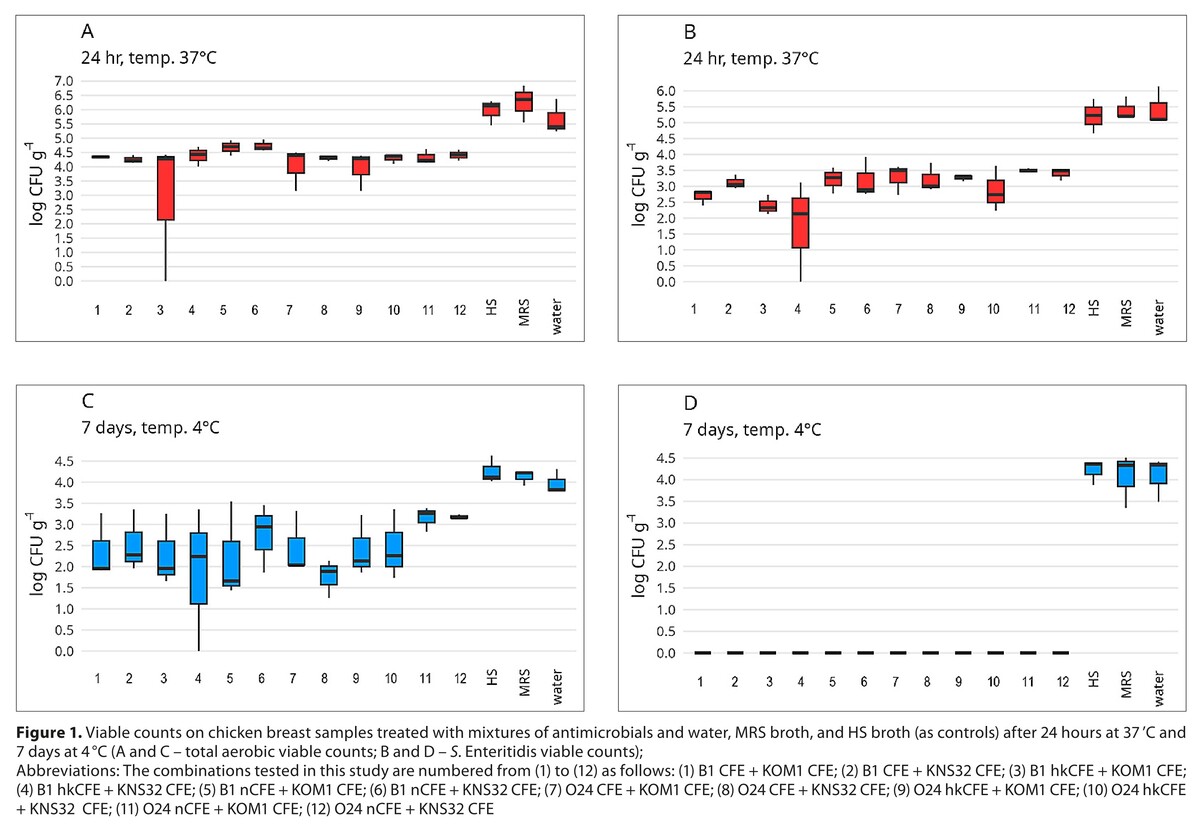
LAB CFEs contained lactic, gluconic, and acetic acids, whereas AAB CFEs contained gluconic, acetic, and citric acids. MIC values ranged from 3.1 – 100 AU/mL, and several LAB–AAB combinations exhibited synergistic antibacterial activity. In the chicken model, CFEs reduced S. Enteritidis counts below the detection limit, and decreased total viable counts by more than 1 log CFU/g after 7 days.
Conclusions:
The synergistic combination of LAB and AAB CFEs exhibited strong antimicrobial and antioxidant activities, indicating high potential as natural, microbially derived preservatives for safe food biopreservation.
The aim of the study is to evaluate the synergistic biopreservative potential of cell-free extracts (CFEs) obtained from lactic acid bacteria (LAB: Lacticaseibacillus paracasei B1, Lactiplantibacillus plantarum O24) and acetic acid bacteria (AAB: Gluconobacter oxydans KNS32, Komagataeibacter saccharivorans KOM1), and to assess their antimicrobial, antioxidant, and overall combined efficacy in food preservation.
Material and methods:
CFEs were analysed for organic acid and polyphenol content, and tested for antioxidant capacity using DPPH and ABTS assays. Antimicrobial activity was assessed by agar well-diffusion and minimum inhibitory concentration (MIC) assays against Gram-positive and Gram-negative indicator strains. Synergistic effects were evaluated by checkerboard microdilution. The combinations were applied to chicken meat inoculated with Salmonella enterica subsp. enterica serovar Enteritidis and stored for 7 days at 37 °C and 4 °C.
Results:
LAB CFEs contained lactic, gluconic, and acetic acids, whereas AAB CFEs contained gluconic, acetic, and citric acids. MIC values ranged from 3.1 – 100 AU/mL, and several LAB–AAB combinations exhibited synergistic antibacterial activity. In the chicken model, CFEs reduced S. Enteritidis counts below the detection limit, and decreased total viable counts by more than 1 log CFU/g after 7 days.
Conclusions:
The synergistic combination of LAB and AAB CFEs exhibited strong antimicrobial and antioxidant activities, indicating high potential as natural, microbially derived preservatives for safe food biopreservation.
PEER REVIEW INFORMATION
Article has been screened for originality
REFERENCES (72)
1.
The European Union One Health 2023 Zoonoses report. EFSA J. 2024;22(12). https://doi:10.2903/j.efsa.202....
2.
Muthuvelu KS, Ethiraj B, Pramnik S, et al. Biopreservative technologies of food: an alternative to chemical preservation and recent developments. Food Sci Biotechnol. 2023;32(10):1337–50. https://doi:10.1007/s10068-023....
3.
Sionek B, Szydłowska A, Kołożyn-Krajewska D. The Role of Microorganisms and Their Antibacterial Compounds in Food Biopreservation. Appl Sci. 2024;14(13):5557. https://doi.org/10.3390/app141....
4.
Dinglasan JLN, Otani H, Doering DT, et al. Microbial secondary metabolites: advancements to accelerate discovery towards application. Nat Rev Microbiol. 2025:1–17. https://doi.org/10.1038/s41579....
5.
Liang M, Wang H, Zhou Z, et al. Antibacterial mechanism of Lactiplantibacillus plantarum SHY96 cell-free supernatant against Listeria monocytogenes revealed by metabolomics and potential application on chicken breast meat preservation. Food Chem. 2025;25:102078. https://doi.org/10.1016/j.foch....
6.
Salminen S, Collado MC, Endo A, et al. The International Scientific Association of Probiotics and Prebiotics (ISAPP) consensus statement on the definition and scope of postbiotics. Nat Rev Gastroenterol Hepatol. 2021;18(9):649–67. https://doi:10.1038/s41575-021....
7.
Vinderola G, Sanders ME, Cunningham M, et al. Frequently asked questions about the ISAPP postbiotic definition. Front Microbiol. 2023;14:1324565. https://doi:10.3389/fmicb.2023....
8.
Arrioja-Bretón D, Mani-López E, Palou E, et al. Antimicrobial activity and storage stability of cell-free supernatants from lactic acid bacteria and their applications with fresh beef. Food Control. 2020;115:107286. https://doi.org/10.1016/j.food....
9.
Rouhi A, Falah F, Azghandi M, et al. Investigating the effect of Lactiplantibacillus plantarum TW57–4 in preventing biofilm formation and expression of virulence genes in Listeria monocytogenes ATCC 19115. LWT. 2024;191:115669. https://doi.org/10.1016/j.lwt.....
10.
Sarita B, Samadhan D, Hassan MZ, et al. A comprehensive review of probiotics and human health-current prospective and applications. Front Microbiol. 2025;15. https://doi:10.3389/fmicb.2024....
11.
Moradi M, Kousheh SA, Almasi H, et al. Postbiotics produced by lactic acid bacteria: The next frontier in food safety. Compr Rev Food Sci Food Saf. 2020;19(6):3390–415. https://doi:10.1111/1541-4337.
12.
Rathod NB, Phadke GG, Tabanelli G, et al. Recent advances in bio-preservatives impacts of lactic acid bacteria and their metabolites on aquatic food products. Food Biosci. 2021;44:101440. https://doi:10.3390/microorgan....
13.
Yang H, Liu Y, Nychas G-JE, et al. Utilizing lactic acid bacteria and their metabolites for controlling Listeria monocytogenes in meat products: Applications, limitations, and future perspectives. Trends Food Sci Technol. 2024:104699. https://doi.org/10.1016/j.tifs....
14.
Huang X, Nzekoue FK, Wang J, et al. A Study of Bioactivities and Composition of a Cocktail of Supernatants Derived from Lactic Acid Bacteria for Potential Food Applications. Probiotics Antimicrob Proteins. 2025. https://doi:10.1007/s12602-024....
15.
Rocchetti MT, Russo P, De Simone N, et al. Immunomodulatory Activity on Human Macrophages by Cell-Free Supernatants to Explore the Probiotic and Postbiotic Potential of Lactiplantibacillus plantarum Strains of Plant Origin. Probiotics Antimicrob Proteins. 2024;16(3):911–26. https://doi:10.1007/s12602-023....
16.
Sionek B, Szydłowska A, Zielińska D, et al. Beneficial Bacteria Isolated from Food in Relation to the Next Generation of Probiotics. Microorganisms. 2023;11(7):1714. https://doi:10.3390/microorgan....
17.
Neffe-Skocińska K, Karbowiak M, Kruk M, et al. Polyphenol and antioxidant properties of food obtained by the activity of acetic acid bacteria (AAB)–A systematic review. J Funct Foods. 2023;107:105691. https://doi.org/10.1016/j.jff.....
18.
Lynch KM, Zannini E, Wilkinson S, et al. Physiology of acetic acid bacteria and their role in vinegar and fermented beverages. Compr Rev Food Sci Food Saf. 2019;18(3):587–625. https://doi:10.1111/1541-4337.....
19.
Liu G, Nie R, Liu Y, et al. Combined antimicrobial effect of bacteriocins with other hurdles of physicochemic and microbiome to prolong shelf life of food: A review. Sci Total Environ. 2022;825:154058. https://doi:10.1016/j.scitoten....
20.
Neffe-Skocińska K, Długosz E, Szulc-Dąbrowska L, et al. Novel Gluconobacter oxydans strains selected from Kombucha with potential postbiotic activity. Appl Microbiol Biotechnol. 2024;108(1):27. https://doi:10.1007/s00253-023....
21.
Han D, Yang Y, Guo Z, et al. A Review on the Interaction of Acetic Acid Bacteria and Microbes in Food Fermentation: A Microbial Ecology Perspective. Foods. 2024;13(16):2534. https://doi:10.3390/foods13162....
22.
Sharafi H, Divsalar E, Rezaei Z, et al. The potential of postbiotics as a novel approach in food packaging and biopreservation: a systematic review of the latest developments. Crit Rev Food Sci Nutr. 2023:1–31. https://doi:10.1080/10408398.2....
23.
Mathur H, Field D, Rea MC, et al. Bacteriocin-Antimicrobial Synergy: A Medical and Food Perspective. Front Microbiol. 2017;8:1205. https://doi:10.3389/fmicb.2017....
24.
Dan SD, Mihaiu M, Reget O, et al. Pathogens contamination level reduction on beef using organic acids decontamination methods. B UASVM Vet Med. 2017;74(2):212–217. https://doi:10.15835/buasvmcn-....
25.
Tirloni E, Bernardi C, Celandroni F, et al. Effectiveness of lactic and acetic acids on the growth of Listeria monocytogenes and Bacillus cereus in primo sale fresh cheese. LWT. 2021;151:112170. https://doi.org/10.1016/j.lwt.....
26.
Sallam KI, Abd-Elghany SM, Hussein MA, et al. Microbial decontamination of beef carcass surfaces by lactic acid, acetic acid, and trisodium phosphate sprays. Biomed Res Int. 2020;2020(1):2324358. https://doi.org/10.1155/2020/2....
27.
Ramirez-Hernandez A, Brashears MM, Sanchez-Plata MX. Efficacy of lactic acid, lactic acid–acetic acid blends, and peracetic acid to reduce salmonella on chicken parts under simulated commercial processing conditions. J Food Prot. 2018;81(1):17–24. https://doi:10.4315/0362-028x.....
28.
Bangar SP, Suri S, Trif M, et al. Organic acids production from lactic acid bacteria: A preservation approach. Food Biosci. 2022;46:101615. https://doi.org/10.1016/j.fbio....
29.
Karbowiak M, Szymanski P, Zielinska D. Synergistic Effect of Combination of Various Microbial Hurdles in the Biopreservation of Meat and Meat Products. Foods. 2023;12(7). https://doi:10.3390/foods12071....
30.
Zielińska D, Marciniak-Łukasiak K, Karbowiak M, et al. Effects of Fructose and Oligofructose Addition on Milk Fermentation Using Novel Lactobacillus Cultures to Obtain High-Quality Yogurt-like Products. Molecules. 2021;26(19). https://doi:10.3390/molecules2....
31.
Zielińska D, Łepecka A, Ołdak A, et al. Growth and adhesion inhibition of pathogenic bacteria by live and heat-killed food-origin Lactobacillus strains or their supernatants. FEMS Microbiol Lett. 2021;368(5). https://doi:10.1093/femsle/fna....
32.
Zielińska D, Długosz E, Zawistowska-Deniziak A. Functional Properties of Food Origin Lactobacillus in the Gastrointestinal Ecosystem—In Vitro Study. Probiotics Antimicrob Proteins. 2019;11(3):820–9. https://doi:10.1007/s12602-018....
33.
Neffe-Skocińska K, Kruk M, Ścibisz I, et al. The Novel Strain of Gluconobacter oxydans H32 Isolated from Kombucha as a Proposition of a Starter Culture for Sour Ale Craft Beer Production. Appl Sci. 2022;12(6):3047. https://doi:10.3390/app1206304....
34.
Ołdak A, Zielińska D, Rzepkowska A, et al. Comparison of Antibacterial Activity of Lactobacillus plantarum Strains Isolated from Two Different Kinds of Regional Cheeses from Poland: Oscypek and Korycinski Cheese. Biomed Res Int. 2017;2017:6820369. https://doi:10.1155/2017/68203....
35.
Milk I. Milk Products: Determination of the Minimal Inhibitory Concentration (MIC) of Antibiotics Applicable to Bifidobacteria and Non-enterococcal Lactic Acid Bacteria. ISO Stand. 2010:10932, 2010.
36.
Bellio P, Fagnani L, Nazzicone L, et al. New and simplified method for drug combination studies by checkerboard assay. MethodsX. 2021;8:101543. https://doi:10.1016/j.mex.2021....
37.
Fatsis-Kavalopoulos N, Sánchez-Hevia DL, Andersson DI. Beyond the FIC index: The extended information from fractional inhibitory concentrations (FICs). J Antimicrob Chemother. 2024;79(9):2394–6. https://doi.org/10.1093/jac/dk....
38.
Abubakar A, Fitri CA, Zulaini Z, et al. The Ability of Lactobacillus plantarum to Reduce the Growth of Bacteria in Beef Meat by the Differences in Temperature and Storage Time in Term of pH and Microbiological Tests. International Conference on Improving Tropical Animal Production for Food Security (ITAPS 2021); 2022: Atlantis Press. https://doi.org/10.2991/absr.k....
39.
Łepecka A, Okoń A, Szymański P, et al. The use of unique, environmental lactic Acid Bacteria strains in the traditional production of organic cheeses from unpasteurized cow’s Milk. Molecules. 2022;27(3):1097. https://doi.org/10.3390/molecu....
40.
Szymański P, Łaszkiewicz B, Kern-Jędrychowska A, et al. The effect of the use of Limosilactobacillus fermentum S8 isolated from organic acid whey on nitrosyl pigment concentration and the colour formation of uncured cooked meat products. Meat Sci. 2023;196:109031. https://doi:10.1016/j.meatsci.....
41.
da Silva GAR, Oliveira SSS, Lima SF, et al. The industrial versatility of Gluconobacter oxydans: current applications and future perspectives. World J Microbiol Biotechnol. 2022;38(8):134. https://doi:10.1007/s11274-022....
42.
Anguluri K, La China S, Brugnoli M, et al. Better under stress: Improving bacterial cellulose production by Komagataeibacter xylinus K2G30 (UMCC 2756) using adaptive laboratory evolution. Front Microbiol. 2022;13:994097. https://doi:10.3389/fmicb.2022....
43.
Pappenberger G, Hohmann HP. Industrial production of L-ascorbic Acid (vitamin C) and D-isoascorbic acid. Adv Biochem Eng Biotechnol. 2014;143:143–88. https://doi:10.1007/10_2013_24....
44.
Zhu J, Xie J, Wei L, et al. Identification of the enzymes responsible for 3-hydroxypropionic acid formation and their use in improving 3-hydroxypropionic acid production in Gluconobacter oxydans DSM 2003. Bioresour Technol. 2018;265:328–33. https://doi.org/10.1016/j.bior....
45.
He Y, Xie Z, Zhang H, et al. Oxidative Fermentation of Acetic Acid Bacteria and Its Products. Front Microbiol. 2022;13. https://doi:10.3389/fmicb.2022....
46.
Švitel J, Šturdík E. n-Propanol conversion to propionic acid by Gluconobacter oxydans. Enzyme Microb Technol. 1995;17(6):546–50. https://doi.org/10.1016/0141-0....
47.
Filannino P, Bai Y, Di Cagno R, et al. Metabolism of phenolic compounds by Lactobacillus spp. during fermentation of cherry juice and broccoli puree. Food Microbiol. 2015;46:272–9. https://doi:10.1016/j.fm.2014.....
48.
Septembre-Malaterre A, Remize F, Poucheret P. Fruits and vegetables, as a source of nutritional compounds and phytochemicals: Changes in bioactive compounds during lactic fermentation. Food Res Int. 2018;104:86–99. https://doi:10.1016/j.foodres.....
49.
Łepecka A, Szymański P, Okoń A, et al. Antioxidant activity of environmental lactic acid bacteria strains isolated from organic raw fermented meat products. LWT. 2023;174:114440. https://doi.org/10.1016/j.lwt.....
50.
Kuo H-C, Kwong HK, Chen H-Y, et al. Enhanced antioxidant activity of Chenopodium formosanum Koidz. by lactic acid bacteria: Optimization of fermentation conditions. PLOS ONE. 2021;16(5):e0249250. https://doi:10.1371/journal.po....
51.
Li T, Jiang T, Liu N, et al. Biotransformation of phenolic profiles and improvement of antioxidant capacities in jujube juice by select lactic acid bacteria. Food Chem. 2021;339:127859. https://doi.org/10.1016/j.food....
52.
Okoń A, Łepecka A, Szymański P, et al. The Effect of the Use of the Beneficial Acetic Acid Bacteria Starter Cultures on the Microbiological and Physicochemical Quality of Raw Ripening Sausages. Appl Sci. 2024;15(1):263. https://doi.org/10.3390/app150....
53.
Yassunaka Hata NN, Surek M, Sartori D, et al. Role of Acetic Acid Bacteria in Food and Beverages. Food Technol Biotechnol. 2023;61(1):85–103. https://doi:10.17113/ftb.61.01....
54.
Pérez M, Dominguez-López I, Lamuela-Raventós RM. The Chemistry Behind the Folin-Ciocalteu Method for the Estimation of (Poly)phenol Content in Food: Total Phenolic Intake in a Mediterranean Dietary Pattern. J Agric Food Chem. 2023;71(46):17543–53. https://doi:10.1021/acs.jafc.3....
55.
Mueller EA, Levin PA. Bacterial Cell Wall Quality Control during Environmental Stress. mBio. 2020;11(5). https://doi:10.1128/mBio.02456....
56.
Stoyanova LG, Ustyugova EA, Netrusov AI. Antibacterial metabolites of lactic acid bacteria: Their diversity and properties. Appl Biochem Microbiol. 2012;48(3):229–43. https://doi:10.1134/s000368381....
57.
da Costa WKA, de Souza GT, Brandão LR, et al. Exploiting antagonistic activity of fruit-derived Lactobacillus to control pathogenic bacteria in fresh cheese and chicken meat. Food Res Int. 2018;108:172–82. https://doi.org/10.1016/j.food....
58.
Karbowiak M, Gałek M, Szydłowska A, et al. The Influence of the Degree of Thermal Inactivation of Probiotic Lactic Acid Bacteria and Their Postbiotics on Aggregation and Adhesion Inhibition of Selected Pathogens. Pathogens. 2022;11(11). https://doi:10.3390/pathogens1....
59.
Selegato DM, Castro-Gamboa I. Enhancing chemical and biological diversity by co-cultivation. Front Microbiol. 2023;14. https://doi:10.3389/fmicb.2023....
60.
Singh S, Shalini R. Effect of Hurdle Technology in Food Preservation: A Review. Crit Rev Food Sci Nutr. 2016;56(4):641–9. https://doi: 10.1080/10408398.2012.761594.
61.
Segli F, Melian C, Muñoz V, et al. Bioprotective extracts from Lactobacillus acidophilus CRL641 and Latilactobacillus curvatus CRL705 inhibit a spoilage exopolysaccharide producer in a refrigerated meat system. Food Microbiol. 2021;97:103739. https://doi:10.1016/j.fm.2021.....
62.
Wang J, Xu L, Gu L, et al. Cell-Free Supernatant of Lactiplantibacillus plantarum 90: A Clean Label Strategy to Improve the Shelf Life of Ground Beef Gel and Its Bacteriostatic Mechanism. Foods. 2023;12(22). https://doi:10.3390/foods12224....
63.
Abouloifa H, Hasnaoui I, Ben Slima S, et al. Bio-preservation Effect of Probiotic Lactiplantibacillus plantarum S61 Against Rhodotorula glutinis and Listeria monocytogenes in Poultry Meat. Curr Microbiol. 2022;79(8):232. https://doi:10.1007/s00284-022....
64.
Saad SM, Hassanin FS, Salem AM, et al. Efficiency of some organic acids as decontaminants in sheep carcasses. Benha Vet Med J. 2020;38(2):116–9. https://doi:10.21608/bvmj.2020....
65.
Spanu C, Scarano C, Ibba M, et al. Microbiological Challenge Testing for Listeria monocytogenes in Ready-to-Eat Food: A Practical Approach. Ital J Food Saf. 2014;3(4). https://doi:10.4081/ijfs.2014.....
66.
Zhang L, Ben Said L, Diarra M S, et al. Inhibitory Activity of Natural Synergetic Antimicrobial Consortia Against Salmonella enterica on Broiler Chicken Carcasses. Front Microbiol. 2021;12,656956. https://doi:10.3389/fmicb.2021....
67.
Kim J, Kim S, Wang J, Ahn J. Synergistic antimicrobial activity of essential oils in combination with phage endolysin against Salmonella Typhimurium in cooked ground beef. Food Control. 2024;157:110187. https://doi.org/10.1016/j.food....
68.
Elbarbary NK, Abdelmotilib NM, Salem-Bekhit MM, et al. Antibacterial efficiency of apple vinegar marination on beef-borne Salmonella. Open Vet J. 2024;14(1):274–83. https://doi:10.5455/OVJ.2024.v....
69.
Łepecka A, Szymański P, Okoń A, et al. The Use of Apple Vinegar from Natural Fermentation in the Technology Production of Raw-Ripened Wild Boar Loins. Foods. 2023;12(21). https://doi:10.3390/foods12213....
70.
Ben Braïek O, Smaoui S. Chemistry, Safety, and Challenges of the Use of Organic Acids and Their Derivative Salts in Meat Preservation. J Food Qual. 2021;2021:1–20. https://doi:10.1155/2021/66531....
71.
Karbowiak M, Wójcicki M, Hyun JE, et al. Novel Antimicrobial Compounds from Fermented Food-Derived Lacticaseibacillus paracasei B1 and Lactiplantibacillus plantarum O24 Strains: Genomic and Proteomic Analysis. LWT. 2025:118597. https://doi.org/10.1016/j.lwt.....
72.
Hu X, Shou B, Yang L, et al. Antimicrobial photodynamic therapy encapsulation technology: Frontier exploration and application prospects of novel antimicrobial technology. Chem Eng J. 2023:146773. https://doi.org/10.1016/j.cej.....
Share
RELATED ARTICLE
| eISSN: | 1898-2263 |
| ISSN: | 1232-1966 |


Generation of the DOI (Digital Object Identifier) - task financed under the agreement No NrRCN/SP/0532/2021/1 by the Minister of Science and Higher
© 2006-2026 Journal hosting platform by Bentus
We process personal data collected when visiting the website. The function of obtaining information about users and their behavior is carried out by voluntarily entered information in forms and saving cookies in end devices. Data, including cookies, are used to provide services, improve the user experience and to analyze the traffic in accordance with the Privacy policy. Data are also collected and processed by Google Analytics tool (more).
You can change cookies settings in your browser. Restricted use of cookies in the browser configuration may affect some functionalities of the website.
You can change cookies settings in your browser. Restricted use of cookies in the browser configuration may affect some functionalities of the website.