Online first
Current issue
Archive
Special Issues
About the Journal
Publication Ethics
Anti-Plagiarism system
Instructions for Authors
Instructions for Reviewers
Editorial Board
Editorial Office
Contact
Reviewers
All Reviewers
2025
2024
2023
2022
2021
2020
2019
2018
2017
2016
General Data Protection Regulation (RODO)

RESEARCH PAPER
Nutrient density, energy availability and stress levels in relation to well-being among physically active adults
1
Human Nutrition, University of Life Sciences, Warsaw, Poland
2
Division of Nutrition Physiology and Dietetics, Institute of Sport – National Research Institute, Warsaw, Poland
Corresponding author
Katarzyna Łożyńska
Human Nutrition, University of Life Sciences, Nowoursynowska 166, 02-787 Warsaw, Poland
Human Nutrition, University of Life Sciences, Nowoursynowska 166, 02-787 Warsaw, Poland
KEYWORDS
TOPICS
ABSTRACT
Introduction and objective:
Well-being in physically active adults is shaped by multiple interacting lifestyle factors. The aim of the study is to examine associations between nutrient density, energy availability (EA), and stress levels with well-being in adults meeting the World Health Organisation (WHO) physical activity guidelines.
Material and methods:
The cross-sectional study included 312 female 115 male amateur athletes (18–40 years old; mean age ± SD: 29.8 ± 5.7 for women and 31.2 ± 5.7 for men) who reported engaging in ≥75 minutes of vigorous-intensity aerobic activity per week. Food intake was assessed using a validated 138-item food frequency questionnaire; stress level was measured using a Visual Analogue Scale (VAS), and well-being measured using the WHO-5 Well-Being Index (WHO-5- Index). EA was calculated as dietary energy intake minus exercise energy expenditure, normalised to body mass. To identify predictors of well-being, multivariate-adjusted logistic regression models were used to estimate odds ratios (ORs) and 95% confidence intervals (95% CIs).
Results:
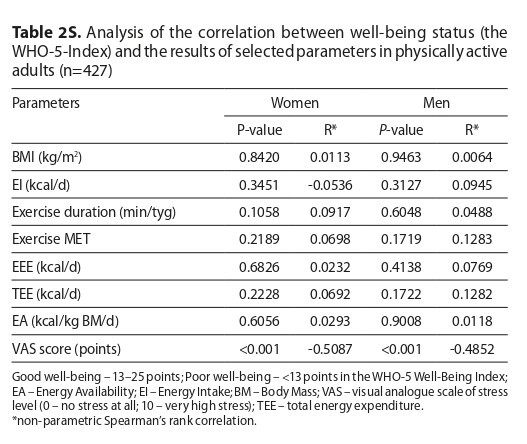
Overall, 36.2% of women and 29.6% of men were classified as having poor well-being (WHO-5-Index <13). In multivariable models, lower perceived stress was independently associated with better well-being (OR=0.62 per 1-point increase on the VAS; 95% CI: 0.54–0.70; P-trend <0.001). Additionally, higher dietary densities of vitamin A, folate, vitamin B12, potassium, iron and copper, were significantly associated with better well-being (all P-trends ≤0.05). No such associations were observed for EA.
Conclusions:
These findings indicate that lower perceived stress and higher dietary nutrient density are independently associated with better well-being in physically active adults.
Well-being in physically active adults is shaped by multiple interacting lifestyle factors. The aim of the study is to examine associations between nutrient density, energy availability (EA), and stress levels with well-being in adults meeting the World Health Organisation (WHO) physical activity guidelines.
Material and methods:
The cross-sectional study included 312 female 115 male amateur athletes (18–40 years old; mean age ± SD: 29.8 ± 5.7 for women and 31.2 ± 5.7 for men) who reported engaging in ≥75 minutes of vigorous-intensity aerobic activity per week. Food intake was assessed using a validated 138-item food frequency questionnaire; stress level was measured using a Visual Analogue Scale (VAS), and well-being measured using the WHO-5 Well-Being Index (WHO-5- Index). EA was calculated as dietary energy intake minus exercise energy expenditure, normalised to body mass. To identify predictors of well-being, multivariate-adjusted logistic regression models were used to estimate odds ratios (ORs) and 95% confidence intervals (95% CIs).
Results:
Overall, 36.2% of women and 29.6% of men were classified as having poor well-being (WHO-5-Index <13). In multivariable models, lower perceived stress was independently associated with better well-being (OR=0.62 per 1-point increase on the VAS; 95% CI: 0.54–0.70; P-trend <0.001). Additionally, higher dietary densities of vitamin A, folate, vitamin B12, potassium, iron and copper, were significantly associated with better well-being (all P-trends ≤0.05). No such associations were observed for EA.
Conclusions:
These findings indicate that lower perceived stress and higher dietary nutrient density are independently associated with better well-being in physically active adults.
PEER REVIEW INFORMATION
Article has been screened for originality
REFERENCES (25)
1.
WHO. Physical activity and adults. World Health Organization. https://www.who.int/news-room/... (access: 2026.06.25).
2.
Gautam S, Jain A, Chaudhary J, et al. Concept of mental health and mental well-being, its determinants and coping strategies. Indian J Psychiatry. 2024 Jan;66(Suppl 2):S231–44.
3.
Schweren LJS, Larsson H, Vinke PC, et al. Diet quality, stress and common mental health problems: A cohort study of 121,008 adults. Clin Nutr Edinb Scotl. 2021 Mar;40(3):901–6.
4.
White RL, Vella S, Biddle S, et al. Physical activity and mental health: a systematic review and best-evidence synthesis of mediation and moderation studies. Int J Behav Nutr Phys Act. 2024 Nov 28;21(1):134.
5.
Iasiello M, Ali K, Van Agteren J, et al. What’s the difference between measures of wellbeing, quality of life, resilience, and coping? An umbrella review and concept map of 155 measures of positive mental health. Int J Wellbeing. 2024 May 31;14(2):1–25.
6.
Singh B, Olds T, Curtis R, et al. Effectiveness of physical activity interventions for improving depression, anxiety and distress: an overview of systematic reviews. Br J Sports Med. 2023 Sep;57(18):1203–9.
7.
Schuch FB, Vancampfort D, Firth J, et al. Physical Activity and Incident Depression: A Meta-Analysis of Prospective Cohort Studies. Am J Psychiatry. 2018 Jul 1;175(7):631–48.
8.
Meegan AP, Perry IJ, Phillips CM. The Association between Dietary Quality and Dietary Guideline Adherence with Mental Health Outcomes in Adults: A Cross-Sectional Analysis. Nutrients. 2017 Mar 5;9(3):238.
9.
Kaluza J, Lozynska K, Rudzinska J, et al. Mediterranean-Style Diet and Other Determinants of Well-Being in Omnivorous, Vegetarian, and Vegan Women. Nutrients. 2023 Feb 1;15(3):725.
10.
Van Der Wurff I, Golsteijn R, Stamhuis I, et al. The association between Mediterranean diet, fruit and vegetable consumption, mental well-being, and quality of life in Dutch adults: a longitudinal study. Eur J Nutr. 2025 Aug;64(5):243.
11.
Çıtar Dazıroğlu ME, Bilici S, Türker PF. Associations of Dietary Inflammatory and Antioxidant Indices with Mental Health Indicators Among University Students: A Cross-Sectional Study. Nutrients. 2025 Jul 26;17(15):2442.
12.
Lane MM, Gamage E, Travica N, et al. Ultra-Processed Food Consumption and Mental Health: A Systematic Review and Meta- Analysis of Observational Studies. Nutrients. 2022 Jun 21;14(13):2568.
13.
Cohen S, Kamarck T, Mermelstein R. A global measure of perceived stress. J Health Soc Behav. 1983 Dec;24(4):385–96.
14.
Schuch FB, Vancampfort D. Physical activity, exercise, and mental disorders: it is time to move on. Trends Psychiatry Psychother 2021;43(3):177–84.
15.
Mountjoy M, Sundgot-Borgen JK, Burke LM, et al. IOC consensus statement on relative energy deficiency in sport (RED-S): 2018 update. Br J Sports Med. 2018 Jun;52(11):687–97.
16.
Loucks AB, Callister R. Induction and prevention of low-T3 syndrome in exercising women. Am J Physiol-Regul Integr Comp Physiol. 1993 May 1;264(5):R924–30.
17.
Herrmann SD, Willis EA, Ainsworth BE, et al. 2024 Adult Compendium of Physical Activities: A third update of the energy costs of human activities. J Sport Health Sci. 2024 Jan;13(1):6–12.
18.
World Anti-Doping Agency (WADA). The World Anti-Doping Agency: Prohibited List. World Anti-Doping Agency. https://www.wada-ama.org/en/pr... (access: 2026.06.25).
19.
Topp CW, Østergaard SD, Søndergaard S, et al. The WHO-5 Well-Being Index: A Systematic Review of the Literature. Psychother Psychosom. 2015;84(3):167–76.
20.
Cichoń E, Kiejna A, Kokoszka A, et al. Validation of the Polish version of WHO-5 as a screening instrument for depression in adults with diabetes. Diabetes Res Clin Pract. 2020 Jan;159:107970.
21.
Szmidt MK, Sicinska E, Januszko O, et al. FFQ-NutriForHer: Reproducibility and Validity of a Semi-Quantitative Food Frequency. Questionnaire for Young and Older Women. Nutrients. 2025 Dec 5;17(24):3811.
22.
Dias IH, Griffiths HR, Milward MR, et al. Antioxidant micronutrients and oxidative stress biomarkers. In: Seymour GJ, Cullinan MP, Heng NCK, Cooper PR, editors. Oral Biology. New York (NY): Springer US; 2023. p. 41–58. doi:10.1007/978–1–0716–2780–8_4.
23.
Huang Q, Liu H, Suzuki K, et al. Linking What We Eat to Our Mood: A Review of Diet, Dietary Antioxidants, and Depression. Antioxidants. 2019 Sep 5;8(9):376.
24.
Mountjoy M, Sloan S, Ali-Zada M, et al. International Olympic Committee consensus-driven guidelines for athlete mental health support at sporting events. Br J Sports Med. 2025 Nov 26;59(21).
25.
Loucks AB, Thuma JR. Luteinizing Hormone Pulsatility Is Disrupted at a Threshold of Energy Availability in Regularly Menstruating Women. J Clin Endocrinol Metab. 2003 Jan;88(1):297–311.
Share
RELATED ARTICLE
| eISSN: | 1898-2263 |
| ISSN: | 1232-1966 |


Generation of the DOI (Digital Object Identifier) - task financed under the agreement No NrRCN/SP/0532/2021/1 by the Minister of Science and Higher
© 2006-2026 Journal hosting platform by Bentus
We process personal data collected when visiting the website. The function of obtaining information about users and their behavior is carried out by voluntarily entered information in forms and saving cookies in end devices. Data, including cookies, are used to provide services, improve the user experience and to analyze the traffic in accordance with the Privacy policy. Data are also collected and processed by Google Analytics tool (more).
You can change cookies settings in your browser. Restricted use of cookies in the browser configuration may affect some functionalities of the website.
You can change cookies settings in your browser. Restricted use of cookies in the browser configuration may affect some functionalities of the website.