Online first
Current issue
Archive
Special Issues
About the Journal
Publication Ethics
Anti-Plagiarism system
Instructions for Authors
Instructions for Reviewers
Editorial Board
Editorial Office
Contact
Reviewers
All Reviewers
2025
2024
2023
2022
2021
2020
2019
2018
2017
2016
General Data Protection Regulation (RODO)

RESEARCH PAPER
Development of the use of innovative drug therapy programmes in Poland 2012–2024
1
Law Office Dagmara Różyk, Attorney-at-Law, Warsaw, Poland
2
Department of Spatial Econometrics, Centre for Labour Market Analysis, Faculty of Economics and Sociology, University of Łódź, Poland
3
Department of Social Medicine, Medical University, Łódź, Poland
4
Department of Family Medicine, Medical University, Warsaw, Poland
5
Department of Digital Medicine, Implementation and Innovation, National Medical Institute of the Ministry of the Interior and Administration, Warsaw, Poland
6
WSB-NLU, Nowy Sącz, Poland
Corresponding author
KEYWORDS
health care systemcost-effectivenesshealth technology assessmentdrug technologiespublic financingregional disparities
TOPICS
ABSTRACT
Introduction and objective:
The aim of this study was to evaluate the role of drug programs in the Polish: (1) assess whether the centralized financing model contributes to reducing regional disparities in access to modern drug technologies; (2) analyse trends in the number of programs, treated patients, and related public expenditures; and (3) examine associations between regional program utilization and selected socioeconomic indicators, including income, unemployment, and urbanization.
Material and methods:
A mixed-method approach was applied, combining a narrative review of the legal and institutional framework with a secondary analysis of National Health Fund (NFZ) data for 2012–2024. Indicators of program availability, patient numbers, and expenditures were analysed using dynamic measures of change.
Results:
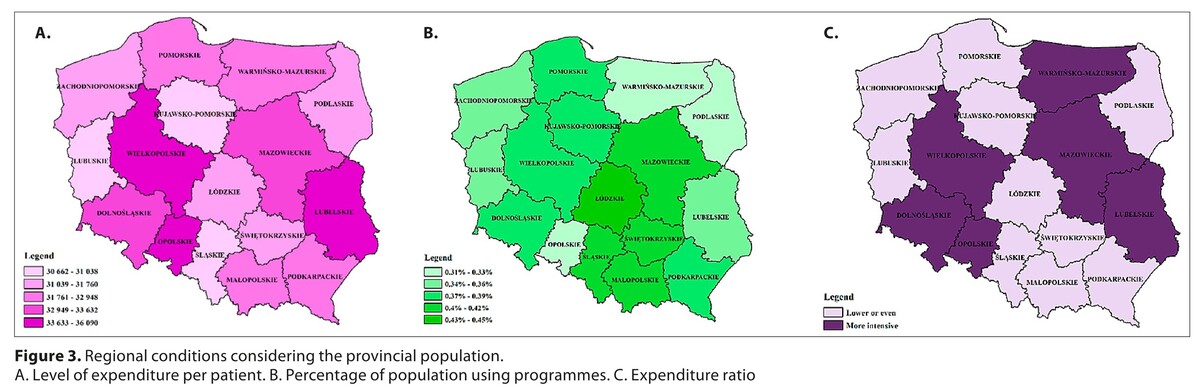
Between 2012 and 2024, the number of drug programs increased from 42 to 133, which was accompanied by a consistent annual growth of approximately 10–11% in both the number of patients and healthcare expenditures. Although regional variation in utilization and spending was observed, no statistically significant associations were found between drug program use and socioeconomic indicators. The average number of services per patient remained relatively stable over time, with a slight downward trend.
Conclusions:
Drug programs represent a stable and effective component of the Polish healthcare system, supporting broader access to innovative therapies and potentially reducing socioeconomic inequalities. The lack of association with regional socioeconomic factors suggests that centralized financing and uniform eligibility criteria may mitigate disparities in access. Nevertheless, organizational and infrastructural factors, such as the distribution of specialized centres, likely continue to influence regional variation.
The aim of this study was to evaluate the role of drug programs in the Polish: (1) assess whether the centralized financing model contributes to reducing regional disparities in access to modern drug technologies; (2) analyse trends in the number of programs, treated patients, and related public expenditures; and (3) examine associations between regional program utilization and selected socioeconomic indicators, including income, unemployment, and urbanization.
Material and methods:
A mixed-method approach was applied, combining a narrative review of the legal and institutional framework with a secondary analysis of National Health Fund (NFZ) data for 2012–2024. Indicators of program availability, patient numbers, and expenditures were analysed using dynamic measures of change.
Results:
Between 2012 and 2024, the number of drug programs increased from 42 to 133, which was accompanied by a consistent annual growth of approximately 10–11% in both the number of patients and healthcare expenditures. Although regional variation in utilization and spending was observed, no statistically significant associations were found between drug program use and socioeconomic indicators. The average number of services per patient remained relatively stable over time, with a slight downward trend.
Conclusions:
Drug programs represent a stable and effective component of the Polish healthcare system, supporting broader access to innovative therapies and potentially reducing socioeconomic inequalities. The lack of association with regional socioeconomic factors suggests that centralized financing and uniform eligibility criteria may mitigate disparities in access. Nevertheless, organizational and infrastructural factors, such as the distribution of specialized centres, likely continue to influence regional variation.
FUNDING
Publication was funded by the Medical University of Lodz,
Department of Social Medicine (project No. 503/6‑029‑
01/503‑61‑001).
PEER REVIEW INFORMATION
Article has been screened for originality
REFERENCES (15)
3.
Patikorn C, Taychakhoonavudh S, Sakulbumrungsil R, et al. Financing Strategies to Facilitate Access to High‑Cost Anticancer Drugs: A Systematic Review of the Literature. Int J Health Policy Manag. 2022;11(9):1625–1634. https://doi.org/10.34172/IJHPM....
4.
Act of 12 May 2011 on the reimbursement of medicines, foodstuffs intended for particular nutritional uses and medical devices (consolidated text: Journal of Laws of 2025, item 907, as amended).
5.
Crawford SM, Sauerzapf V, Haynes R, et al. Social and geographical factors affecting access to treatment of lung cancer. Br J Cancer. 2009;101(6):897–901. https://doi.org/10.1038/sj.bjc....
6.
Emerson MA, Golightly YM, Aiello AE, et al. Breast cancer treatment delays by socioeconomic and health care access latent classes in Black and White women. Cancer. 2020;126(22):4957–4966. https://doi.org/10.1002/cncr.3....
7.
Bowen SA, Williams EM, Stoneberg‑Cooper CM, et al. Effects of Social Injustice on Breast Health—Seeking Behaviors of Low‑Income Women. Am J Health Promot. 2013;27(4):222–230. https://doi.org/10.4278/ajhp.1....
9.
Bourgeois A, Horrill T, Mollison A, et al. Barriers to cancer treatment for people experiencing socioeconomic disadvantage in high‑income countries: a scoping review. BMC Health Serv Res. 2024;24(1):670. https://doi.org/10.1186/s12913....
10.
Vallano A, Pontes C, & Agustí A. The challenges of access to innovative medicines with limited evidence in the European Union. Front Pharmacol. 2023;14:1215431. https://doi.org/10.3389/fphar.
11.
Lawrie K, Charow R, Giuliani M, et al. Cancer and Health Literacy: a scoping review. J Health Care Poor Underserved. 2020;31(1):81–104. https://doi.org/10.1353/hpu.20....
12.
Vancoppenolle JM, Franzen N, Koole SN, et al. Differences in time to patient access to innovative cancer medicines in six European countries. Int J Cancer. 2024;154(5):886–894. https://doi.org/10.1002/ijc.34....
13.
Akodad S, Goldman M, Stevens H. Early access disparities in innovative therapies across the US, EU, China, and Japan. Front Med (Lausanne). 2025;12:1642882. https://doi.org/10.3389/fmed.2....
14.
Hofmarcher T, Charalambous A, Normanno N, et al. Access to novel cancer medicines in Europe: inequities across countries and their drivers. ESMO Open. 2025;10(10):105810. https://doi.org/10.1016/j.esmo....
15.
Kanavos P, Angelis A, Drummond M. An EU‑wide approach to HTA: An irrelevant development or an opportunity not to be missed? Eur J Health Econ. 2019;20(3):329–332. https://doi.org/10.1007/S10198....
| eISSN: | 1898-2263 |
| ISSN: | 1232-1966 |


Generation of the DOI (Digital Object Identifier) - task financed under the agreement No NrRCN/SP/0532/2021/1 by the Minister of Science and Higher
© 2006-2026 Journal hosting platform by Bentus
We process personal data collected when visiting the website. The function of obtaining information about users and their behavior is carried out by voluntarily entered information in forms and saving cookies in end devices. Data, including cookies, are used to provide services, improve the user experience and to analyze the traffic in accordance with the Privacy policy. Data are also collected and processed by Google Analytics tool (more).
You can change cookies settings in your browser. Restricted use of cookies in the browser configuration may affect some functionalities of the website.
You can change cookies settings in your browser. Restricted use of cookies in the browser configuration may affect some functionalities of the website.