Online first
Current issue
Archive
Special Issues
About the Journal
Publication Ethics
Anti-Plagiarism system
Instructions for Authors
Instructions for Reviewers
Editorial Board
Editorial Office
Contact
Reviewers
All Reviewers
2025
2024
2023
2022
2021
2020
2019
2018
2017
2016
General Data Protection Regulation (RODO)

RESEARCH PAPER
The role of climatic factors and air quality on the temporal patterns of suicide attempts in Balıkesir, Turkey (2017–2024)
1
Public Health, Provincial Health Directorate, Balikesir, Turkey
2
Family Medicine, Ataturk City Hospital, Balikesir, Turkey
3
Public Health, Ataturk University, Erzurum, Turkey
4
Emergency Medicine, Ataturk City Hospital, Balikesir, Turkey
Corresponding author
Ann Agric Environ Med. 2026;33(3):333-338
KEYWORDS
TOPICS
ABSTRACT
Introduction and objective:
The aim of this ecological study is to evaluate the potential relationships between the incidence of suicide attempts and climatic factors, as well as air quality parameters, in Balikesir, Turkey.
Material and methods:
Daily counts of cases of attempted suicide, climate, and air quality data were used. Prior to analysis, logarithmic transformation was applied to the data in order to stabilize variance. Data analysis was performed in EViews 10 using descriptive statistics (annual, monthly, weekly patterns) and ARMA error regression (ARIMAX). Stationarity was assessed with the ADF test, while the basic model structure was determined using ACF/PACF plots.
Results:
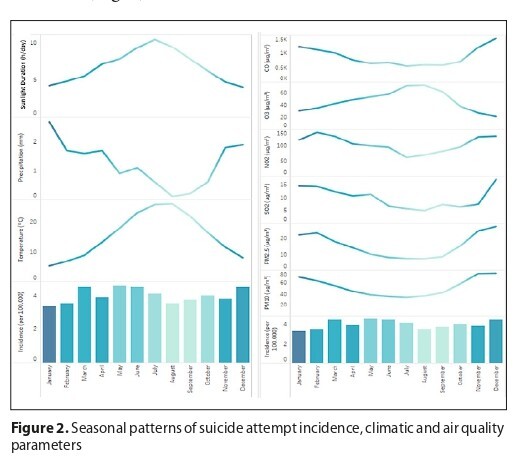
A total of 1,413 cases of attempted suicide, with a mean age of 26.9±14.2 years and 64.0% females, were included. Case distributions revealed a bimodal seasonal pattern (spring/early summer and winter) and a weekly rhythm with a marked decrease on Thursdays. Time series analyses indicated a strong association between the incidence of suicide attempts and its own short-term past values, with the ARMA(1,1) model providing the best fit. None of the lagged climatic, air quality, or seasonal dummy variables added to the model had a statistically significant effect on daily incidence (p>0.05).
Conclusions:
The findings of this study suggest that the predominant factor shaping the daily course of the incidence of suicide attempt in Balıkesir is the short-term autocorrelation structure of the series itself. The temporal dynamics and the potential effects of environmental factors may be more likely to operate through indirect mechanisms or cumulative influences, rather than immediate fluctuations.
The aim of this ecological study is to evaluate the potential relationships between the incidence of suicide attempts and climatic factors, as well as air quality parameters, in Balikesir, Turkey.
Material and methods:
Daily counts of cases of attempted suicide, climate, and air quality data were used. Prior to analysis, logarithmic transformation was applied to the data in order to stabilize variance. Data analysis was performed in EViews 10 using descriptive statistics (annual, monthly, weekly patterns) and ARMA error regression (ARIMAX). Stationarity was assessed with the ADF test, while the basic model structure was determined using ACF/PACF plots.
Results:
A total of 1,413 cases of attempted suicide, with a mean age of 26.9±14.2 years and 64.0% females, were included. Case distributions revealed a bimodal seasonal pattern (spring/early summer and winter) and a weekly rhythm with a marked decrease on Thursdays. Time series analyses indicated a strong association between the incidence of suicide attempts and its own short-term past values, with the ARMA(1,1) model providing the best fit. None of the lagged climatic, air quality, or seasonal dummy variables added to the model had a statistically significant effect on daily incidence (p>0.05).
Conclusions:
The findings of this study suggest that the predominant factor shaping the daily course of the incidence of suicide attempt in Balıkesir is the short-term autocorrelation structure of the series itself. The temporal dynamics and the potential effects of environmental factors may be more likely to operate through indirect mechanisms or cumulative influences, rather than immediate fluctuations.
PEER REVIEW INFORMATION
Article has been screened for originality
REFERENCES (19)
1.
World Health Organization. Suicide worldwide in 2021: global health estimates. Geneva: WHO; 2025.
3.
Cornelius SL, Berry T, Goodrich AJ, Shiner B, Riblet NB. The effect of meteorological, pollution, and geographic exposures on death by suicide: a scoping review. Int J Environ Res Public Health. 2021;18(15):7809.
5.
Dixon PG, Kalkstein AJ. Where are weather-suicide associations valid? An examination of nine US counties with varying seasonality. Int J Biometeorol. 2018;62:685–97.
6.
Schneider A, Hampel R, Ladwig KH, et al. Impact of meteorological parameters on suicide mortality rates: a case-crossover analysis. Sci Total Environ. 2020;707:136053.
7.
Gao J, Cheng Q, Duan J, et al. Ambient temperature, sunlight duration, and suicide: a systematic review and meta-analysis. Sci Total Environ. 2019;646:1021–9.
8.
Lee W, et al. Association of holidays and day of the week with suicide risk: multicounty, two-stage, time series study. BMJ. 2024;387.
9.
Liu Q, Wang W, Gu X, et al. Association between particulate matter air pollution and risk of depression and suicide: a systematic review and meta-analysis. Environ Sci Pollut Res. 2021;28:9029–49.
10.
Davoudi M, Barjasteh-Askari F, Amini H, et al. Association of suicide with short-term exposure to air pollution at different lag times: a systematic review and meta-analysis. Sci Total Environ. 2021;771:144882.
11.
Çevre TC, Şehircilik ve İklim Değişikliği Bakanlığı. Ulusal Hava Kalitesi İzleme Ağı. 2025.
12.
Palmu R, Koskinen S, Partonen T. Seasonal changes in mood and behavior contribute to suicidality and worthlessness in a population-based study. J Psych Res. 2022;150: 184–188.
13.
Ambar Akkaoui M, Chan-Chee C, Laaidi K, et al. Seasonal changes and decrease of suicides and suicide attempts in France over the last 10 years. Sci Rep. 2022; 12(1): 8231.
14.
Şahbaz H. Coğrafi bir bakış açısıyla 2002–2019 döneminde Türkiye’deki intiharlar. ETÜ Sosyal Bilimler Enstitüsü Dergisi. 2022;15:64–103.
15.
Yu J, Yang D, Kim Y, et al. Seasonality of suicide: a multi-country multi-community observational study. Epidemiol Psych Sci. 2020; 29: e163.
16.
Modzelewski S, Naumowicz M, Suprunowicz M, et al. The impact of seasonality on mental health disorders: a narrative review and extension of the immunoseasonal theory. J Clin Med. 2025:14(4), 1119.
17.
Zhang R, Volkow ND. Seasonality of brain function: role in psychiatric disorders. Translational Psych. 2023; 13(1): 65.
18.
Chen DD, Tu JH, Ling KN, et al. Climate change and suicide epidemiology: a systematic review and meta-analysis of gender variations in global suicide rates. Front Public Health. 2025;12: 1463676.
19.
Stańdo J, et al. Increase in search interest for “suicide” and “depression” for particular days of the week and times of day. J Clin Med. 2022;12(1):191.
Share
RELATED ARTICLE
| eISSN: | 1898-2263 |
| ISSN: | 1232-1966 |


Generation of the DOI (Digital Object Identifier) - task financed under the agreement No NrRCN/SP/0532/2021/1 by the Minister of Science and Higher
© 2006-2026 Journal hosting platform by Bentus
We process personal data collected when visiting the website. The function of obtaining information about users and their behavior is carried out by voluntarily entered information in forms and saving cookies in end devices. Data, including cookies, are used to provide services, improve the user experience and to analyze the traffic in accordance with the Privacy policy. Data are also collected and processed by Google Analytics tool (more).
You can change cookies settings in your browser. Restricted use of cookies in the browser configuration may affect some functionalities of the website.
You can change cookies settings in your browser. Restricted use of cookies in the browser configuration may affect some functionalities of the website.