Online first
Current issue
Archive
Special Issues
About the Journal
Publication Ethics
Anti-Plagiarism system
Instructions for Authors
Instructions for Reviewers
Editorial Board
Editorial Office
Contact
Reviewers
All Reviewers
2025
2024
2023
2022
2021
2020
2019
2018
2017
2016
General Data Protection Regulation (RODO)

RESEARCH PAPER
Xiangsha Weiling Pills alleviate intestinal barrier damage via the TGFB1/IL6 in diarrhea with syndrome of spleen deficiency with dampness encumbrance
1
Bozhou Pharmaceutical Co., LTD., Xiuzheng Pharmaceutical Group, China
2
Qinba Biomedical Research Institute, Pharmaceutical Group of Chuanxiang, China
These authors had equal contribution to this work
Corresponding author
Kexia Qin
Bozhou Pharmaceutical Co., LTD., Xiuzheng Pharmaceutical Group, Bozhou Pharmaceutical Co., LTD., Xiuzheng Pharmaceutical Group, China
Bozhou Pharmaceutical Co., LTD., Xiuzheng Pharmaceutical Group, Bozhou Pharmaceutical Co., LTD., Xiuzheng Pharmaceutical Group, China
Ann Agric Environ Med. 2026;33(3):339-346
KEYWORDS
diarrheanetwork pharmacologyInterleukin 6spleen deficiency syndrome with dampness encumbranceXiangsha Weiling Pillstransforming growth factor beta 1
TOPICS
ABSTRACT
Introduction and objective:
Diarrhea with syndrome of spleen deficiency with dampness encumbrance (D-SSDDE) is a clinically debilitating condition, and the therapeutic mechanisms of Xiangsha Weiling Pills (XsWlP) against it remain unclear. The aim of the study is to explore the multidimensional regulatory mechanisms of XsWlP on D-SSDDE, and predict the key targets of its therapeutic effects using network pharmacology.
Material and methods:
In the D-SSDDE mouse model, physiological disorders were assessed by measuring loose stool rates and abdominal temperature, and using enzyme-linked immunosorbent assay (ELISA) to measure serum triglyceride (TG) levels. Gut barrier function was assessed by detecting goblet cell proportions using flow cytometry and quantifying tight junction protein (ZO-1, Claudin-1, MUC2) expression levels via reverse transcription quantitative polymerase chain reaction (RT-qPCR). The potential targets of XsWlP were predicted using network pharmacology. Additionally, we quantified interleukin 6 (IL6) and transforming growth factor beta 1 (TGFB1) expression levels in mouse intestinal tissues and serum via RT-qPCR and ELISA.
Results:
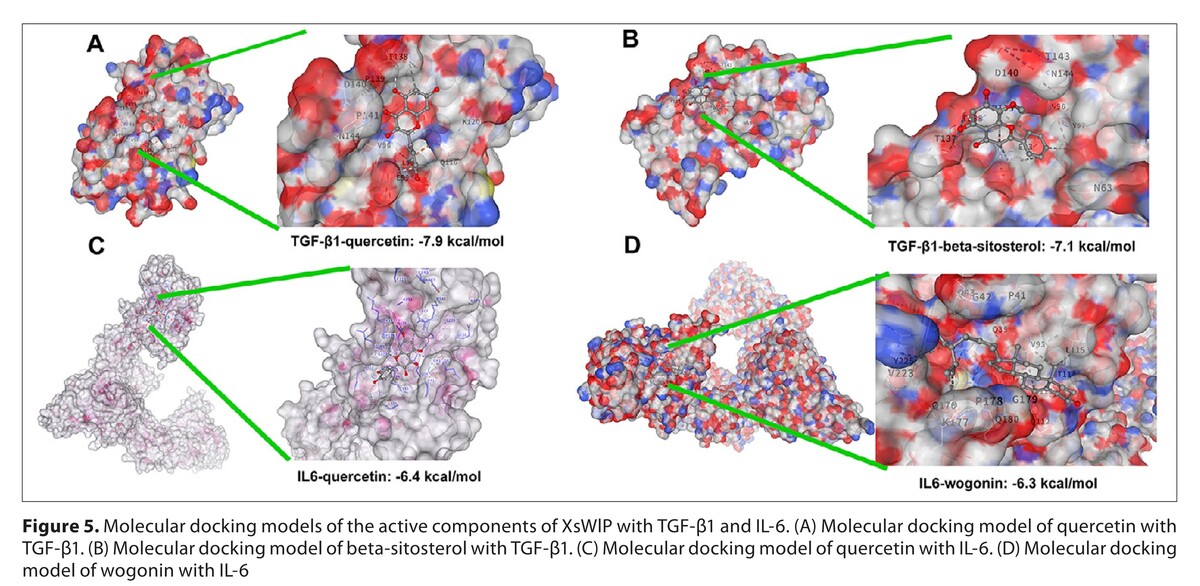
XsWlP substantially reverses D-SSDDE-induced metabolic disruptions, including reduced loose stool rate, restored abdominal temperature, and normalized serum TG levels, while repairing gut barrier integrity by adjusting goblet cell ratio and inducing tight junction proteins. Molecular docking validates TGFB1 and IL6 binding affinity. Moreover, XsWlP markedly suppresses the aberrant expression of D-SSDDE-induced pro-inflammatory factors, such as IL-6 and TGF-β1.
Conclusions:
The study demonstrates that XsWlP reduces intestinal barrier disruption in D-SSDDE via TGFB1/IL-6 signaling.
Diarrhea with syndrome of spleen deficiency with dampness encumbrance (D-SSDDE) is a clinically debilitating condition, and the therapeutic mechanisms of Xiangsha Weiling Pills (XsWlP) against it remain unclear. The aim of the study is to explore the multidimensional regulatory mechanisms of XsWlP on D-SSDDE, and predict the key targets of its therapeutic effects using network pharmacology.
Material and methods:
In the D-SSDDE mouse model, physiological disorders were assessed by measuring loose stool rates and abdominal temperature, and using enzyme-linked immunosorbent assay (ELISA) to measure serum triglyceride (TG) levels. Gut barrier function was assessed by detecting goblet cell proportions using flow cytometry and quantifying tight junction protein (ZO-1, Claudin-1, MUC2) expression levels via reverse transcription quantitative polymerase chain reaction (RT-qPCR). The potential targets of XsWlP were predicted using network pharmacology. Additionally, we quantified interleukin 6 (IL6) and transforming growth factor beta 1 (TGFB1) expression levels in mouse intestinal tissues and serum via RT-qPCR and ELISA.
Results:
XsWlP substantially reverses D-SSDDE-induced metabolic disruptions, including reduced loose stool rate, restored abdominal temperature, and normalized serum TG levels, while repairing gut barrier integrity by adjusting goblet cell ratio and inducing tight junction proteins. Molecular docking validates TGFB1 and IL6 binding affinity. Moreover, XsWlP markedly suppresses the aberrant expression of D-SSDDE-induced pro-inflammatory factors, such as IL-6 and TGF-β1.
Conclusions:
The study demonstrates that XsWlP reduces intestinal barrier disruption in D-SSDDE via TGFB1/IL-6 signaling.
PEER REVIEW INFORMATION
Article has been screened for originality
REFERENCES (23)
1.
Hu R, Tang F. Effects of Wei Chang An pill on enzyme activity and levels of vasoactive peptide and substance P in the small intestine of rats with compound diarrhea. J Tradit Chin Med. 2012;32(1):52–7.
2.
Persistent diarrhoea in children in developing countries: memorandum from a WHO meeting. Bull World Health Organ. 1988;66(6):709–17.
3.
Devanarayana NM, Rajindrajith S, Pathmeswaran A, et al. Epidemiology of irritable bowel syndrome in children and adolescents in Asia. J Pediatr Gastroenterol Nutr. 2015;60(6):792–8.
4.
Wang H, Zhou G, Luo L, et al. Serological Screening for Celiac Disease in Adult Chinese Patients With Diarrhea Predominant Irritable Bowel Syndrome. Medicine (Baltimore). 2015;94(42):e1779.
5.
Wei X, Chen M, Wang J. [The epidemiology of irritable bowel syndrome and functional constipation of Guangzhou residents]. Zhonghua Nei Ke Za Zhi. 2001;40(8):517–20.
6.
Tang BB, Su CX, Wen N, et al. FMT and TCM to treat diarrhoeal irritable bowel syndrome with induced spleen deficiency syndrome- microbiomic and metabolomic insights. BMC Microbiol. 2024;24(1):433.
7.
Wu Y, Deng N, Liu J, et al. Unlocking the therapeutic potential of Huoxiang Zhengqi San in cold and high humidity-induced diarrhea: Insights into intestinal microbiota modulation and digestive enzyme activity. Heliyon. 2024;10(12):e32789.
8.
Tu Y, Luo X, Liu D, et al. Extracts of Poria cocos improve functional dyspepsia via regulating brain-gut peptides, immunity and repairing of gastrointestinal mucosa. Phytomedicine. 2022;95:153875.
9.
Ye H, Ma S, Qiu Z, et al. Poria cocos polysaccharides rescue pyroptosis-driven gut vascular barrier disruption in order to alleviates non-alcoholic steatohepatitis. J Ethnopharmacol. 2022;296:115457.
10.
Choi NR, Choi WG, Lee JH, et al. Atractylodes macrocephala Koidz Alleviates Symptoms in Zymosan-Induced Irritable Bowel Syndrome Mouse Model through TRPV1, NaV1.5, and NaV1.7 Channel Modulation. Nutrients. 2024;16(11).
11.
He Z, Guo J, Zhang H, et al. Atractylodes macrocephala Koidz polysaccharide improves glycolipid metabolism disorders through activation of aryl hydrocarbon receptor by gut flora-produced tryptophan metabolites. Int J Biol Macromol. 2023;253(Pt 4):126987.
12.
Tian H, Huang D, Li T, et al. The protective effects of total phenols in magnolia officinalix rehd. et wils on gastrointestinal tract dysmotility is mainly based on its influence on interstitial cells of cajal. Int J Clin Exp Med. 2015;8(11):20279–86.
13.
Liu S, Yang D, Li W, et al. Magnolia Officinalis Alcohol Extract Alleviates the Intestinal Injury Induced by Polygala Tenuifolia Through Regulating the PI3K/AKT/NF-kappaB Signaling Pathway and Intestinal Flora. Drug Des Devel Ther. 2024;18:1695–710.
14.
Moreno-Navarrete JM, Fernandez-Real JM. The gut microbiota modulates both browning of white adipose tissue and the activity of brown adipose tissue. Rev Endocr Metab Disord. 2019;20(4):387–97.
15.
Worthmann A, John C, Ruhlemann MC, et al. Cold-induced conversion of cholesterol to bile acids in mice shapes the gut microbiome and promotes adaptive thermogenesis. Nat Med. 2017;23(7):839–49.
16.
Gu Y, Li L, Yang M, et al. Bile acid-gut microbiota crosstalk in irritable bowel syndrome. Crit Rev Microbiol. 2023;49(3):350–69.
17.
Fischer K, Ruiz HH, Jhun K, et al. Alternatively activated macrophages do not synthesize catecholamines or contribute to adipose tissue adaptive thermogenesis. Nat Med. 2017;23(5):623–30.
18.
Sirnio P, Vayrynen JP, Klintrup K, et al. Alterations in serum amino-acid profile in the progression of colorectal cancer: associations with systemic inflammation, tumour stage and patient survival. Br J Cancer. 2019;120(2):238–46.
19.
Alhendi A, Naser SA. The dual role of interleukin-6 in Crohn’s disease pathophysiology. Front Immunol. 2023;14:1295230.
20.
Kim DY, Furuta GT, Nguyen N, Inage E, Masterson JC. Epithelial Claudin Proteins and Their Role in Gastrointestinal Diseases. J Pediatr Gastroenterol Nutr. 2019;68(5):611–4.
21.
Yu X, Sun S, Guo Y, et al. Citri Reticulatae Pericarpium (Chenpi): Botany, ethnopharmacology, phytochemistry, and pharmacology of a frequently used traditional Chinese medicine. J Ethnopharmacol. 2018;220:265–82.
22.
Boaru DL, Fraile-Martinez O, De Leon-Oliva D, et al. Harnessing the Anti-Inflammatory Properties of Polyphenols in the Treatment of Inflammatory Bowel Disease. Int J Biol Sci. 2024;20(14):5608–72.
23.
Zhou X, Li Y, Yang Y, et al. Regulatory effects of Poria cocos polysaccharides on gut microbiota and metabolites: evaluation of prebiotic potential. NPJ Sci Food. 2025;9(1):53.
Share
RELATED ARTICLE
| eISSN: | 1898-2263 |
| ISSN: | 1232-1966 |


Generation of the DOI (Digital Object Identifier) - task financed under the agreement No NrRCN/SP/0532/2021/1 by the Minister of Science and Higher
© 2006-2026 Journal hosting platform by Bentus
We process personal data collected when visiting the website. The function of obtaining information about users and their behavior is carried out by voluntarily entered information in forms and saving cookies in end devices. Data, including cookies, are used to provide services, improve the user experience and to analyze the traffic in accordance with the Privacy policy. Data are also collected and processed by Google Analytics tool (more).
You can change cookies settings in your browser. Restricted use of cookies in the browser configuration may affect some functionalities of the website.
You can change cookies settings in your browser. Restricted use of cookies in the browser configuration may affect some functionalities of the website.