Online first
Current issue
Archive
Special Issues
About the Journal
Publication Ethics
Anti-Plagiarism system
Instructions for Authors
Instructions for Reviewers
Editorial Board
Editorial Office
Contact
Reviewers
All Reviewers
2025
2024
2023
2022
2021
2020
2019
2018
2017
2016
General Data Protection Regulation (RODO)

RESEARCH PAPER
Is the ammonia concentration highest in the farrowing and piglet-feeding sector on a pig farm?
1
Department of Monogastric Animal Sciences, West Pomeranian University of Technology in Szczecin, Poland
2
Institute of Animal Production and Fisheries, University of Siedlce, Poland
3
Department of Agriculture, John Paul II University in Biala Podlaska, Poland
Corresponding author
Jagoda Kępińska-Pacelik
Department of Monogastric Animal Sciences, Division of Animal Nutrition and Food, West Pomeranian University of Technology in Szczecin, Klemensa Janickiego 29, 71-270 Szczecin, Poland
Department of Monogastric Animal Sciences, Division of Animal Nutrition and Food, West Pomeranian University of Technology in Szczecin, Klemensa Janickiego 29, 71-270 Szczecin, Poland
KEYWORDS
ecological impactammonia levelsprotein content in dietfeeding strategies in pigspig production systems
TOPICS
ABSTRACT
Introduction and objective:
Ammonia (NH₃) is released during all stages of pig production, with particularly high emissions occurring in the breeding phase. The aim of this study is to compare ammonia concentrations across different sectors of a breed-to-wean pig farm, and to identify their daily variation patterns. Therefore, the exposure of support staff to ammonia in different production sectors may vary. It was assumed that differences in sow feeding strategies – resulting from varying protein and nitrogen levels in rations during mating, gestation, and farrowing/lactation – would lead to differences in ammonia concentrations between production sectors. The initial hypothesis suggested that the farrowing and lactation sector would show the highest ammonia levels.
Material and methods:
The study was conducted from March – October 2023. on a breed-to-wean farm located in the West Pomeranian Province of Poland. Ammonia concentration was measured using a portable multi-gas detector (MultiRAE Lite by Honeywell). Collected data were statistically analysed using the Statistica 13 software package.
Results:
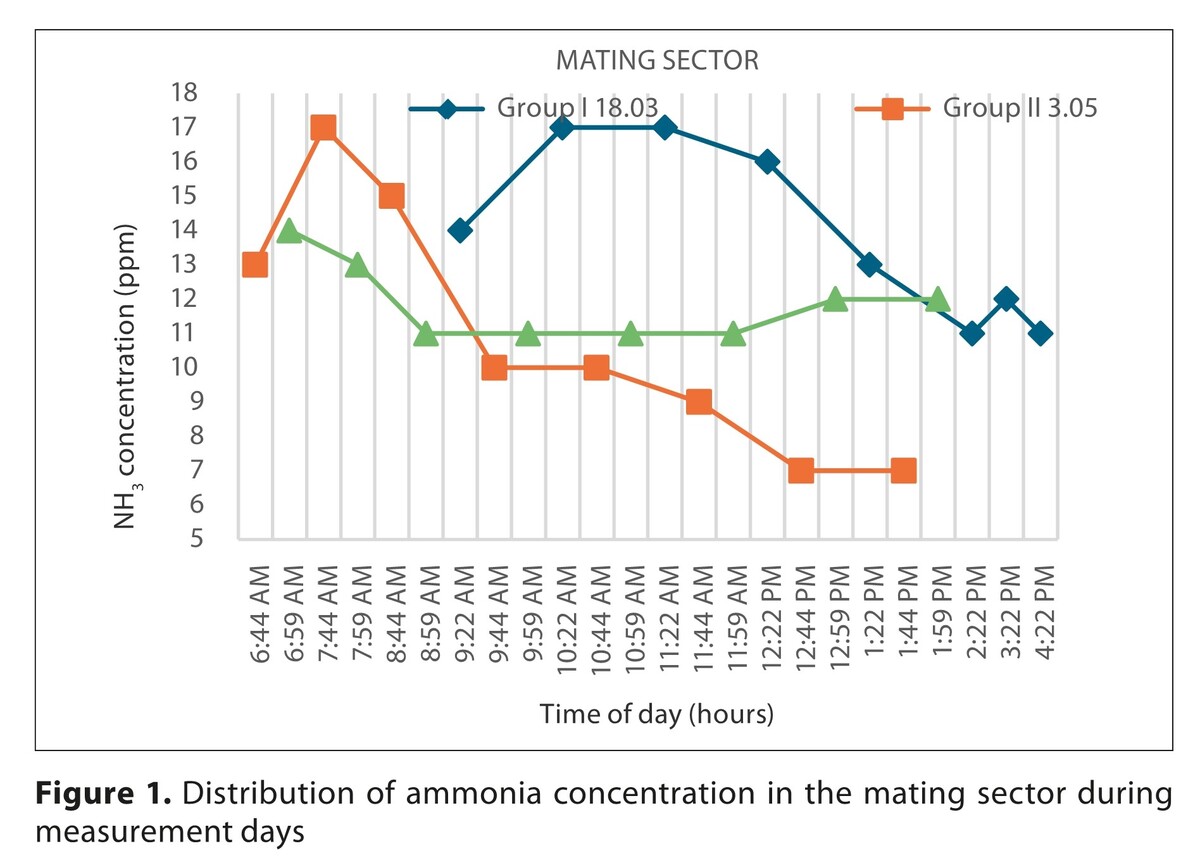
Ammonia concentration in pig housing depends on multiple factors, including not only the protein content of the feed, but also ambient temperature and animal density. The study revealed that ammonia distribution across production sectors changed throughout the day, with concentrations peaking in the morning and gradually decreasing afterwards. Statistically significant correlations were found between ammonia concentration in individual sectors and both internal housing temperature, as well as minimum and maximum outdoor temperatures.
Conclusions:
Contrary to the hypothesis, the results showed that the highest ammonia levels were recorded in the mating sector rather than in the farrowing and lactation sectors.
Ammonia (NH₃) is released during all stages of pig production, with particularly high emissions occurring in the breeding phase. The aim of this study is to compare ammonia concentrations across different sectors of a breed-to-wean pig farm, and to identify their daily variation patterns. Therefore, the exposure of support staff to ammonia in different production sectors may vary. It was assumed that differences in sow feeding strategies – resulting from varying protein and nitrogen levels in rations during mating, gestation, and farrowing/lactation – would lead to differences in ammonia concentrations between production sectors. The initial hypothesis suggested that the farrowing and lactation sector would show the highest ammonia levels.
Material and methods:
The study was conducted from March – October 2023. on a breed-to-wean farm located in the West Pomeranian Province of Poland. Ammonia concentration was measured using a portable multi-gas detector (MultiRAE Lite by Honeywell). Collected data were statistically analysed using the Statistica 13 software package.
Results:
Ammonia concentration in pig housing depends on multiple factors, including not only the protein content of the feed, but also ambient temperature and animal density. The study revealed that ammonia distribution across production sectors changed throughout the day, with concentrations peaking in the morning and gradually decreasing afterwards. Statistically significant correlations were found between ammonia concentration in individual sectors and both internal housing temperature, as well as minimum and maximum outdoor temperatures.
Conclusions:
Contrary to the hypothesis, the results showed that the highest ammonia levels were recorded in the mating sector rather than in the farrowing and lactation sectors.
PEER REVIEW INFORMATION
Article has been screened for originality
REFERENCES (25)
1.
Mateos GG, Corrales NL, Talegón G, et al. Pig meat production in the European Union-27: current status, challenges, and future trends. Anim Biosci. 2024;37:755–774. https://doi.org/10.5713/ab.23.....
2.
Menegat S, Ledo A, Tirado R. Greenhouse gas emissions from global production and use of nitrogen synthetic fertilisers in agriculture. Sci Rep. 2022;12:1–13. https://doi.org/10.1038/s41598....
3.
Audi M, Ali A, Kassem M. Greenhouse gases: a review of losses and benefits. Int J Energy Econ Policy. 2020;10:403–418. https://doi.org/10.32479/ijeep....
4.
Smit LAM, Heederik D. Impacts of intensive livestock production on human health in densely populated regions. GeoHealth. 2017;1:272–277. https://doi.org/10.1002/2017GH....
5.
Usman M, Sanaullah M, Ullah A, et al. Nitrogen pollution originating from wastewater and agriculture: advances in treatment and management. Rev Environ Contam. 2022;260:1–27. https://doi.org/10.1007/s44169....
6.
Jin X, Behrens P, Erisman JW, et al. Ammonia emissions from agricultural products at high resolution across Europe. Sci Data. 2025;12:1–18. https://doi.org/10.1038/s41597....
7.
Yuliarti R, Khambali K, Rusmiati R. Risk analysis of exposure to NH3 and H2S gas to workers in the small industrial environment of magetan regency in 2021. IJAHST. 2022;2:169–174. https://doi.org/10.35882/ijahs....
8.
Regulation of the Minister of Agriculture and Rural Development of 15 February 2010 on the requirements and procedures for keeping farm animal species for which protection standards have been specified in European Union regulations. Journal of Laws No. 56, item 344. Available: https://api.sejm.gov.pl/eli/ac... (access: 2025.10.13) [in Polish].
9.
Kanjilal B, Masoumi A, Sharifi N, et al. Ammonia harms and diseases: ammonia corrosion hazards on human body systems (liver, muscles, kidney, brain). In: Basile A, Rahimpour MR, editors. Progresses in ammonia: science, technology and membranes. Elsevier, Amsterdam; 2024. p. 307–324. https://doi.org/10.1016/B978-0....
11.
An European Green Deal (2024). Available: https://ec.europa.eu/info/stra... (access: 2025.08.01).
12.
MARD, Ministry of Agriculture and Rural Development. Advisory code of good agricultural practice for reducing ammonia emissions (2019). Available: https://www.gov.pl/web/rolnict... (access: 2025.07.31).
13.
Knoknerienė I, Bleizgys R, Naujokienė V, Surface moisture control for sustainable manure management: reducing ammonia emissions and preserving nutrients. Sustainability. 2025;17:1–14. https://doi.org/10.3390/su1714....
14.
Koerkamp PG, Metz JHM, Uenk GH, et al. Concentrations and emissions of ammonia in livestock buildings in Northern Europe. Agric Ecosyst Environ. 1998;70:79–95. https://doi.org/10.1006/jaer.1....
15.
Clark OG, Moehn S, Edeogu I, et al. Manipulation of dietary protein and non-starch polysaccharide to control swine manure emissions. J Environ Qual. 2005;34:1461–1466. https://doi.org/10.2134/jeq200....
16.
Hossain MM, Cho SB, Kim IH, Strategies for reducing noxious gas emissions in pig production: a comprehensive review on the role of feed additives. J Anim Sci Technol. 2024;66:237–250. https://doi.org/10.5187/jast.2....
17.
Kim YJ, Cho SB, Song MH, et al. Effects of different Bacillus licheniformis and Bacillus subtilis ratios on nutrient digestibility, fecal microflora, and gas emissions of growing pigs. J Anim Sci Technol. 2022;64:291–301. https://doi.org/10.5187/jast.2....
18.
Hong JS, Jeong YD, Park HJ, et al. Effects of Italian ryegrass with multi-enzymes supplementation on growth performance, gut microbial, and manure odor emission in finisher pig. J Anim Sci Technol. 2024;66:1182–1192. https://doi.org/10.5187/jast.2....
19.
Liu Z, Powers W, Murphy J, et al. Ammonia and hydrogen sulfide emissions from swine production facilities in North America: a meta-analysis. J Anim Sci. 2014;92:1656–1665. https://doi.org/10.2527/jas.20....
20.
Shin J, Roh H, Kim D, et al. Seasonal and diurnal ammonia emissions from swine-finishing barn with ground channel ventilation. Animals. 2025;15:1–16. https://doi.org/10.3390/ani151....
21.
Zhou Y, Dong H, Xin H, et al. Carbon footprint assessment of a large-scale pig production system in northern China: a case study. Transact ASABE. 2018;61:1121–1131. https://doi.org/10.13031/trans....
22.
Rodríguez MR, Losada E, Doval RB, et al. Evolution of NH3 concentrations in weaner pig buildings based on setpoint temperature. Agronomy. 2020;10:1–14. https://doi.org/10.3390/agrono....
23.
Zong C, Li H, Zhang G, Ammonia and greenhouse gas emissions from fattening pig house with two types of partial pit ventilation systems. Agric Ecosyst Environ. 2015;208:94–105. https://doi.org/10.1016/j.agee....
24.
Banhazi TM, Seasonal, diurnal and spatial variations of environmental variables in Australian livestock buildings. Aust J Multi-Discip Eng. 2013;10:60–69. https://doi.org/10.7158/N12-AE....
25.
Ni JQ, Heber AJ, Lim TT, Ammonia and hydrogen sulfide in swine production. In: Banhazi T, Aland A, Hartung J, editors. Air Quality and Livestock Farming, CRC Press, London; 2018. p. 69–88.
| eISSN: | 1898-2263 |
| ISSN: | 1232-1966 |


Generation of the DOI (Digital Object Identifier) - task financed under the agreement No NrRCN/SP/0532/2021/1 by the Minister of Science and Higher
© 2006-2026 Journal hosting platform by Bentus
We process personal data collected when visiting the website. The function of obtaining information about users and their behavior is carried out by voluntarily entered information in forms and saving cookies in end devices. Data, including cookies, are used to provide services, improve the user experience and to analyze the traffic in accordance with the Privacy policy. Data are also collected and processed by Google Analytics tool (more).
You can change cookies settings in your browser. Restricted use of cookies in the browser configuration may affect some functionalities of the website.
You can change cookies settings in your browser. Restricted use of cookies in the browser configuration may affect some functionalities of the website.