Online first
Current issue
Archive
Special Issues
About the Journal
Publication Ethics
Anti-Plagiarism system
Instructions for Authors
Instructions for Reviewers
Editorial Board
Editorial Office
Contact
Reviewers
All Reviewers
2025
2024
2023
2022
2021
2020
2019
2018
2017
2016
General Data Protection Regulation (RODO)

RESEARCH PAPER
Simulation-based training to enhance emergency response in low-resource settings – a model for paramedic education in Ghana
1
Department of Emergency Medical Services, Collegium Medicum, Bydgoszcz / Nicolaus Copernicus University, Torun, Poland
2
Farmepo Sp. z o.o., Bydgoszcz, Poland
3
Department of Psychology and Sociology of Health and Public Health, School of Public Health, University of Warmia and Mazury, Olsztyn, Poland
4
Faculty of Medicine and Health Sciences, University of Applied Sciences, Tarnow, Poland
5
Department of Dental Surgery, Medical University, Lublin, Poland
6
Department of Experimental Immunology, Medical University, Lublin, Poland
7
Independent Laboratory of Behaviour Genetics and Epigenetics, Pomeranian Medical University, Szczecin, Poland
8
Department of General, Minimally Invasive and Elderly Surgery, University of Warmia and Mazury, Olsztyn, Poland
Corresponding author
Sebastian Mertowski
Department of Experimental Immunology, Medical University of Lublin, ul. Chodźki 4a (Collegium Pharmaceuticum), 20-093, Lublin, Poland
Department of Experimental Immunology, Medical University of Lublin, ul. Chodźki 4a (Collegium Pharmaceuticum), 20-093, Lublin, Poland
Ann Agric Environ Med. 2026;33(3):393-399
KEYWORDS
TOPICS
ABSTRACT
Introduction and objective:
Despite targeted investments in acute care in Ghana, significant challenges persist, including limited medical supplies, shortages of trained personnel, and restricted access to medications. A key barrier to effective prehospital care is the lack of formal education among paramedics. To address this gap, the Paramedics for Africa 3 programme was implemented between July – December 2020, aimed at improving emergency medical knowledge and skills among healthcare providers.
Material and methods:
A pre-post intervention design was used to evaluate the impact of the training. A total of 268 participants, including paramedics, hospital staff, and outpatient clinic workers, were enrolled. Each completed a 50-question multiple-choice test covering anatomy, diagnostics, and medical procedures. The programme included hands-on activities, simulation-based scenarios, and case-based learning. Statistical analysis was used to assess changes in test performance.
Results:
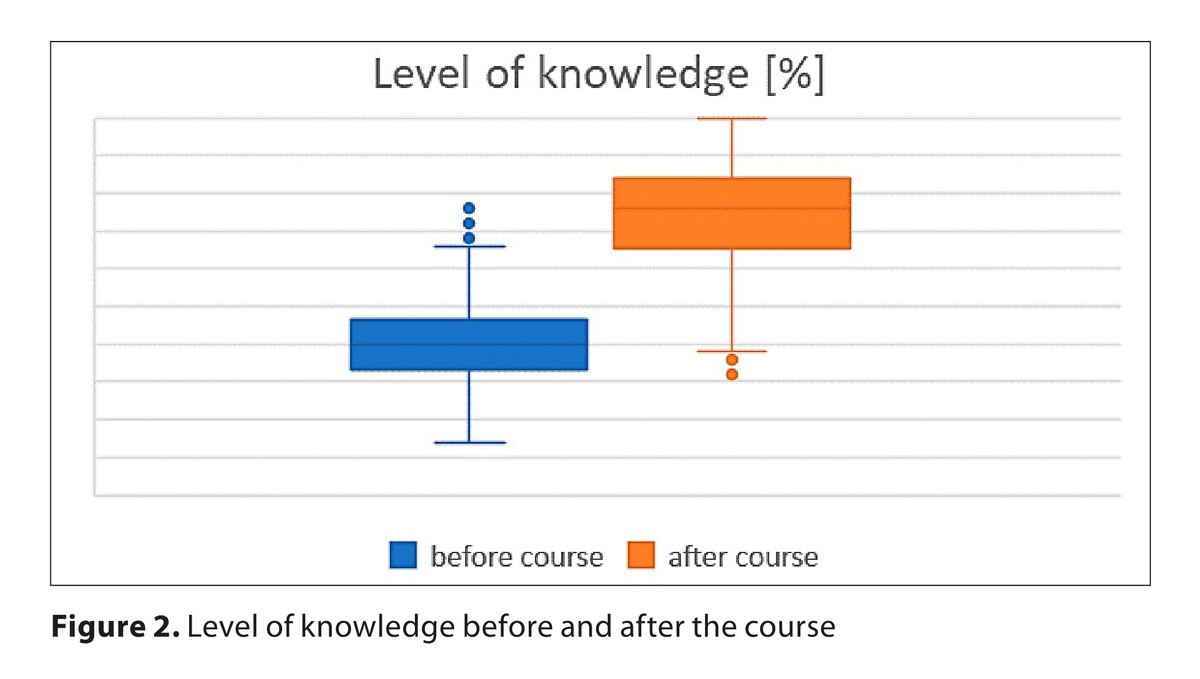
Baseline test scores ranged from 14% – 76% (median: 40%), increasing post-training to 32% -100% (median: 76%; p < 0.001). The most notable improvements were observed in trauma care and resuscitation. Emergency service staff demonstrated the most significant gains (p = 0.03). No statistically significant differences were found in terms of age, gender, education, or residence.
Conclusions:
The programme led to a significant improvement in participants’ knowledge of emergency medicine. The positive impact of simulation-based learning highlights the importance of expanding such educational models in resource-limited healthcare settings.
Despite targeted investments in acute care in Ghana, significant challenges persist, including limited medical supplies, shortages of trained personnel, and restricted access to medications. A key barrier to effective prehospital care is the lack of formal education among paramedics. To address this gap, the Paramedics for Africa 3 programme was implemented between July – December 2020, aimed at improving emergency medical knowledge and skills among healthcare providers.
Material and methods:
A pre-post intervention design was used to evaluate the impact of the training. A total of 268 participants, including paramedics, hospital staff, and outpatient clinic workers, were enrolled. Each completed a 50-question multiple-choice test covering anatomy, diagnostics, and medical procedures. The programme included hands-on activities, simulation-based scenarios, and case-based learning. Statistical analysis was used to assess changes in test performance.
Results:
Baseline test scores ranged from 14% – 76% (median: 40%), increasing post-training to 32% -100% (median: 76%; p < 0.001). The most notable improvements were observed in trauma care and resuscitation. Emergency service staff demonstrated the most significant gains (p = 0.03). No statistically significant differences were found in terms of age, gender, education, or residence.
Conclusions:
The programme led to a significant improvement in participants’ knowledge of emergency medicine. The positive impact of simulation-based learning highlights the importance of expanding such educational models in resource-limited healthcare settings.
PEER REVIEW INFORMATION
Article has been screened for originality
REFERENCES (25)
1.
Yiadom M, McWade CM, Awoonor-Williams K, et al. Public Health Rationale for Investments in Emergency Medicine in Developing Countries—Ghana as a Case Study. J Emerg Med. 2018;55:537–543. https://doi.org/10.1016/j.jeme....
2.
Dartey AF, Dzansi G, Lotse CW, et al. Midwives’ Experiences of Managing Clients with Eclampsia in a Low-Resource Setting: A Qualitative Descriptive Study. SAGE Open Nurs. 2022;8:23779608221094542. https://doi.org/10.1177/237796....
3.
Kumah A. The future of patient safety in Ghana: challenges and opportunities. Front Health Serv. 2025;5:1581468. https://doi.org/10.3389/frhs.2....
4.
Asamani JA, Christmals CD, Reitsma GM. Modelling the supply and need for health professionals for primary health care in Ghana: Implications for health professions education and employment planning. PLoS One. 2021;16:e0257957. https://doi.org/10.1371/journa....
5.
Gyedu A, Stewart B, Otupiri E, et al. First Aid Practices for Injured Children in Rural Ghana: A Cluster-Random Population-Based Survey. Prehosp Disaster Med. 2021;36:79–85. https://doi.org/10.1017/S10490....
6.
Anto-Ocrah M, Maxwell N, Cushman J, et al. Public knowledge and attitudes towards bystander cardiopulmonary resuscitation (CPR) in Ghana, West Africa. Int J Emerg Med. 2020;13:29. https://doi.org/10.1186/s12245....
7.
Akomeah AO, Sawe HR, Mfinanga JA, et al. Emergency medicine registrar training in Africa: overview of programmes, faculty and sustainability. Emerg Med J. 2020;37(5):300–305. https://doi.org/10.1136/emerme....
8.
Alhassan RK, Beyere CB, Nketiah-Amponsah E, et al. Perceived needs of health tutors in rural and urban health training institutions in Ghana: Implications for health sector staff internal migration control. PLoS One. 2017;12:e0185748. https://doi.org/10.1371/journa....
9.
Traicoff D, Tchoualeu DD, Opare J, et al. Applying Adult Learning Best Practices to Design Immunization Training for Health Care Workers in Ghana. Glob Health Sci Pract. 2021;9:487–497. https://doi.org/10.9745/GHSP-D....
10.
Flaherty KE, Zakariah AN, Vescio VA, et al. The state of emergency medical technician education in Ghana. Afr J Emerg Med. 2020;10:107–110. https://doi.org/10.1016/j.afje....
11.
Haruna U, Woods H, Kansanga M, et al. Enablers and barriers of community initiated health emergency transport systems in the Upper West Region of Ghana. Afr Geogr Rev. 2022;41(3):281–298. https://doi.org/10.1080/193768....
12.
Kironji AG, Hodkinson P, Stewart de Ramirez S, et al. Identifying barriers for out of hospital emergency care in low and low-middle income countries: a systematic review. BMC Health Serv Res. 2018;18:291. https://doi.org/10.1186/s12913....
13.
Moabom M, Akayuure P, Anuwoje I, et al. Survival Analysis of the Sick and Injured in the Era of Pre-Hospital Care in the Upper East Region of Ghana. Authorea. 2023. https://doi.org/10.22541/au.16....
14.
Arkoh AA, Coombs J, Talboys S. PAs in Ghana: A rich tradition with a hopeful future. JAAPA. 2025;38(4):e6-e9. https://doi.org/10.1097/01.JAA....
15.
Afulani PA, Aborigo RA, Walker D, et al. Can an integrated obstetric emergency simulation training improve respectful maternity care? Results from a pilot study in Ghana. Birth. 2019;46:523–532. https://doi.org/10.1111/birt.1....
16.
Tansley G, Bailey JG, Gu Y, et al. Efficacy of Surgical Simulation Training in a Low-Income Country. World J Surg. 2016;40:2643–2649. https://doi.org/10.1007/s00268....
17.
Debrah S, Donkor P, Mock C, et al. Increasing the use of continuing professional development courses to strengthen trauma care in Ghana. Ghana Med J. 2020;54:197–200. https://doi.org/10.4314/gmj.v5....
18.
Adamtey R, Frimpong J, Dinye R. An Analysis of Emergency Healthcare Delivery in Ghana: Lessons from Ambulance and Emergency Services in Bibiani Anhwiaso Bekwai District. Ghana J Dev Stud. 2015;12(1–2):71–87. https://doi.org/10.4314/gjds.v....
19.
AlShatarat M, Rayan A, Eshah NF, et al. Triage Knowledge and Practice and Associated Factors Among Emergency Department Nurses. SAGE Open Nurs. 2022;8:23779608221130588. https://doi.org/10.1177/237796....
20.
Japiong KB, Asiamah G, Owusu-Dabo E, et al. Availability of resources for emergency care at a second-level hospital in Ghana: A mixed methods assessment. Afr J Emerg Med. 2016;6:30–37. https://doi.org/10.1016/j.afje....
21.
Yakubu M, Jensen J. Developing Degree Programs in Emergency Management: Ghana’s Experience. J Homel Secur Emerg Manag. 2019;16(2):1–12. https://doi.org/10.1515/jhsem-....
22.
Konadu-Yeboah D, Yempabe T, Bo-ib Buunaaim AD, et al. Training Traditional Bonesetters in Basic Principles of Fracture Treatment: A Proof of Concept in Ghana. J Bone Joint Surg Am. 2023;105(24):1995–2001. https://doi.org/10.2106/JBJS.2....
23.
Asiedu C, Mensah M, Erzuah IA, et al. Knowledge of triage and resuscitation among emergency nurses in Ghana’s Central Region: a cross-sectional study. Discov Soc Sci Health. 2025;5:160. https://doi.org/10.1007/s44155....
24.
Bam V, Diji A K A, Asante E, et al. Self-assessed competencies of nurses at an emergency department in Ghana. Afr J Emerg Med. 2020;10(1):8–12. https://doi.org/10.1016/j.afje....
25.
Dzakpasu D, Agyemang Opoku O, Owusu S, et al. Emergency Preparedness of Nurses and Midwives in Accra, Ghana. AJHS. 2023;2:339–352. https://doi.org/10.58631/ajhs.....
Share
RELATED ARTICLE
| eISSN: | 1898-2263 |
| ISSN: | 1232-1966 |


Generation of the DOI (Digital Object Identifier) - task financed under the agreement No NrRCN/SP/0532/2021/1 by the Minister of Science and Higher
© 2006-2026 Journal hosting platform by Bentus
We process personal data collected when visiting the website. The function of obtaining information about users and their behavior is carried out by voluntarily entered information in forms and saving cookies in end devices. Data, including cookies, are used to provide services, improve the user experience and to analyze the traffic in accordance with the Privacy policy. Data are also collected and processed by Google Analytics tool (more).
You can change cookies settings in your browser. Restricted use of cookies in the browser configuration may affect some functionalities of the website.
You can change cookies settings in your browser. Restricted use of cookies in the browser configuration may affect some functionalities of the website.