Online first
Current issue
Archive
Special Issues
About the Journal
Publication Ethics
Anti-Plagiarism system
Instructions for Authors
Instructions for Reviewers
Editorial Board
Editorial Office
Contact
Reviewers
All Reviewers
2025
2024
2023
2022
2021
2020
2019
2018
2017
2016
General Data Protection Regulation (RODO)

REVIEW PAPER
Bystander use of automated external defibrillators in OHCA – gender differences, context modifiers, and clinical implications
1
Doctoral School, Medical University, Lublin, Poland
2
Laboratory of Specialistic and Tactical Simulation, Chair of Medical Education, Medical University, Lublin, Poland
3
Clinical Department of Otolaryngology and Laryngological Oncology, Masovian Specialist Hospital, Radom, Poland
4
Simulation Laboratory for Patient Safety, Chair of Medical Education, Medical University, Lublin, Poland
5
Department of Experimental Immunology, Medical University, Lublin, Poland
6
Department of Plastic, Reconstructive Surgery and Microsurgery, Medical University, Lublin, Poland
These authors had equal contribution to this work
Corresponding author
Anna Przysucha
Doctoral School, Medical University of Lublin, Poland, Chodzki 7, 20-093, Lublin, Poland
Doctoral School, Medical University of Lublin, Poland, Chodzki 7, 20-093, Lublin, Poland
KEYWORDS
cardiopulmonary resuscitationgender differencesautomated external defibrillatorsout of hospital cardiac arrest
TOPICS
ABSTRACT
Introduction and objective:
Out-of-hospital sudden cardiac arrest (OHCA) remains a significant cause of death, and early defibrillation by bystanders using an automated external defibrilator (AED) increases survival. Despite the lack of gender differences in basic life support (BLS) algorithms, reports suggest disparities in AED use among women. The aim of the study is to assess global gender differences in bystander AED use, and to identify potential determinants of these differences.
Review methods:
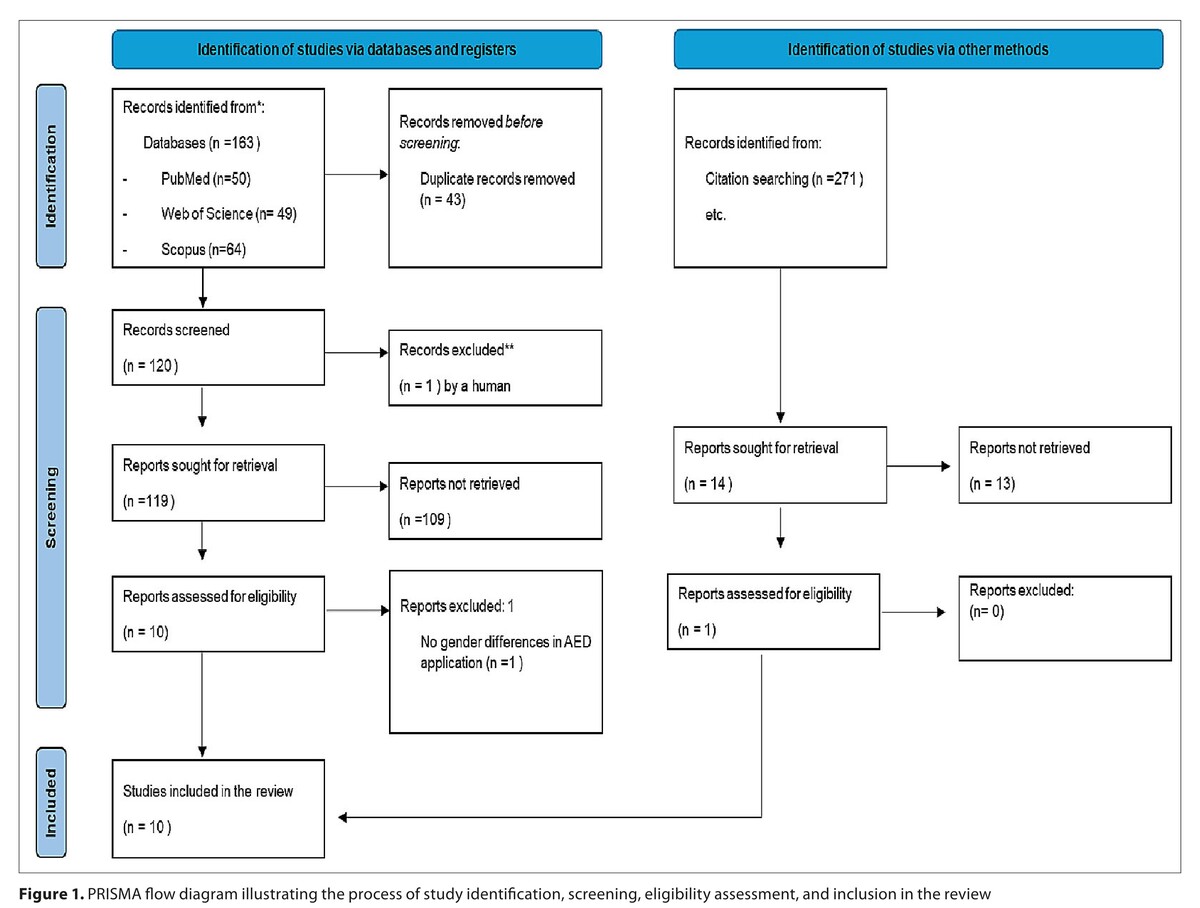
The review was conducted according to PRISMA 2020. PubMed, Web of Science, and Scopus were searched (publications 2014–2024). Studies of OHCA with non-traumatic etiology and reporting bystander AED use by bystanders by gender were included; exclusively paediatric populations were excluded. Modifiers, including the location of the event and age, were extracted.
Brief description of the state of knowledge:
120 abstracts were screened from 163 records after removing 43 duplicates. 10 studies from Asia, Australia, North America, and Europe were finally included in the analysis. In most studies, women were less likely than men to receive an AED; the effect was greater in public spaces and remote locations, and in some cases, it was non-significant in private settings. In some analyses, after controlling for the location of arrest, the differences disappeared. Interpretation is limited by heterogeneity in definitions (pad placement vs. defibrillation) and covariates, as well as the variable proportion of patients under 18 years of age.
Summary:
There is a global, context-dependent gender disparity in bystander AED use, to the detriment of women. Standardization of definitions and reporting, with mandatory stratification by location and age, and research in under-represented regions, is necessary. Corrective actions should include targeted BLS training, dispatch scripts that standardize chest exposure, and AED use in women.
Out-of-hospital sudden cardiac arrest (OHCA) remains a significant cause of death, and early defibrillation by bystanders using an automated external defibrilator (AED) increases survival. Despite the lack of gender differences in basic life support (BLS) algorithms, reports suggest disparities in AED use among women. The aim of the study is to assess global gender differences in bystander AED use, and to identify potential determinants of these differences.
Review methods:
The review was conducted according to PRISMA 2020. PubMed, Web of Science, and Scopus were searched (publications 2014–2024). Studies of OHCA with non-traumatic etiology and reporting bystander AED use by bystanders by gender were included; exclusively paediatric populations were excluded. Modifiers, including the location of the event and age, were extracted.
Brief description of the state of knowledge:
120 abstracts were screened from 163 records after removing 43 duplicates. 10 studies from Asia, Australia, North America, and Europe were finally included in the analysis. In most studies, women were less likely than men to receive an AED; the effect was greater in public spaces and remote locations, and in some cases, it was non-significant in private settings. In some analyses, after controlling for the location of arrest, the differences disappeared. Interpretation is limited by heterogeneity in definitions (pad placement vs. defibrillation) and covariates, as well as the variable proportion of patients under 18 years of age.
Summary:
There is a global, context-dependent gender disparity in bystander AED use, to the detriment of women. Standardization of definitions and reporting, with mandatory stratification by location and age, and research in under-represented regions, is necessary. Corrective actions should include targeted BLS training, dispatch scripts that standardize chest exposure, and AED use in women.
PEER REVIEW INFORMATION
Article has been screened for originality
REFERENCES (27)
1.
Myat A, Song KJ, Rea T. Out-of-hospital cardiac arrest: current concepts. Lancet. 2018;391(10124):970–979. doi:10.1016/S0140-6736(18)30472-0.
2.
Kiguchi T, Okubo M, Nishiyama C, et al. Out-of-hospital cardiac arrest across the World: First report from the International Liaison Committee on Resuscitation (ILCOR). Resuscitation. 2020;152:39–49. doi:10.1016/j.resuscitation.2020.02.044.
3.
Amacher SA, Bohren C, Blatter R, et al. Long-term Survival After Out-of-Hospital Cardiac Arrest: A Systematic Review and Meta-analysis. JAMA Cardiol. 2022;7(6):633–643. doi:10.1001/jamacardio.2022.0795.
4.
Oliveira NC, Oliveira H, Silva TLC, et al. The role of bystander CPR in out-of-hospital cardiac arrest: what the evidence tells us. Hellenic J Cardiol. 2025;82:86–98. doi:10.1016/j.hjc.2024.09.002.
5.
Ong MEH, Perkins GD, Cariou A. Out-of-hospital cardiac arrest: prehospital management. Lancet. 2018;391(10124):980–988. doi:10.1016/S0140-6736(18)30316-7.
6.
Olasveengen TM, Semeraro F, Ristagno G, et al. European Resuscitation Council Guidelines 2021: Basic Life Support. Resuscitation. 2021;161:98–114. doi:10.1016/j.resuscitation.2021.02.009.
7.
Gräsner JT, Herlitz J, Tjelmeland IBM, et al. European Resuscitation Council Guidelines 2021: Epidemiology of cardiac arrest in Europe. Resuscitation. 2021;161:61–79. doi:10.1016/j.resuscitation.2021.02.007.
8.
Case R, Cartledge S, Siedenburg J, et al. Identifying barriers to the provision of bystander cardiopulmonary resuscitation (CPR) in high-risk regions: A qualitative review of emergency calls. Resuscitation. 2018;129:43–47. doi:10.1016/j.resuscitation.2018.06.001.
9.
Munot S, Bray JE, Redfern J, et al. Bystander cardiopulmonary resuscitation differences by sex – The role of arrest recognition. Resuscitation. 2024;199:110224. doi:10.1016/j.resuscitation.2024.110224.
10.
Souers A, Zuver C, Rodriguez A, et al. Bystander CPR occurrences in out of hospital cardiac arrest between sexes. Resuscitation. 2021;166:1–6. doi:10.1016/j.resuscitation.2021.06.021.
11.
Thompson K, Smith J, Tanski M, et al. Gender Differences in Defibrillator Practices in Out-of-Hospital Cardiac Arrest. Prehosp Emerg Care. 2025;29(5):586–592. doi:10.1080/10903127.2024.2394590.
12.
Grunau B, Humphries K, Stenstrom R, et al. Public access defibrillators: Gender-based inequities in access and application. Resuscitation. 2020;150:17–22. doi:10.1016/j.resuscitation.2020.02.024.
13.
Blewer AL, Starks MA, Malta-Hansen C, et al. Sex Differences in Receipt of Bystander Cardiopulmonary Resuscitation Considering Neighborhood Racial and Ethnic Composition. J Am Heart Assoc. 2024;13(5):e031113. doi:10.1161/JAHA.123.031113.
14.
Gordon M, Grafton-Clarke C, Hill E, et al. Twelve tips for undertaking a focused systematic review in medical education. Med Teach. 2019;41(11):1232–1238. doi:10.1080/0142159X.2018.1513642.
15.
Jadhav S, Gaddam S. Gender and location disparities in prehospital bystander AED usage. Resuscitation. 2021;158:139–142. doi:10.1016/j.resuscitation.2020.11.006.
16.
Kiyohara K, Katayama Y, Kitamura T, et al. Gender disparities in the application of public-access AED pads among OHCA patients in public locations. Resuscitation. 2020;150:60–64. doi:10.1016/j.resuscitation.2020.02.038.
17.
Paratz ED, Nehme E, Heriot N, et al. Sex disparities in bystander defibrillation for out-of-hospital cardiac arrest. Resusc Plus. 2024;17:100532. doi:10.1016/j.resplu.2023.100532.
18.
Ishii M, Tsujita K, Seki T, et al. Sex- and Age-Based Disparities in Public Access Defibrillation, Bystander Cardiopulmonary Resuscitation, and Neurological Outcome in Cardiac Arrest. JAMA Netw Open. 2023;6(7):e2321783. doi:10.1001/jamanetworkopen.2023.21783.
19.
Barry T, Kasemiire A, Quinn M, et al. Bystander defibrillation for out-of-hospital cardiac arrest in Ireland. Resusc Plus. 2024;19:100712. doi:10.1016/j.resplu.2024.100712.
20.
Orlob S, Grundner S, Wittig J, et al. Assessing the weak links – Necessity and impact of regional cardiac arrest awareness campaigns for laypersons. Resusc Plus. 2023;13:100352. doi:10.1016/j.resplu.2022.100352.
21.
Tierney NJ, Reinhold HJ, Mira A, et al. Novel relocation methods for automatic external defibrillator improve out-of-hospital cardiac arrest coverage under limited resources. Resuscitation. 2018;125:83–89. doi:10.1016/j.resuscitation.2018.01.055.
22.
Huebinger R, Jarvis J, Schulz K, et al. Community Variations in Out-of-Hospital Cardiac Arrest Care and Outcomes in Texas. Prehospital Emergency Care. 2022;26(2):204–211. doi:10.1080/10903127.2021.1907007.
23.
Masterson S, Wright P, O’Donnell C, et al. Urban and rural differences in out-of-hospital cardiac arrest in Ireland. Resuscitation. 2015;91:42–47. doi:10.1016/j.resuscitation.2015.03.012.
24.
Shelton SK, Rice JD, Knoepke CE, et al. Examining the Impact of Layperson Rescuer Gender on the Receipt of Bystander CPR for Women in Cardiac Arrest. Circ Cardiovasc Qual Outcomes. 2024;17(4):e010249. doi:10.1161/CIRCOUTCOMES.123.010249.
25.
Hosomi S, Zha L, Kiyohara K, et al. Sex disparities in prehospital advanced cardiac life support in out-of-hospital cardiac arrests in Japan. Am J Emerg Med. 2023;64:67–73. doi:10.1016/j.ajem.2022.11.025.
26.
Public Perceptions on Why Women Receive Less Bystander Cardiopulmonary Resuscitation Than Men in Out-of-Hospital Cardiac Arrest | Circulation. Accessed September 15, 2025. https://www.ahajournals.org/do....
27.
Blewer AL, Bigham BL, Kaplan S, et al. Gender, Socioeconomic Status, Race, and Ethnic Disparities in Bystander Cardiopulmonary Resuscitation and Education-A Scoping Review. Healthcare (Basel). 2024;12(4):456. doi:10.3390/healthcare12040456.
| eISSN: | 1898-2263 |
| ISSN: | 1232-1966 |


Generation of the DOI (Digital Object Identifier) - task financed under the agreement No NrRCN/SP/0532/2021/1 by the Minister of Science and Higher
© 2006-2026 Journal hosting platform by Bentus
We process personal data collected when visiting the website. The function of obtaining information about users and their behavior is carried out by voluntarily entered information in forms and saving cookies in end devices. Data, including cookies, are used to provide services, improve the user experience and to analyze the traffic in accordance with the Privacy policy. Data are also collected and processed by Google Analytics tool (more).
You can change cookies settings in your browser. Restricted use of cookies in the browser configuration may affect some functionalities of the website.
You can change cookies settings in your browser. Restricted use of cookies in the browser configuration may affect some functionalities of the website.