Online first
Current issue
Archive
Special Issues
About the Journal
Publication Ethics
Anti-Plagiarism system
Instructions for Authors
Instructions for Reviewers
Editorial Board
Editorial Office
Contact
Reviewers
All Reviewers
2025
2024
2023
2022
2021
2020
2019
2018
2017
2016
General Data Protection Regulation (RODO)

RESEARCH PAPER
AKT1 and ferroptosis involved in the anti-cerebral infarction effect of Ginkgolide Injection
1
Pharmacy, Ezhou Central Hospital, China
2
Neurology Department Ward 3, Dali Bai Autonomous Prefecture People’s Hospital, China
3
Pharmacy, Beijing Friendship Hospital, Capital Medical University, China
4
Laboratory, The Third People’s Hospital of Cangnan County, China
These authors had equal contribution to this work
Corresponding author
Ann Agric Environ Med. 2026;33(3):318-324
KEYWORDS
TOPICS
ABSTRACT
Introduction and objective:
Ferroptosis is essential for the occurrence and development of myocardial infarction. The aim of the study is to elucidate the molecular mechanism of Ginkgolide Injection against ischemic cerebral infarction (ICI), focusing on its multi-target regulation of ferroptosis via the AKT1 and NFE2L2.
Material and methods:
Human primary neurons and astrocytes were subjected to oxygen-glucose deprivation/reoxygenation (OGD/R) to mimic cerebral ischemia. Cells were treated with Ginkgolide Injection or transfected with AKT1-targeting siRNA. Targets of Ginkgolide Injection components against ICI-associated genes were retrieved from TCMSP, CTD, HERB, OMIM, and DisGeNET databases. A compound-target-disease network was constructed using Cytoscape, followed by PPI, GO, and KEGG analyses. Cell viability (CCK-8), lipid peroxidation assessment (C11-BODIPY581/591 staining), redox markers (GSH, ROS, MDA), and AKT1/Nrf2 signaling (RT-qPCR, Western blot) were analyzed.
Results:
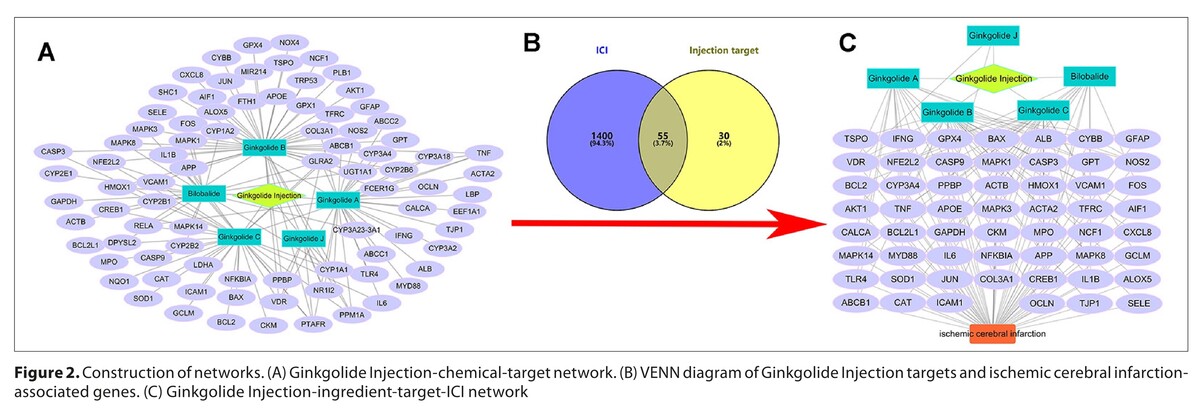
Ginkgolide Injection restored viability in OGD/R-injured neurons and astrocytes. Bilobalide in Ginkgolide Injection targeted 22 genes; Ginkgolide A targeted 32 genes; Ginkgolide B targeted 48 genes; Ginkgolide C targeted 30 genes; Ginkgolide J targeted 7 genes. A total of 55 targets for Ginkgolide Injection were common with ICI-associated genes. Network pharmacology identified AKT1 and NFE2L2 as core targets of Ginkgolide Injection against ICI. Ginkgolide Injection suppressed ferroptosis (reduced PTGS2 mRNA and lipid peroxidation) and activated AKT1 signalling in OGD/R-injured neurons and astrocytes. AKT1 knockdown abolished Ginkgolide’s anti-ferroptotic effects, confirming AKT1’s regulatory role.
Conclusions:
Ginkgolide Injection mitigates cerebral infarction by co-activating AKT1 and NFE2L2 to suppress ferroptosis, highlighting its potential as a multi-target therapy for ischemic ICI.
Ferroptosis is essential for the occurrence and development of myocardial infarction. The aim of the study is to elucidate the molecular mechanism of Ginkgolide Injection against ischemic cerebral infarction (ICI), focusing on its multi-target regulation of ferroptosis via the AKT1 and NFE2L2.
Material and methods:
Human primary neurons and astrocytes were subjected to oxygen-glucose deprivation/reoxygenation (OGD/R) to mimic cerebral ischemia. Cells were treated with Ginkgolide Injection or transfected with AKT1-targeting siRNA. Targets of Ginkgolide Injection components against ICI-associated genes were retrieved from TCMSP, CTD, HERB, OMIM, and DisGeNET databases. A compound-target-disease network was constructed using Cytoscape, followed by PPI, GO, and KEGG analyses. Cell viability (CCK-8), lipid peroxidation assessment (C11-BODIPY581/591 staining), redox markers (GSH, ROS, MDA), and AKT1/Nrf2 signaling (RT-qPCR, Western blot) were analyzed.
Results:
Ginkgolide Injection restored viability in OGD/R-injured neurons and astrocytes. Bilobalide in Ginkgolide Injection targeted 22 genes; Ginkgolide A targeted 32 genes; Ginkgolide B targeted 48 genes; Ginkgolide C targeted 30 genes; Ginkgolide J targeted 7 genes. A total of 55 targets for Ginkgolide Injection were common with ICI-associated genes. Network pharmacology identified AKT1 and NFE2L2 as core targets of Ginkgolide Injection against ICI. Ginkgolide Injection suppressed ferroptosis (reduced PTGS2 mRNA and lipid peroxidation) and activated AKT1 signalling in OGD/R-injured neurons and astrocytes. AKT1 knockdown abolished Ginkgolide’s anti-ferroptotic effects, confirming AKT1’s regulatory role.
Conclusions:
Ginkgolide Injection mitigates cerebral infarction by co-activating AKT1 and NFE2L2 to suppress ferroptosis, highlighting its potential as a multi-target therapy for ischemic ICI.
PEER REVIEW INFORMATION
Article has been screened for originality
REFERENCES (27)
1.
Zhao Y, Zhang X, Chen X, et al. Neuronal injuries in cerebral infarction and ischemic stroke: From mechanisms to treatment (Review). Int J Mol Med. 2022;49(2). http://doi.org/10.3892/ijmm.20....
2.
Liu Z, Chopp M. Astrocytes, therapeutic targets for neuroprotection and neurorestoration in ischemic stroke. Prog Neurobiol. 2016;144:103–20. http://doi.org/10.1016/j.pneur....
3.
Zhang M, Liu Q, Meng H, et al. Ischemia-reperfusion injury: molecular mechanisms and therapeutic targets. Signal Transduct Target Ther. 2024;9(1):12. http://doi.org/10.1038/s41392-....
4.
Chen S, Chen H, Du Q, et al. Targeting Myeloperoxidase (MPO) Mediated Oxidative Stress and Inflammation for Reducing Brain Ischemia Injury: Potential Application of Natural Compounds. Front Physiol. 2020;11:433. http://doi.org/10.3389/fphys.2....
5.
Liu FM, Xie YM, Wang ZF, et al. [Clinical comprehensive evaluation of Ginkgolide Injection in treatment of cerebral infarction]. Zhongguo Zhong Yao Za Zhi. 2022;47(6):1493–500. http://doi.org/10.19540/j.cnki....
6.
Xiang Y, Yang N, Guo Z, et al. Cost-Effectiveness Analysis of Ginkgolide Injection in the Treatment of Ischemic Stroke Based on a Randomized Clinical Trial. J Altern Complement Med. 2021;27(4):331–41. http://doi.org/10.1089/acm.202....
7.
Yan M, Wu J, Wang L, et al. Ginkgolide injections in meglumine, combined with edaravone, significantly increases the efficacy in acute ischemic stroke: A meta-analysis. Front Pharmacol. 2023;14:1236684. http://doi.org/10.3389/fphar.2....
8.
Geng JL, Aa JY, Feng SQ, et al. Exploring the neuroprotective effects of ginkgolides injection in a rodent model of cerebral ischemia-reperfusion injury by GC-MS based metabolomic profiling. J Pharm Biomed Anal. 2017;142:190–200. http://doi.org/10.1016/j.jpba.....
9.
Xu H, Wang E, Chen F, et al. Neuroprotective Phytochemicals in Experimental Ischemic Stroke: Mechanisms and Potential Clinical Applications. Oxid Med Cell Longev. 2021;2021:6687386. http://doi.org/10.1155/2021/66....
10.
Lu M, Zhang Y, Ma X, et al. Shenmai Injection Alleviates Myocardial Ferroptosis via Activating the AKT1/mTOR Pathway in Rats with Acute Myocardial Infarction. Ann Clin Lab Sci. 2024;54(1):35–46.
11.
Anandhan A, Dodson M, Shakya A, et al. NRF2 controls iron homeostasis and ferroptosis through HERC2 and VAMP8. Sci Adv. 2023;9(5):eade9585. http://doi.org/10.1126/sciadv.....
12.
Ma X, Xin D, She R, et al. Novel insight into cGAS-STING pathway in ischemic stroke: from pre- to post-disease. Front Immunol. 2023;14:1275408. http://doi.org/10.3389/fimmu.2....
13.
Nogales C, Mamdouh ZM, List M, et al. Network pharmacology: curing causal mechanisms instead of treating symptoms. Trends in Pharmacological Sciences. 2022;43(2):136–50. http://doi.org/10.1016/j.tips.....
14.
Ma S, Fan W, Zhang J. Network pharmacology study on the potential effect mechanism of Chuanzhi Tongluo Capsule in the treatment of cerebral infarction. Medicine (Baltimore). 2022;101(41):e30916. http://doi.org/10.1097/md.0000....
15.
Zhang Y, Song Q, Wang Y, et al. Neuroprotective effect of aspirin combined with ginkgolide injection on cerebral ischemic stroke rats and its effect on ERK12 signal pathway. Saudi J Biol Sci. 2021;28(6):3193–7. http://doi.org/10.1016/j.sjbs.....
16.
Zhang X, Chen L, Dang X, et al. Neuroprotective effects of total steroid saponins on cerebral ischemia injuries in an animal model of focal ischemia/reperfusion. Planta Med. 2014;80(8–9):637–44. http://doi.org/10.1055/s-0034-....
17.
Struzyna LA, Katiyar K, Cullen DK. Living scaffolds for neuroregeneration. Curr Opin Solid State Mater Sci. 2014;18(6):308–18. http://doi.org/10.1016/j.cossm....
18.
Yang X, Zheng T, Hong H, et al. Neuroprotective effects of Ginkgo biloba extract and Ginkgolide B against oxygen-glucose deprivation/reoxygenation and glucose injury in a new in vitro multicellular network model. Front Med. 2018;12(3):307–18. http://doi.org/10.1007/s11684-....
19.
Wang J, Guan Z, Li W, et al. The role of H3K27 acetylation in oxygen-glucose deprivation-induced spinal cord injury and potential for neuroprotective therapies. Brain Res Bull. 2025;220:111152. http://doi.org/10.1016/j.brain....
20.
Jiang X, Stockwell BR, Conrad M. Ferroptosis: mechanisms, biology and role in disease. Nat Rev Mol Cell Biol. 2021;22(4):266–82. http://doi.org/10.1038/s41580-....
21.
Zou R, Liu Z, Wang P, Liu Y. Ginkgolide B binds to GPX4 and FSP1 to alleviate cerebral ischemia/reperfusion injury in rats. Toxicol Appl Pharmacol. 2025;495:117237. http://doi.org/10.1016/j.taap.....
22.
Huang J, Li Q, Wang H, et al. Betulinic Acid Inhibits Glioma Progression by Inducing Ferroptosis Through the PI3K/Akt and NRF2/HO-1 Pathways. J Gene Med. 2025;27(2):e70011. http://doi.org/10.1002/jgm.700....
23.
Wang L, Zhang X, Xiong X, et al. Nrf2 Regulates Oxidative Stress and Its Role in Cerebral Ischemic Stroke. Antioxidants (Basel). 2022;11(12). http://doi.org/10.3390/antiox1....
24.
Farina M, Vieira LE, Buttari B, et al. The Nrf2 Pathway in Ischemic Stroke: A Review. Molecules. 2021;26(16). http://doi.org/10.3390/molecul....
25.
Fan W, Chen H, Li M, et al. NRF2 activation ameliorates blood-brain barrier injury after cerebral ischemic stroke by regulating ferroptosis and inflammation. Sci Rep. 2024;14(1):5300. http://doi.org/10.1038/s41598-....
26.
Fu C, Wu Y, Liu S, et al. Rehmannioside A improves cognitive impairment and alleviates ferroptosis via activating PI3K/AKT/Nrf2 and SLC7A11/GPX4 signaling pathway after ischemia. J Ethnopharmacol. 2022;289:115021. http://doi.org/10.1016/j.jep.2....
27.
Shang YF, Feng WD, Liu DN, et al. Salvianolic Acid A Activates Nrf2-Related Signaling Pathways to Inhibit Ferroptosis to Improve Ischemic Stroke. Molecules. 2025;30(15). http://doi.org/10.3390/molecul....
| eISSN: | 1898-2263 |
| ISSN: | 1232-1966 |


Generation of the DOI (Digital Object Identifier) - task financed under the agreement No NrRCN/SP/0532/2021/1 by the Minister of Science and Higher
© 2006-2026 Journal hosting platform by Bentus
We process personal data collected when visiting the website. The function of obtaining information about users and their behavior is carried out by voluntarily entered information in forms and saving cookies in end devices. Data, including cookies, are used to provide services, improve the user experience and to analyze the traffic in accordance with the Privacy policy. Data are also collected and processed by Google Analytics tool (more).
You can change cookies settings in your browser. Restricted use of cookies in the browser configuration may affect some functionalities of the website.
You can change cookies settings in your browser. Restricted use of cookies in the browser configuration may affect some functionalities of the website.