Online first
Current issue
Archive
Special Issues
About the Journal
Publication Ethics
Anti-Plagiarism system
Instructions for Authors
Instructions for Reviewers
Editorial Board
Editorial Office
Contact
Reviewers
All Reviewers
2025
2024
2023
2022
2021
2020
2019
2018
2017
2016
General Data Protection Regulation (RODO)

RESEARCH PAPER
Nutritional status, dietary intake, and family predisposition to overweight and obesity in relation to the FTO rs9939609 polymorphism
1
Department of Food Gastronomy and Food Hygiene, Institute of Human Nutrition Sciences, Warsaw University of Life Sciences, Poland
2
Department of Dietetics, Institute of Human Nutrition Sciences, Warsaw University of Life Sciences, Poland
Corresponding author
Joanna Myszkowska-Ryciak
Katedra Dietetyki, Szkoła Główna Gospodarstwa Wiejskiego w Warszawie Instytut Nauk o Żywieniu Człowieka, Nowoursynowska 159C, 02-776, Warszawa, Poland
Katedra Dietetyki, Szkoła Główna Gospodarstwa Wiejskiego w Warszawie Instytut Nauk o Żywieniu Człowieka, Nowoursynowska 159C, 02-776, Warszawa, Poland
KEYWORDS
TOPICS
ABSTRACT
Introduction and objective:
The FTO rs9939609 gene variant has been associated with obesity in humans; however, its role in the regulation of dietary intake remains unclear. The aim of the study is to examine the associations between dietary intake, nutritional status, and familial predisposition to overweight and obesity, as well as to evaluate the contribution of the FTO rs9939609 polymorphism in this context.
Material and methods:
The study included 112 adults (74% women; mean age: 40.1 ± 13.2 years). Body composition was assessed using bioelectrical impedance analysis; weight status was classified according to body mass index (BMI). Dietary intake was evaluated using a three-day food records and a food frequency questionnaire. Genotyping of the FTO rs9939609 polymorphism (AA, AT, and TT) was performed using fast real-time PCR on DNA isolated from buccal swabs. Statistical analyses included analysis of variance, non-parametric tests, and multivariate methods.
Results:
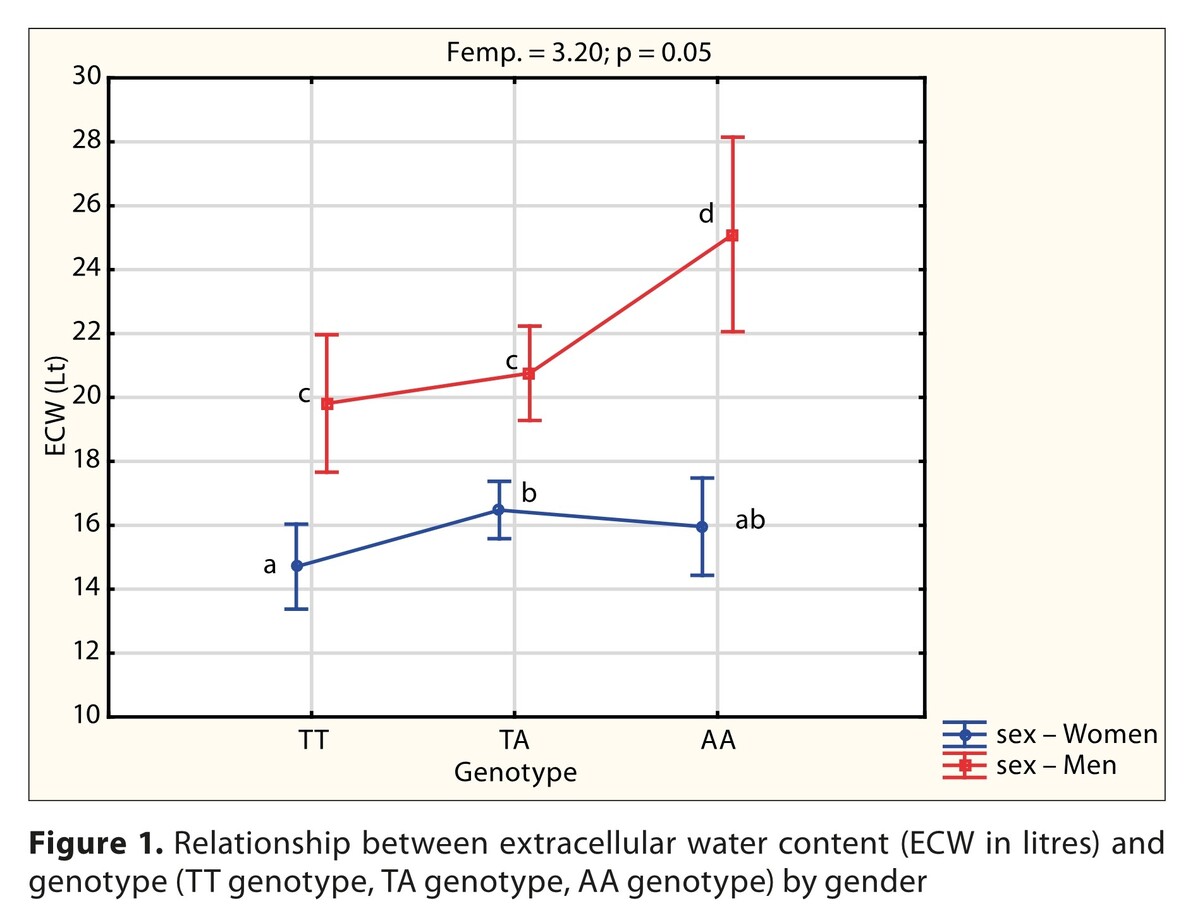
The frequency of the A allele was 0.46. Genotype frequencies (TT = 0.26, AT = 0.56, AA = 0.18) were consistent with Hardy–Weinberg equilibrium. The FTO rs9939609 polymorphism was associated with a higher prevalence of excessive body weight. However, no significant differences were observed in anthropometric measurements or body composition parameters between genotype groups. The polymorphism explained 7.82% of the variability in indicators of nutritional status.
Conclusions:
The study supports an association between the rs9939609 polymorphism of the FTO gene and increased susceptibility to excessive body mass, particularly among carriers of the A allele, and a significant influence of relatives along the maternal line. These observations highlight the potential contribution of shared genetic susceptibility and familial environment to obesity.
The FTO rs9939609 gene variant has been associated with obesity in humans; however, its role in the regulation of dietary intake remains unclear. The aim of the study is to examine the associations between dietary intake, nutritional status, and familial predisposition to overweight and obesity, as well as to evaluate the contribution of the FTO rs9939609 polymorphism in this context.
Material and methods:
The study included 112 adults (74% women; mean age: 40.1 ± 13.2 years). Body composition was assessed using bioelectrical impedance analysis; weight status was classified according to body mass index (BMI). Dietary intake was evaluated using a three-day food records and a food frequency questionnaire. Genotyping of the FTO rs9939609 polymorphism (AA, AT, and TT) was performed using fast real-time PCR on DNA isolated from buccal swabs. Statistical analyses included analysis of variance, non-parametric tests, and multivariate methods.
Results:
The frequency of the A allele was 0.46. Genotype frequencies (TT = 0.26, AT = 0.56, AA = 0.18) were consistent with Hardy–Weinberg equilibrium. The FTO rs9939609 polymorphism was associated with a higher prevalence of excessive body weight. However, no significant differences were observed in anthropometric measurements or body composition parameters between genotype groups. The polymorphism explained 7.82% of the variability in indicators of nutritional status.
Conclusions:
The study supports an association between the rs9939609 polymorphism of the FTO gene and increased susceptibility to excessive body mass, particularly among carriers of the A allele, and a significant influence of relatives along the maternal line. These observations highlight the potential contribution of shared genetic susceptibility and familial environment to obesity.
PEER REVIEW INFORMATION
Article has been screened for originality
REFERENCES (25)
1.
Czajkowski P, Adamska-Patruno E, Bauer W, et al. The Impact of FTO Genetic Variants on Obesity and Its Metabolic Consequences is Dependent on Daily Macronutrient Intake. Nutrients 2020;12:3255. https://doi.org/10.3390/nu1211....
2.
Loos RJF, Yeo GSH. The genetics of obesity: from discovery to biology. Nat Rev Genet. 23;2022:120–133. https://doi.org/10.1038/s41576....
3.
Huang Ch, Chen W, Wang X. Studies on the fat mass and obesity-associated (FTO) gene and its impact on obesity-associated diseases. Genes Dis. 2023;10:2351e2365.
4.
Falbová D, Vorobeľová L, Siváková D, et al. Association between FTO (rs17817449) genetic variant gamma-glutamyl transferase and hypertension in Slovak midlife women. Am J Hum Biol. 2022;34:e23672.
5.
Gao X, Shin Y-H, Li M, et al. The Fat Mass and Obesity Associated Gene FTO Functions in the Brain to Regulate Postnatal Growth in Mice. PLoS ONE 2010;5(11):e14005. https://doi.org/10.1371/journa....
6.
Song T, Yang Y, Jiang S, et al. Novel Insights into Adipogenesis from the Perspective of Transcriptional and RNA N6-Methyladenosine-Mediated Post-Transcriptional Regulation. Adv Sci. 2020;7:2001563. https://doi.org/10.1002/advs.2....
7.
Olmedo L, Luna FJ, Zubrzycki J, et al. Associations Between rs9939609 FTO Polymorphism With Nutrient and Food Intake and Adherence to Dietary Patterns in an Urban Argentinian Population. J Acad Nutr Diet. 2024;124:874–882.
8.
Rahimlou M, Ghobadian B, Ramezani A, et al. Fat mass and obesity-associated gene (FTO) rs9939609 (A/T) polymorphism and food preference in obese people with low-calorie intake and non-obese individuals with high-calorie intake. BMC Nutr. 2023;9:143. https://doi.org/10.1186/s40795....
9.
Madrigal-Juarez A, Martínez-López E, Sanchez-Murguia T, et al. FTO genotypes (rs9939609 T>A) are Associated with Increased Added Sugar Intake in Healthy Young Adults. Lifestyle Genomics 2023;16(1):214–223. https://doi.org/10.1159/000534....
10.
National Health and Nutrition Examination Survey (NHANES). Anthropometry Procedures Manual. Washington (DC): Centers for Disease Control and Prevention, 2017.
11.
World Health Organization. A Healthy Lifestyle—WHO Recommendations. https://www.who.int/europe/new... (access: 2026.02.20).
12.
World Health Organization. Waist Circumference and Waist-Hip Ratio: Report of a WHO Expert Consultation. Geneva (CH): World Health Organization; 2008. https://www.who.int/publicatio... (access: 2026.02.20).
13.
Wang G, Luo Y, Yang T, et al. Association of waist-to-height ratio with all-cause and obesity-related mortality in adults: a prospective cohort study. Front Nutr. 2025;12:1614347. doi: 10.3389/fnut.2025.1614347.
14.
Kuchowicza H, Przygoda B, Nadolna I, et al. Tabele Składu i Wartości Odżywczej Żywności. Warszawa (PL): Wydawnictwo PZWL, 2020.
15.
Willett WC, Howe GR, Kushi LH. Adjustment for total energy intake in epidemiologic studies. Am J Clin Nutr. 1997;65:1220S-1228S.
16.
Niedzwiedzka E, Wadolowska L, Kowalkowska J. Reproducibility of A Non-Quantitative Food Frequency Questionnaire (62-Item FFQ-6) and PCA-Driven Dietary Pattern Identification in 13–21-Year-Old Females. Nutrients 2019;11:2183.
17.
Livingstone KM, Brayner B, Celis‐Morales C, et al. Associations between dietary patterns FTO genotype and obesity in adults from seven European countries. Eur J Nutr. 2022;61:2953–2965.
18.
Mehrdad M, Fardaei M, Fararouei M, et al. The association between FTO rs9939609 gene polymorphism and anthropometric indices in adults. J Physiol Anthropol. 2020;39:14.
19.
Piwonska AM, Cicha-Mikolajczyk A, Sobczyk-Kopciol A, et al. Independent association of FTO rs9939609 polymorphism with overweight and obesity in Polish adults. Results from the representative population-based WOBASZ study. J Physiol Pharmacol. 2022;73(3): 395–402. doi: 10.26402/jpp.2022.3.07.
20.
Ikhanjal MA, Elouarid MA, Zouine C, et al. FTO gene variants (rs9939609, rs8050136 and rs17817449) and type 2 diabetes mellitus risk: A Meta-Analysis. Gene 2023;887:147791.
21.
Gholamalizadeh M, Mirzaei Dahka S, Vahid F, et al. Does the rs9939609 FTO gene polymorphism affect fat percentage? A meta-analysis. Arch Physiol Biochem. 2020;128:1421–1425.
22.
Liang X, Chen X, Li J, et al. Study on body composition and its correlation with obesity: A Cohort Study in 5121 Chinese Han participants. Medicine 2018;97(21):e10722. doi: 10.1097/MD.0000000000010722.
23.
Livingstone K, Celis-Morales C, Lara J, et al. Associations between FTO genotype and total energy and macronutrients intake: a systematic review and meta-analysis. Obes Rev. 2015;16:666–678.
24.
Daya M, Pujianto DA, Witjaksono F, et al. Obesity risk and preference for high dietary fat intake are determined by FTO rs9939609 gene polymorphism in selected Indonesian adults. Asia Pac J Clin Nutr. 2019;28:183–191.
25.
Lusting R, Collier D, Kassotis Ch, et al. Obesity I: Overview and Molecular and Biochemical Mechanisms. Biochem Pharmacol. 2022;199:115012.
Share
RELATED ARTICLE
| eISSN: | 1898-2263 |
| ISSN: | 1232-1966 |


Generation of the DOI (Digital Object Identifier) - task financed under the agreement No NrRCN/SP/0532/2021/1 by the Minister of Science and Higher
© 2006-2026 Journal hosting platform by Bentus
We process personal data collected when visiting the website. The function of obtaining information about users and their behavior is carried out by voluntarily entered information in forms and saving cookies in end devices. Data, including cookies, are used to provide services, improve the user experience and to analyze the traffic in accordance with the Privacy policy. Data are also collected and processed by Google Analytics tool (more).
You can change cookies settings in your browser. Restricted use of cookies in the browser configuration may affect some functionalities of the website.
You can change cookies settings in your browser. Restricted use of cookies in the browser configuration may affect some functionalities of the website.