Online first
Current issue
Archive
Special Issues
About the Journal
Publication Ethics
Anti-Plagiarism system
Instructions for Authors
Instructions for Reviewers
Editorial Board
Editorial Office
Contact
Reviewers
All Reviewers
2025
2024
2023
2022
2021
2020
2019
2018
2017
2016
General Data Protection Regulation (RODO)

RESEARCH PAPER
Comparison of dietary patterns and selected health parameters in an adult population assessed before and during the COVID-19 pandemic
1
Department of Population Medicine and Lifestyle Diseases Prevention, Medical University, Białystok, Poland
2
Department of Epidemiology and Biostatistics, Institute of Rural Medicine, Lublin, Poland
3
Society and Cognition Unit, University of Białystok, Poland
4
Department of Cardiology and Internal Medicine with Cardiac Intensive Care Unit, Medical University, Białystok, Poland
Corresponding author
Magdalena Zalewska
Department of Population Medicine and Lifestyle Diseases Prevention, Medical University of Bialystok, Poland
Department of Population Medicine and Lifestyle Diseases Prevention, Medical University of Bialystok, Poland
KEYWORDS
TOPICS
ABSTRACT
Introduction and objective:
The COVID-19 pandemic has been associated with changes in health-related behaviours, including dietary patterns. The aim of this study was to compare dietary habits, nutritional intake, and selected health parameters in adult populations assessed before and during the COVID-19 pandemic.
Material and methods:
The analysis was based on two groups from the population-based Białystok PLUS cohort: pre-pandemic (n=565) and during-pandemic (n=637). Dietary intake, lifestyle factors, and clinical measurements were compared. Statistical analyses were adjusted for seasonality using IBM SPSS Statistics 27.0.
Results:
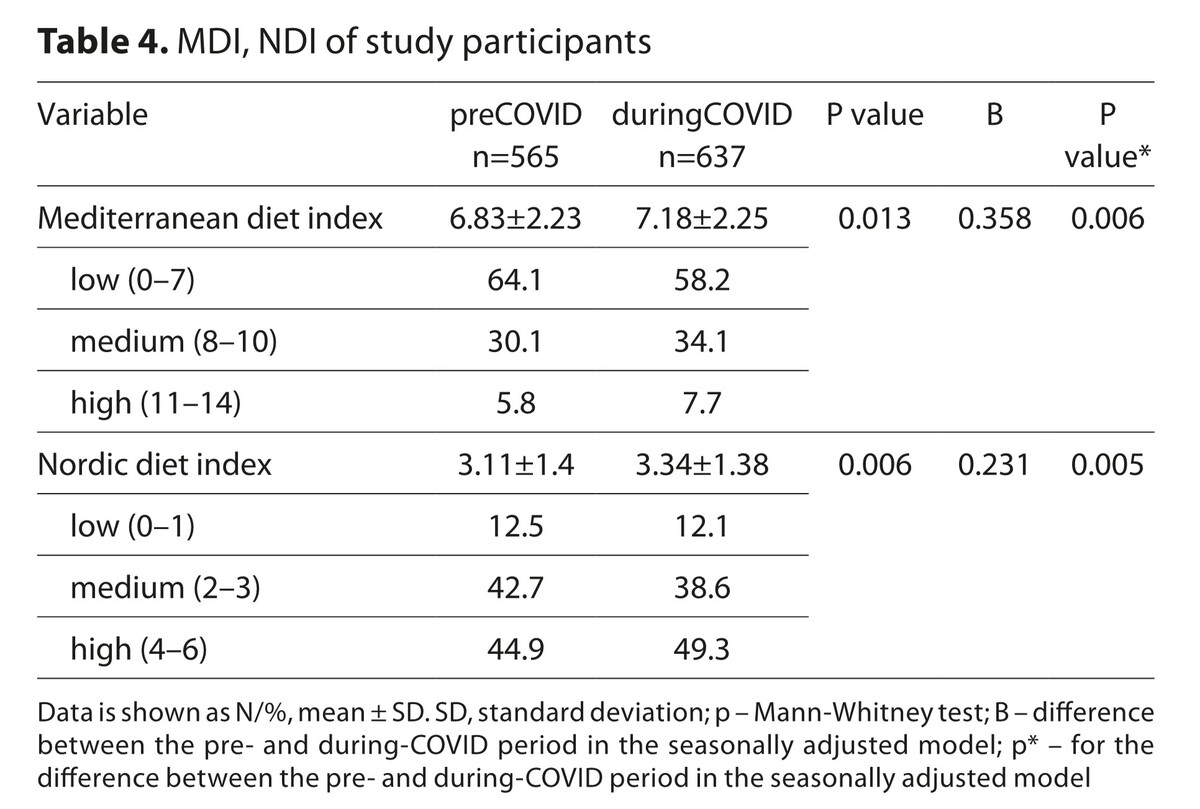
Participants assessed during the pandemic reported higher consumption of vegetables, particularly root and cruciferous types, legumes, and water, and demonstrated greater adherence to Mediterranean and Nordic dietary patterns. At the same time, higher levels of sedentary behaviour and screen exposure were observed. Clinically, the pandemic-period group presented lower waist-to-hip ratio, blood pressure, LDL and HDL cholesterol, and interleukin-6 levels. Despite these objectively more favourable dietary patterns, self-rated diet quality was lower.
Conclusions:
Significant differences in dietary behaviours, lifestyle factors, and selected health parameters were observed between adult populations assessed before and during the COVID-19 pandemic. The findings indicate the coexistence of both beneficial and adverse behavioural patterns, underscoring the importance of integrated public health strategies addressing diet quality, physical activity, and health awareness.
The COVID-19 pandemic has been associated with changes in health-related behaviours, including dietary patterns. The aim of this study was to compare dietary habits, nutritional intake, and selected health parameters in adult populations assessed before and during the COVID-19 pandemic.
Material and methods:
The analysis was based on two groups from the population-based Białystok PLUS cohort: pre-pandemic (n=565) and during-pandemic (n=637). Dietary intake, lifestyle factors, and clinical measurements were compared. Statistical analyses were adjusted for seasonality using IBM SPSS Statistics 27.0.
Results:
Participants assessed during the pandemic reported higher consumption of vegetables, particularly root and cruciferous types, legumes, and water, and demonstrated greater adherence to Mediterranean and Nordic dietary patterns. At the same time, higher levels of sedentary behaviour and screen exposure were observed. Clinically, the pandemic-period group presented lower waist-to-hip ratio, blood pressure, LDL and HDL cholesterol, and interleukin-6 levels. Despite these objectively more favourable dietary patterns, self-rated diet quality was lower.
Conclusions:
Significant differences in dietary behaviours, lifestyle factors, and selected health parameters were observed between adult populations assessed before and during the COVID-19 pandemic. The findings indicate the coexistence of both beneficial and adverse behavioural patterns, underscoring the importance of integrated public health strategies addressing diet quality, physical activity, and health awareness.
PEER REVIEW INFORMATION
Article has been screened for originality
REFERENCES (29)
1.
Del Rio C, Collins LF, Malani P. Long-term health consequences of COVID-19. JAMA. 2020;324(17):1723–1724. doi:10.1001/jama.2020.19719.
2.
Musa S, Dergaa I, Bachiller V, Saad HB. Global implications of COVID-19 pandemic on adults’ lifestyle behavior: the invisible pandemic of noncommunicable disease. Int J Prev Med. 2023;14:15. doi:10.4103/ijpvm.ijpvm_157_21.
3.
Oszajca K, Basińska-Zych A, Szczygieł D, et al. Long-term effects of the COVID-19 pandemic on health behaviors in Europe: a cross-country comparative study. BMC Public Health. 2023;23:1516. doi:10.1186/s12889-023-16023-4.
4.
Rust P, Ekmekcioglu C. The role of diet and specific nutrients during the COVID-19 pandemic: what have we learned over the last three years? Int J Environ Res Public Health. 2023;20(7):5400. doi:10.3390/ijerph20075400.
5.
Wilson K, St-Onge MP, Tasali E. Diet composition and objectively assessed sleep quality: a narrative review. J Acad Nutr Diet. 2022;122(6):1182–1195. doi:10.1016/j.jand.2022.01.007.
6.
de Faria Coelho-Ravagnani C, Corgosinho FC, Sanches FLFZ, et al. Dietary recommendations during the COVID-19 pandemic. Nutr Rev. 2021;79:382–393. doi:10.1093/nutrit/nuaa067.
7.
Halim M, Iddrisu W, Abdul Razak M, et al. Relevance of Mediterranean diet as a nutritional strategy in diminishing COVID-19 risk: a systematic review. PLoS One. 2024;19(5):e0301847. doi:10.1371/journal.pone.0301847.
8.
Moore E, Fadel A, Lane KE. The effects of consuming a Mediterranean-style diet on associated COVID-19 severity biomarkers in obese/overweight adults: a systematic review. Nutr Health. 2022;28(4):647–667. doi:10.1177/02601060221127853.
9.
Olsen A, Egeberg R, Halkjær J, et al. Healthy aspects of the Nordic diet are related to lower total mortality. J Nutr. 2011;141(4):639–644. doi:10.3945/jn.110.131375.
10.
Galbete C, Kröger J, Jannasch F, et al. Nordic diet, Mediterranean diet, and the risk of chronic diseases: the EPIC-Potsdam study. BMC Med. 2018;16:99. doi:10.1186/s12916-018-1082-y.
11.
Reyneke GL, Lambert K, Beck EJ. Food-based indexes and their association with dietary inflammation. Adv Nutr. 2025;16(4):100400. doi:10.1016/j.advnut.2025.100400.
12.
Stefler D, Malyutina S, Kubinova R, et al. Mediterranean diet score and total and cardiovascular mortality in Eastern Europe: the HAPIEE study. Eur J Nutr. 2017;56(1):421–429. doi: 10.1007/s00394-015-1092-x.
13.
Frąckiewicz J, Tarwacka Z, Drywień ME. Changes in diet and physical activity in students during lockdown by example of COVID-19 pandemic. Rocz Panstw Zakl Hig. 2024;75(1):83–91. doi:10.32394/rpzh.2024.0289.
14.
Sheppard JP, Nicholson BD, Lee J, et al. Association between blood pressure control and coronavirus disease 2019 outcomes in 45,418 symptomatic patients with hypertension: an observational cohort study. Hypertension. 2021;77(3):846–855. doi:10.1161/HYPERTENSIONAHA.120.16472.
15.
Smith J, Müller L, Rossi F. Dietary changes during the COVID-19 pandemic in Europe: a systematic review of observational studies. Nutr Res. 2022;101:25–36. doi:10.1016/j.nutres.2022.01.005.
16.
Kucharska A, Sińska B, Panczyk M, et al. Diet and selected elements of lifestyle in the Polish population before and during the COVID-19 pandemic – a population study. Ann Agric Environ Med. 2023;30(1):118–126. doi:10.26444/aaem/156939.
17.
Smith L, Merlo M, Botella-Juan R, et al. Global trends in alcohol consumption before, during and after the COVID-19 pandemic: a meta-analysis. Sci Rep. 2025;15:21712. doi:10.1038/s41598-025-21712-0.
18.
Rodríguez-Pérez C, Molina-Montes E, Verardo V, et al. Changes in dietary behaviours during the COVID-19 outbreak confinement in the Spanish COVIDiet Study. Nutrients. 2020;12(6):1730. doi:10.3390/nu12061730.
19.
Enriquez-Martinez OG, Martins MCT, Pereira TSS, et al. Diet and lifestyle changes during the COVID-19 pandemic in Ibero-American countries: Argentina, Brazil, Mexico, Peru, and Spain. Front Nutr. 2021;8:671004. doi:10.3389/fnut.2021.671004.
20.
Górnicka M, Drywień ME, Zielinska MA, et al. Dietary and lifestyle changes during COVID-19 and the subsequent lockdowns among Polish adults: a cross-sectional online survey. Nutrients. 2020;12(8):2324. doi:10.3390/nu12082324.
21.
Tassakos A, Kloppman A, Louie JCY. The Impact of Diet Quality on COVID-19 Severity and Outcomes – A Scoping Review. Curr Nutr Rep. 2025;14(1):27. doi:10.1007/s13668-025-00618-3.
22.
Mousavi R, Rostami S, Shourideh Yazdi S, et al. The relationship between healthy eating index and Mediterranean diet adherence score with inflammatory indices and disease severity: a case-control study of hospitalized COVID-19 patients. BMC Nutrition. 2024;10(1):168. doi:10.1186/s40795-024-00983-2.
23.
Vu THT, Rydland KJ, Achenbach CJ, et al. Dietary behaviors and incident COVID-19 in the UK Biobank. Nutrients. 2021;13:2114. doi:10.3390/nu13062114.
24.
Kim H, Rebholz CM, Hegde S, et al. Plant-based diets, pescatarian diets and COVID-19 severity: a population-based case-control study in six countries. BMJ Nutr Prev Health. 2021;4(1):257–266. doi:10.1136/bmjnph-2021-000272.
25.
Pellizzeri M, Cioffi CE, Vieira-Potter VJ, et al. Do pandemics influence food choice motives, diet, and health practices? A mixed-methods study. BMC Nutr. 2025;11:59. doi:10.1186/s40795-024-00959-2.
26.
Dreyer JO, Bertsche T, Klasen M. et al. Impacts of the SARS-CoV-2 pandemic on the dietary- and nutrition-related behaviour of students in the German region – a longitudinal study 2020–2022. Front Nutr. 2024;11:1302308. doi:10.3389/fnut.2024.1302308.
27.
Aknin L, De Neve J, Dunn E, et al. The neurological consequences of contracting COVID-19. Acta Neuropsychol. 2021;19(3):301–305. doi:10.5604/01.3001.0014.9953.
28.
Treder-Rochna N, Witkowska M. Neuropsychological consequences of COVID-19: current approach and clinical recommendations. Acta Neuropsychol. 2024;22(1):107–128.doi:10.5604/01.3001.0054.4467.
29.
Łuckoś M, Cielebąk K, Kamiński P. EEG neurofeedback in the treatment of cognitive dysfunctions after the infection of SARS-CoV-2 and long COVID-19. Acta Neuropsychol. 2021;19(3):361–372. doi:10.5604/01.3001.0015.2464.
Share
RELATED ARTICLE
| eISSN: | 1898-2263 |
| ISSN: | 1232-1966 |


Generation of the DOI (Digital Object Identifier) - task financed under the agreement No NrRCN/SP/0532/2021/1 by the Minister of Science and Higher
© 2006-2026 Journal hosting platform by Bentus
We process personal data collected when visiting the website. The function of obtaining information about users and their behavior is carried out by voluntarily entered information in forms and saving cookies in end devices. Data, including cookies, are used to provide services, improve the user experience and to analyze the traffic in accordance with the Privacy policy. Data are also collected and processed by Google Analytics tool (more).
You can change cookies settings in your browser. Restricted use of cookies in the browser configuration may affect some functionalities of the website.
You can change cookies settings in your browser. Restricted use of cookies in the browser configuration may affect some functionalities of the website.