Online first
Current issue
Archive
Special Issues
About the Journal
Publication Ethics
Anti-Plagiarism system
Instructions for Authors
Instructions for Reviewers
Editorial Board
Editorial Office
Contact
Reviewers
All Reviewers
2025
2024
2023
2022
2021
2020
2019
2018
2017
2016
General Data Protection Regulation (RODO)

RESEARCH PAPER
Long noncoding RNA XIST attenuates oxidative stress in hearing loss by regulating miR-454-3p/RARP1
1
Department of Otorhinolaryngology, Huanggang Central Hospital, China
2
E.N.T. Department, The Affiliated Hospital to Changchun University of Chinese Medicine, China
3
Department of Otolaryngology, Affiliated AoYang Hospital of Jiangsu University, China
4
Department of Otolaryngology, Kunshan Women and Children’s Health Care Hospital, China
5
Wards 1–11, Chun’an First People’s Hospital, China
These authors had equal contribution to this work
KEYWORDS
TOPICS
ABSTRACT
Introduction and objective:
Long non-coding RNA XIST is implicated in various diseases, but its role in hearing loss remains unclear. The aim of the study is to investigate the function and molecular mechanism of XIST in oxidative stress-induced cochlear cell damage.
Material and methods:
XIST expression was quantified in clinical samples from presbycusis patients and normal controls. In vitro, the HEI-OC1 cochlear cell line was subjected to glucose oxidase (GO) treatment to mimic injury. XIST expression was knocked down using siRNA. Apoptosis was assessed by flow cytometry. Reactive oxygen species (ROS) levels were measured by DCFH-DA assay. Oxidative stress marker 4-HNE was evaluated. Dual-luciferase reporter assays and RNA pulldown analysis were employed to identify the interactions. Rescue experiments were conducted to elucidate the functional axis.
Results:
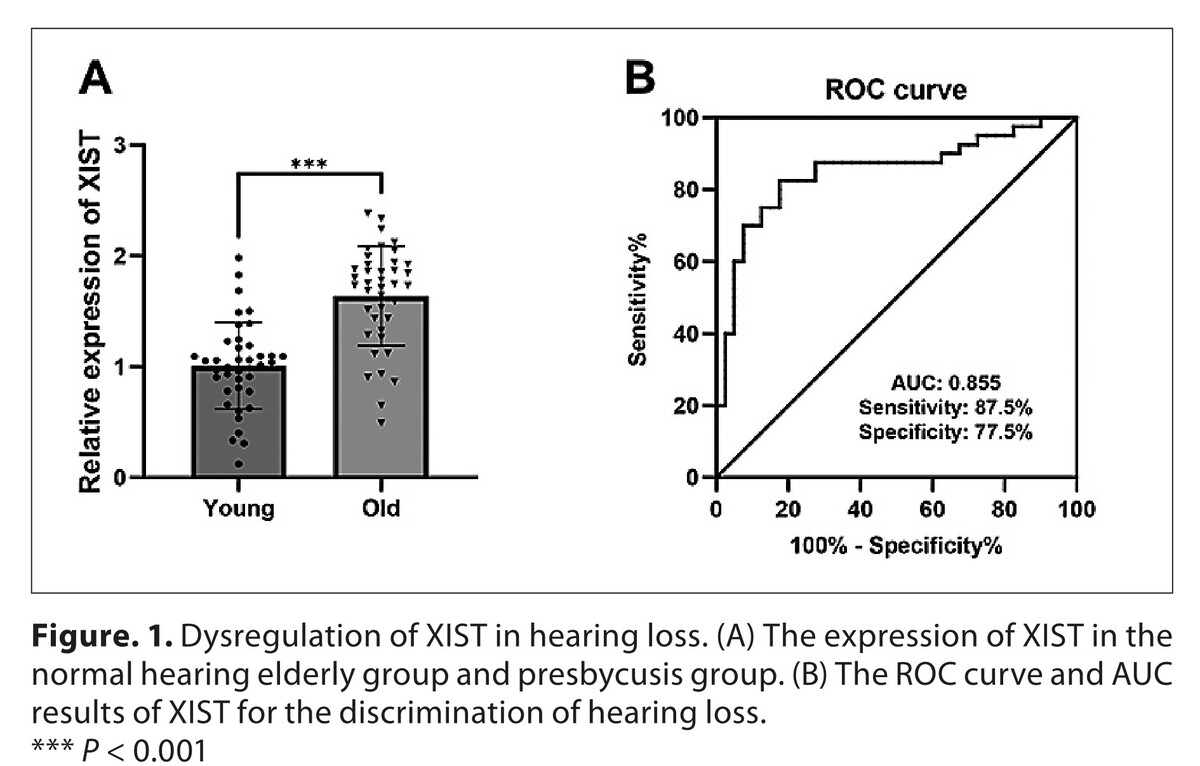
Elevated serum XIST levels in presbycusis patients were associated with a diagnostic AUC of 0.855. In HEI-OC1 cells, XIST knockdown under GO treatment markedly attenuated apoptosis, reduced ROS production, and decreased 4-HNE expression. XIST was confirmed to bind to and sequester miR-454-3p. PARP1 was identified as a direct target of miR-454-3p. MiR-454-3p inhibitor or PARP1 siRNA offset the protective effects of XIST knockdown against oxidative stress and apoptosis.
Conclusions:
LncRNA XIST can exacerbate oxidative stress-induced cochlear cell damage by sponging miR-454-3p and upregulating PARP1 expression.
Long non-coding RNA XIST is implicated in various diseases, but its role in hearing loss remains unclear. The aim of the study is to investigate the function and molecular mechanism of XIST in oxidative stress-induced cochlear cell damage.
Material and methods:
XIST expression was quantified in clinical samples from presbycusis patients and normal controls. In vitro, the HEI-OC1 cochlear cell line was subjected to glucose oxidase (GO) treatment to mimic injury. XIST expression was knocked down using siRNA. Apoptosis was assessed by flow cytometry. Reactive oxygen species (ROS) levels were measured by DCFH-DA assay. Oxidative stress marker 4-HNE was evaluated. Dual-luciferase reporter assays and RNA pulldown analysis were employed to identify the interactions. Rescue experiments were conducted to elucidate the functional axis.
Results:
Elevated serum XIST levels in presbycusis patients were associated with a diagnostic AUC of 0.855. In HEI-OC1 cells, XIST knockdown under GO treatment markedly attenuated apoptosis, reduced ROS production, and decreased 4-HNE expression. XIST was confirmed to bind to and sequester miR-454-3p. PARP1 was identified as a direct target of miR-454-3p. MiR-454-3p inhibitor or PARP1 siRNA offset the protective effects of XIST knockdown against oxidative stress and apoptosis.
Conclusions:
LncRNA XIST can exacerbate oxidative stress-induced cochlear cell damage by sponging miR-454-3p and upregulating PARP1 expression.
PEER REVIEW INFORMATION
Article has been screened for originality
REFERENCES (33)
1.
Baumgartner WD, Gavilán J, Benghalem A, et al. Experts’ discussion: implications of the World Health Organization’s World report on hearing for the cochlear implant field. Brazilian J Otorhinolaryngol. 2025;91(2):101556.
2.
Kitoh R, Nishio SY, Sato H, et al. Clinical practice guidelines for the diagnosis and management of acute sensorineural hearing loss. Auris, nasus, larynx. 2024;51(4):811–21.
3.
Ege T, Tao L, North BJ. The Role of Molecular and Cellular Aging Pathways on Age-Related Hearing Loss. Inter J Molec Sci. 2024;25(17).
4.
Tudeen M, Williams MP, Orlando FA, Malaty J. Otology: Hearing Loss. FP essentials. 2024;542:7–13.
5.
Babajanian EE, Gurgel RK. Cognitive and behavioral effects of hearing loss. Curr Opin Otolaryngol Head Neck Surg. 2022;30(5):339–43.
6.
Herrmann B, Butler BE. Hearing loss and brain plasticity: the hyperactivity phenomenon. Brain Str Function. 2021;226(7):2019–39.
7.
Ono M, Ito T. Hearing loss-related altered neuronal activity in the inferior colliculus. Hear Res. 2024;449:109033.
8.
Yuan C, Ma T, Liu M, et al. Ferroptosis, oxidative stress and hearing loss: Mechanistic insights and therapeutic opportunities. Heliyon. 2024;10(20):e38553.
9.
Maniaci A, La Via L, Lechien JR, et al. Hearing Loss and Oxidative Stress: A Comprehensive Review. Antioxidants (Basel, Switzerland). 2024;13(7).
10.
Yang W, Zhao X, Chai R, Fan J. Progress on mechanisms of age-related hearing loss. Front Neurosci. 2023;17:1253574.
11.
Meng L, Liu S, Luo J, et al. Oxidative stress and reactive oxygen species in otorhinolaryngological diseases: insights from pathophysiology to targeted antioxidant therapies. Redox Rep. 2025;30(1):2458942.
12.
Tan WJT, Song L. Role of mitochondrial dysfunction and oxidative stress in sensorineural hearing loss. Hear Res. 2023;434:108783.
13.
Li Y, Zhao T, Li J, et al. Oxidative Stress and 4-hydroxy-2-nonenal (4-HNE): Implications in the Pathogenesis and Treatment of Aging-related Diseases. J Immunol Res. 2022;2022:2233906.
14.
Wen JF, Jiang YQ, Li C, et al. LncRNA-XIST promotes the oxidative stress-induced migration, invasion, and epithelial-to-mesenchymal transition of osteosarcoma cancer cells through miR-153-SNAI1 axis. Cell Biol Inter. 2020;44(10):1991–2001.
15.
Chen Z, Dai Y, Lai Y, et al. Exploring the XIST axis as oxidative stress-related signatures in systemic lupus erythematosus. Clin Exp Rheumatol. 2024;42(1):145–56.
16.
Lv P, Liu H, Ye T, et al. XIST Inhibition Attenuates Calcium Oxalate Nephrocalcinosis-Induced Renal Inflammation and Oxidative Injury via the miR-223/NLRP3 Pathway. Oxid Med Cell Longev. 2021;2021:1676152.
17.
Wang J, Fu Z, Wang M, et al. Knockdown of XIST Attenuates Cerebral Ischemia/Reperfusion Injury Through Regulation of miR-362/ROCK2 Axis. Neurochem Res. 2021;46(8):2167–80.
18.
Xu Y, Kang X, Liu H, et al. LncRNA XIST promotes insulin resistance in gestational diabetes mellitus via the microRNA-181b-5p/NDRG2 axis. Gen Physiol Biophys. 2023;42(5):443–55.
19.
Zhang Z, Zhu D, Shi P, et al. LncRNA XIST knockdown reduces myocardial damage in myocarditis by targeting the miR-140-3p/RIPK1 axis. Biotechnol Genet Eng Rev. 2024;40(3):1425–37.
20.
Wang H, Li Y, Jiang S, et al. LncRNA xist regulates sepsis associated neuroinflammation in the periventricular white matter of CLP rats by miR-122-5p/PKCη Axis. Front Immunol. 2023;14:1225482.
21.
Luo XB, Li LT, Xi JC, et al. Negative pressure promotes macrophage M1 polarization after Mycobacterium tuberculosis infection via the lncRNA XIST/microRNA-125b-5p/A20/NF-κB axis. Ann N Y Acad Sci. 2022;1514(1):116–31.
22.
Wang E, Li Y, Li H, et al. METTL3 Reduces Oxidative Stress-induced Apoptosis in Presbycusis by Regulating the N6-methyladenosine Level of SIRT1 mRNA. Neurosci. 2023;521:110–22.
23.
Lewis MA, Di Domenico F, Ingham NJ, Prosser HM, Steel KP. Hearing impairment due to Mir183/96/182 mutations suggests both loss and gain of function effects. Dis Model Mechanisms. 2020;14(2).
24.
Zhu K, Wang T, Li S, et al. NcRNA: key and potential in hearing loss. Front Neurosci. 2023;17:1333131.
25.
Xie W, Shu T, Peng H, et al. LncRNA H19 inhibits oxidative stress injury of cochlear hair cells by regulating miR-653-5p/SIRT1 axis. Acta biochimica et biophysica Sinica. 2022;54(3):332–9.
26.
Li Q, Zang Y, Sun Z, Zhang W, Liu H. Long noncoding RNA Gm44593 attenuates oxidative stress from age-related hearing loss by regulating R-29b/WNK1. Bioengineered. 2022;13(1):573–82.
27.
Wang W, Min L, Qiu X, et al. Biological Function of Long Non-coding RNA (LncRNA) Xist. Front Cell Develop Biol. 2021;9:645647.
28.
Jacobson EC, Pandya-Jones A, Plath K. A lifelong duty: how Xist maintains the inactive X chromosome. Curr Opin Gen Develop. 2022;75:101927.
29.
Fetoni AR, Pisani A, Rolesi R, et al. Early Noise-Induced Hearing Loss Accelerates Presbycusis Altering Aging Processes in the Cochlea. Front Aging Neurosci. 2022;14:803973.
30.
Wang E, Li Y, Li H, et al. METTL3 Reduces Oxidative Stress-induced Apoptosis in Presbycusis by Regulating the N6-methyladenosine Level of SIRT1 mRNA. Neurosci. 2023;521:110–2.
31.
Wan H, Chen H, Liu J, et al. PARP1 inhibition prevents oxidative stress in age-related hearing loss via PAR-Ca(2+)-AIF axis in cochlear strial marginal cells. Free Radic Biol Med. 2024;220:222–35.
32.
Zhang T, Han H, Zhou Y, et al. MicroRNA-454 modulates the oxidative stress and neuronal apoptosis after cerebral ischemia/reperfusion injury via targeting NADPH oxidase 4 (NOX4). J Biochem Molec Toxicol. 2022;36(10):e23153.
33.
Naciri I, Liang M, Yang Y, et al. Loss of XIST lncRNA unlocks stemness and cellular plasticity in ovarian cancer. Proc National Acad Sci. 2024;121(47):e2418096121.
Share
RELATED ARTICLE
| eISSN: | 1898-2263 |
| ISSN: | 1232-1966 |


Generation of the DOI (Digital Object Identifier) - task financed under the agreement No NrRCN/SP/0532/2021/1 by the Minister of Science and Higher
© 2006-2026 Journal hosting platform by Bentus
We process personal data collected when visiting the website. The function of obtaining information about users and their behavior is carried out by voluntarily entered information in forms and saving cookies in end devices. Data, including cookies, are used to provide services, improve the user experience and to analyze the traffic in accordance with the Privacy policy. Data are also collected and processed by Google Analytics tool (more).
You can change cookies settings in your browser. Restricted use of cookies in the browser configuration may affect some functionalities of the website.
You can change cookies settings in your browser. Restricted use of cookies in the browser configuration may affect some functionalities of the website.