Online first
Current issue
Archive
Special Issues
About the Journal
Publication Ethics
Anti-Plagiarism system
Instructions for Authors
Instructions for Reviewers
Editorial Board
Editorial Office
Contact
Reviewers
All Reviewers
2025
2024
2023
2022
2021
2020
2019
2018
2017
2016
General Data Protection Regulation (RODO)

RESEARCH PAPER
Criticism of the proposed subject ‘Health Education’ in schools in Poland – the role of socio-demographic, regional, and health knowledge factors
1
Faculty of Medicine, John Paul II Catholic University, Lublin, Poland
2
Department of Paediatric Endocrinology and Diabology with Endocrine–Metabolic Laboratory, Medical University, Lublin, Poland
3
Medical Institute, Jan Grodek State University, Sanok, Poland
Corresponding author
Witold Piotr Kołłątaj
Department of Paediatric Endocrinology and Diabology with Endocrine–Metabolic Laboratory, Medical University of Lublin, Gębali 6, 20-093, Lublin, Poland
Department of Paediatric Endocrinology and Diabology with Endocrine–Metabolic Laboratory, Medical University of Lublin, Gębali 6, 20-093, Lublin, Poland
Ann Agric Environ Med. 2026;33(3):379-384
KEYWORDS
health educationpublic opinionhealth education curriculumhealth knowledgepublic criticismregional differences
TOPICS
ABSTRACT
Introduction and objective:
Public attitudes may affect the implementation of school health reforms. The aim of the study is to examine whether perceived reasons for public criticism of Poland’s proposed Health Education curriculum varied by socio-demographic, regional, educational, and health-knowledge characteristics.
Material and methods:
A 2025 cross-sectional survey included 1,094 adults recruited by convenience sampling in three provinces. Analyses included 1,046 respondents who declared at least some familiarity with the proposal. In a single-choice item, respondents selected one of four categories of reasons for public criticism: substantive, political, ideological, or other. Associations were tested using Pearson’s chi-square test and Cramér’s V, while age was compared using the Kruskal–Wallis test.
Results:
Perceived reasons for public criticism varied by place of residence, province, educational attainment, and health-knowledge level; all effect sizes were small. Substantive responses were more frequent among respondents with higher education than among those with secondary or vocational education, and among respondents with higher health-knowledge levels. Age, household size, self-rated health, and status as a parent or legal guardian of a school-age child, were not significantly associated with the selected category.
Conclusions:
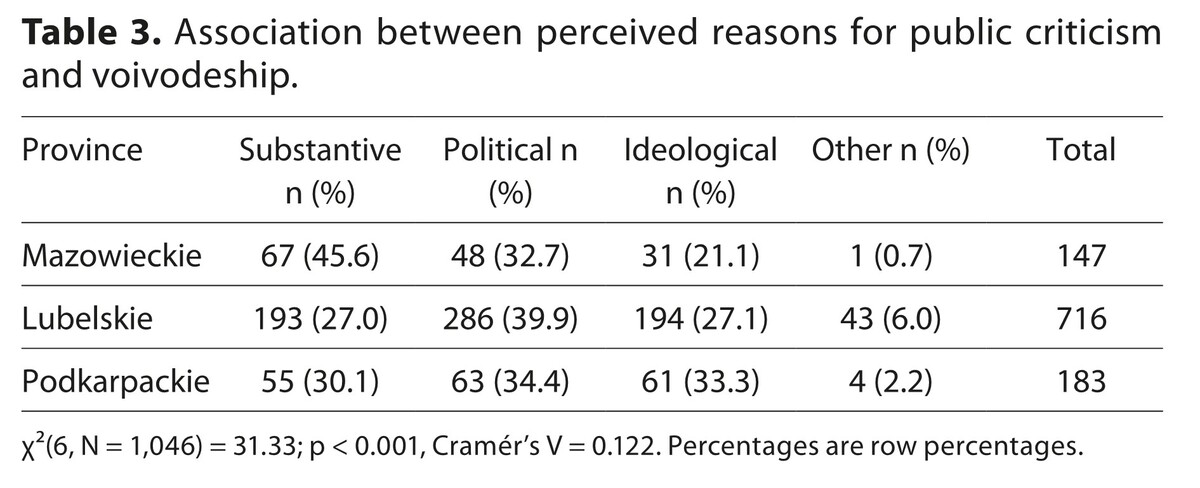
Province showed the strongest association with respondents’ perceptions, although the effect size remained small. Substantive explanations were more frequent in Mazowieckie and political explanations in Lubelskie, whereas ideological explanations were more frequent in Podkarpackie than in the other two provinces. Place of residence, educational attainment, and health-knowledge level showed weaker associations, suggesting that no single factor examined adequately accounts for the observed variation.
Public attitudes may affect the implementation of school health reforms. The aim of the study is to examine whether perceived reasons for public criticism of Poland’s proposed Health Education curriculum varied by socio-demographic, regional, educational, and health-knowledge characteristics.
Material and methods:
A 2025 cross-sectional survey included 1,094 adults recruited by convenience sampling in three provinces. Analyses included 1,046 respondents who declared at least some familiarity with the proposal. In a single-choice item, respondents selected one of four categories of reasons for public criticism: substantive, political, ideological, or other. Associations were tested using Pearson’s chi-square test and Cramér’s V, while age was compared using the Kruskal–Wallis test.
Results:
Perceived reasons for public criticism varied by place of residence, province, educational attainment, and health-knowledge level; all effect sizes were small. Substantive responses were more frequent among respondents with higher education than among those with secondary or vocational education, and among respondents with higher health-knowledge levels. Age, household size, self-rated health, and status as a parent or legal guardian of a school-age child, were not significantly associated with the selected category.
Conclusions:
Province showed the strongest association with respondents’ perceptions, although the effect size remained small. Substantive explanations were more frequent in Mazowieckie and political explanations in Lubelskie, whereas ideological explanations were more frequent in Podkarpackie than in the other two provinces. Place of residence, educational attainment, and health-knowledge level showed weaker associations, suggesting that no single factor examined adequately accounts for the observed variation.
PEER REVIEW INFORMATION
Article has been screened for originality
REFERENCES (24)
1.
International Commission on the Futures of Education. Reimagining our futures together: a new social contract for education. Paris: UNESCO; 2021. https://doi.org/10.54675/ASRB4....
2.
OECD. Trends shaping education 2025. Paris: OECD Publishing; 2025. https://doi.org/10.1787/ee6587....
3.
Dodd S, Widnall E, Russell AE, et al. School-based peer education interventions to improve health: a global systematic review of effectiveness. BMC Public Health. 2022;22:2247. https://doi.org/10.1186/s12889....
4.
de Medeiros GCBS, de Azevedo KPM, Garcia D, et al. Effect of school-based food and nutrition education interventions on the food consumption of adolescents: a systematic review and meta-analysis. Int J Environ Res Public Health. 2022;19(17):10522. https://doi.org/10.3390/ijerph....
5.
Ma KKY, Burn AM, Anderson JK. Review: School-based mental health literacy interventions to promote help-seeking: a systematic review. Child Adolesc Ment Health. 2023;28(3):408–424. https://doi.org/10.1111/camh.1....
6.
Kolbe LJ. The future of school health education in the United States: an ontology. J Sch Health. 2024;94(7):661–673. https://doi.org/10.1111/josh.1....
7.
van der Linden S. Misinformation: susceptibility, spread, and interventions to immunize the public. Nat Med. 2022;28(3):460–467. https://doi.org/10.1038/s41591....
8.
Nutbeam D, Lloyd JE. Understanding and responding to health literacy as a social determinant of health. Annu Rev Public Health. 2021;42:159–173. https://doi.org/10.1146/annure....
9.
Stimpson JP, Park S, Adhikari EH, et al. Perceived health misinformation on social media and public trust in health care. Med Care. 2025;63(9):686–693. https://doi.org/10.1097/MLR.00....
10.
Lohan M, López A. Comprehensive sexuality education: an overview of the international systematic review evidence. Paris: UNESCO; 2023. https://unesco.org.uk/resource... [access: 2026.08.12].
11.
Efe H, Umdu Topsakal Ü. Public opinion study on school health education programs: family needs assessment study. Int J Environ Res Public Health. 2025;22(7):1088. https://doi.org/10.3390/ijerph....
12.
Freeman JL, Caldwell PHY, Scott KM. How adolescents trust health information on social media: a systematic review. Acad Pediatr. 2023;23(4):703–719. https://doi.org/10.1016/j.acap....
13.
Powell J, Pring T. The impact of social media influencers on health outcomes: a systematic review. Soc Sci Med. 2024;340:116472. https://doi.org/10.1016/j.socs....
14.
Niederdeppe J, Boyd AD, King AJ, et al. Strategies for effective public health communication in a complex information environment. Annu Rev Public Health. 2025;46:411–431. https://doi.org/10.1146/annure....
15.
Kołłątaj B, Kołłątaj WP, Wasiewicz J, et al. Public response to the proposed ‘Health Education’ subject in schools in Poland – attitudes, curriculum familiarity, and information sources. Ann Agric Environ Med. 2026. https://doi.org/10.26444/aaem/.... Epub 22 Jul 2026.
16.
Swire-Thompson B, Lazer D. Public health and online misinformation: challenges and recommendations. Annu Rev Public Health. 2020;41:433–451. https://doi.org/10.1146/annure....
17.
Gouëdard P, Pont B, Hyttinen S, et al. Curriculum reform: a literature review to support effective implementation. OECD Education Working Papers, No. 239. Paris: OECD Publishing; 2020. https://doi.org/10.1787/efe8a4....
18.
WHO Regional Office for Europe. Health literacy in the context of health, well-being and learning outcomes: the case of children and adolescents in schools. Copenhagen: WHO Regional Office for Europe; 2021. https://www.who.int/europe/pub... [access: 2026.08.12].
19.
Rueskov V, Korshøj M, Lund T, et al. Health literacy among socioeconomically disadvantaged adolescents: a systematic review of interventions in schools. Adolesc Res Rev. 2026;11(1):1–47. https://doi.org/10.1007/s40894....
20.
El Kazdouh H, El-Ammari A, Bouftini S, et al. Teachers’ perceptions of health education and middle school curriculum: a qualitative study. Teach Teach Educ. 2022;117:103765. https://doi.org/10.1016/j.tate....
21.
World Health Organization. Making every school a health-promoting school: implementation guidance for school health services. Geneva: World Health Organization; 2026. https://www.who.int/publicatio... [access: 2026.08.12].
22.
World Health Organization, United Nations Educational, Scientific and Cultural Organization. Making every school a health-promoting school: global standards and indicators. Geneva: World Health Organization and UNESCO; 2021. https://www.who.int/publicatio... [access: 2026.08.12].
23.
Rickwood D, Coleman-Rose CL. The effect of survey administration mode on youth mental health measures: social desirability bias and sensitive questions. Heliyon. 2023;9(9):e20131. https://doi.org/10.1016/j.heli....
24.
Bispo Júnior JP. Social desirability bias in qualitative health research. Rev Saude Publica. 2022;56:101. https://doi.org/10.11606/s1518....
Share
RELATED ARTICLE
| eISSN: | 1898-2263 |
| ISSN: | 1232-1966 |


Generation of the DOI (Digital Object Identifier) - task financed under the agreement No NrRCN/SP/0532/2021/1 by the Minister of Science and Higher
© 2006-2026 Journal hosting platform by Bentus
We process personal data collected when visiting the website. The function of obtaining information about users and their behavior is carried out by voluntarily entered information in forms and saving cookies in end devices. Data, including cookies, are used to provide services, improve the user experience and to analyze the traffic in accordance with the Privacy policy. Data are also collected and processed by Google Analytics tool (more).
You can change cookies settings in your browser. Restricted use of cookies in the browser configuration may affect some functionalities of the website.
You can change cookies settings in your browser. Restricted use of cookies in the browser configuration may affect some functionalities of the website.