Online first
Current issue
Archive
Special Issues
About the Journal
Publication Ethics
Anti-Plagiarism system
Instructions for Authors
Instructions for Reviewers
Editorial Board
Editorial Office
Contact
Reviewers
All Reviewers
2025
2024
2023
2022
2021
2020
2019
2018
2017
2016
General Data Protection Regulation (RODO)

RESEARCH PAPER
Public response to the proposed ‘Health Education’ subject in schools in Poland – attitudes, curriculum familiarity, and information sources
1
Faculty of Medicine, John Paul II Catholic University, Lublin, Poland
2
Department of Paediatric Endocrinology and Diabology with Endocrine–Metabolic Laboratory, Medical University of Lublin, Poland
3
Medical Institute, Jan Grodek State University, Sanok, Poland
Corresponding author
Witold Piotr Kołłątaj
Klinika Endokrynologii i Diabetologii Dziecięcej z Pracownią Endokrynologiczno-Metaboliczną, Uniwersytet Medyczny w Lublinie, Gębali 6, 20-093, Lublin, Poland
Klinika Endokrynologii i Diabetologii Dziecięcej z Pracownią Endokrynologiczno-Metaboliczną, Uniwersytet Medyczny w Lublinie, Gębali 6, 20-093, Lublin, Poland
Ann Agric Environ Med. 2026;33(3):373-378
KEYWORDS
TOPICS
ABSTRACT
Introduction and objective:
Public attitudes may affect implementation of school-based health promotion. In Poland, the proposed new subject ‘Health Education’ has been widely debated. The aim of the study is to assesses public response to this reform, including perceived health-related knowledge, curriculum evaluation and familiarity, reported information sources, and implementation preferences.
Material and methods:
A cross-sectional survey was conducted in 2025 among 1,094 adults from three Polish regions. A 32-item questionnaire assessed self-reported health-related knowledge, attitudes toward the reform, curriculum evaluation and familiarity, information sources, and implementation preferences. Descriptive statistics, Pearson’s chi-square test, and Cramér’s V were used.
Results:
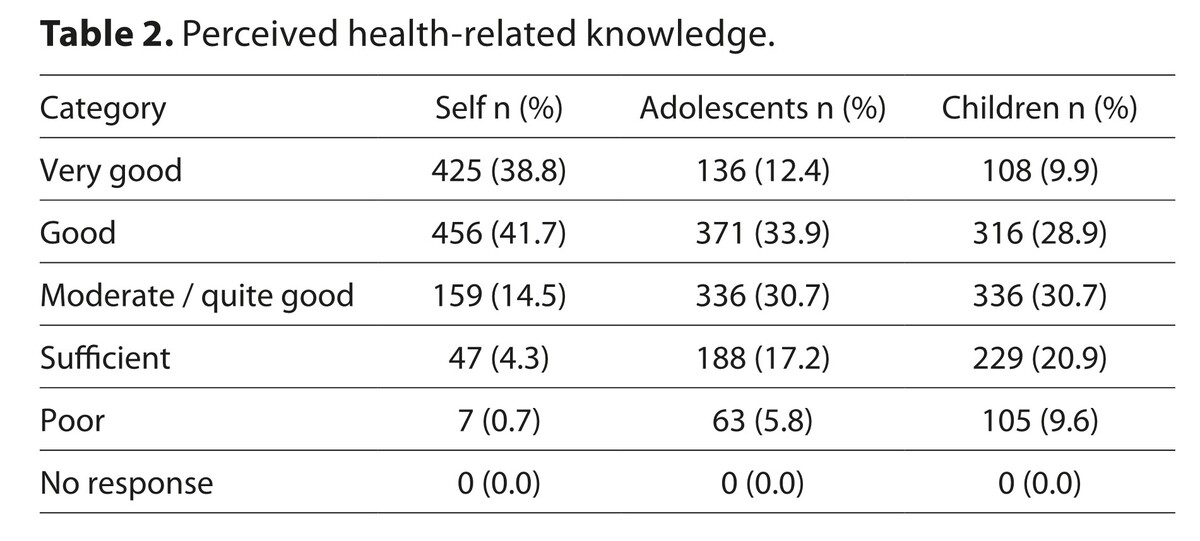
Most respondents assessed their health-related knowledge positively, whereas evaluations concerning children and adolescents were less favourable. Overall, 51.9% supported changes in health education. Familiarity with the proposed curriculum was limited, with 57.3% reporting no or only superficial familiarity. Despite this, attitudes toward the proposed curriculum remained clearly divided, while 33.7% expressed no opinion. The most frequently preferred option was introducing the subject as optional.
Conclusions:
Although respondents generally recognized the need for changes in health education, attitudes toward the proposed curriculum remained divided despite limited familiarity with its content. Since most respondents indicated indirect or non-official information sources, declared opinions should be interpreted with caution, as the credibility, completeness, and fidelity of these sources to the official curriculum could not be verified.
Public attitudes may affect implementation of school-based health promotion. In Poland, the proposed new subject ‘Health Education’ has been widely debated. The aim of the study is to assesses public response to this reform, including perceived health-related knowledge, curriculum evaluation and familiarity, reported information sources, and implementation preferences.
Material and methods:
A cross-sectional survey was conducted in 2025 among 1,094 adults from three Polish regions. A 32-item questionnaire assessed self-reported health-related knowledge, attitudes toward the reform, curriculum evaluation and familiarity, information sources, and implementation preferences. Descriptive statistics, Pearson’s chi-square test, and Cramér’s V were used.
Results:
Most respondents assessed their health-related knowledge positively, whereas evaluations concerning children and adolescents were less favourable. Overall, 51.9% supported changes in health education. Familiarity with the proposed curriculum was limited, with 57.3% reporting no or only superficial familiarity. Despite this, attitudes toward the proposed curriculum remained clearly divided, while 33.7% expressed no opinion. The most frequently preferred option was introducing the subject as optional.
Conclusions:
Although respondents generally recognized the need for changes in health education, attitudes toward the proposed curriculum remained divided despite limited familiarity with its content. Since most respondents indicated indirect or non-official information sources, declared opinions should be interpreted with caution, as the credibility, completeness, and fidelity of these sources to the official curriculum could not be verified.
PEER REVIEW INFORMATION
Article has been screened for originality
REFERENCES (25)
1.
Gouëdard P, Pont B, Hyttinen S, et al. Curriculum reform: a literature review to support effective implementation. OECD Education Working Papers No. 239. Paris: OECD Publishing; 2020. https://doi.org/10.1787/efe8a4....
2.
Nutbeam D, Lloyd JE. Understanding and responding to health literacy as a social determinant of health. Annu Rev Public Health. 2021;42:159–173. https://doi.org/10.1146/annure....
3.
World Health Organization. Health literacy development for the prevention and control of noncommunicable diseases. Geneva: WHO; 2022. https://www.who.int/publicatio... (access: 2026.05.13).
4.
Viner RM, Ozer EM, Denny S, et al. Adolescence and the social determinants of health. Lancet. 2012;379(9826):1641–1652. https://doi.org/10.1016/S0140-....
5.
World Health Organization, UNESCO. Making every school a health-promoting school: global standards and indicators. Geneva: WHO; 2021. https://iris.who.int/handle/10... (access: 2026.05.13).
6.
World Health Organization. Infodemic management in COVID-19 and beyond. Geneva: WHO; 2020. https://www.who.int/publicatio... (access: 2026.05.13).
7.
Zarocostas J. How to fight an infodemic. Lancet. 2020;395(10225):676. https://doi.org/10.1016/S0140-....
8.
Swire-Thompson B, Lazer D. Public health and online misinformation: challenges and recommendations. Annu Rev Public Health. 2020;41:433–451. https://doi.org/10.1146/annure....
9.
Boer M, Stevens GWJM, Finkenauer C, et al. Social media use intensity, social media use problems, and mental health among adolescents: investigating directionality and mediating processes. Comput Human Behav. 2021;116:106645. https://doi.org/10.1016/j.chb.....
10.
UNICEF. The State of the World’s Children 2021: On My Mind – Promoting, Protecting and Caring for Children’s Mental Health. New York: UNICEF; 2021. https://www.unicef.org/reports... (access: 2026.05.13).
11.
Odgers CL, Jensen MR. Annual Research Review: adolescent mental health in the digital age. J Child Psychol Psychiatry. 2020;61(3):336–348. https://doi.org/10.1111/jcpp.1....
12.
Komenda Główna Policji. Zamachy samobójcze od 2020 roku [Suicide attempts since 2020]. Warszawa: KGP; 2024. https://statystyka.policja.pl/... (access: 2026.05.13).
13.
World Health Organization, UNESCO. Global standards and indicators for health-promoting schools and systems. Geneva: WHO; 2021. https://www.who.int/docs/defau... (access: 2026.05.13).
14.
Okan O, Messer M, Levin-Zamir D, et al. Health literacy as a social vaccine in the COVID-19 pandemic. Health Promot Int. 2023;38(4). https://doi.org/10.1093/heapro....
15.
World Health Organization. Health Promoting Schools framework: implementation guide. Geneva: WHO; 2021. https://www.who.int/publicatio... (access: 2026.05.13).
16.
Ministerstwo Edukacji Narodowej. Nowe ramowe plany nauczania – z edukacją obywatelską i edukacją zdrowotną. Warszawa: Ministerstwo Edukacji Narodowej; 2025. https://www.gov.pl/web/edukacj... (access: 2026.05.28). See also: Minister Edukacji. Rozporządzenie Ministra Edukacji z dnia 12 marca 2025 r. zmieniające rozporządzenie w sprawie ramowych planów nauczania dla publicznych szkół. Dz U. 2025; poz. 363.
17.
van der Linden S. Misinformation: susceptibility, spread, and interventions to immunize the public. Nat Med. 2022;28:460–467. https://doi.org/10.1038/s41591....
18.
Freeman JL, Caldwell PHY, Scott KM. How adolescents trust health information on social media: a systematic review. Acad Pediatr. 2023;23(4):703–719. https://doi.org/10.1016/j.acap....
19.
Sørensen K, Okan O, Levin-Zamir D, et al. Health literacy in the context of health, well-being and learning outcomes among children and adolescents: a systematic scoping review. BMC Public Health. 2021;21:1886. https://doi.org/10.1186/s12889....
20.
Brodowska-Szewczuk J. Literature review and analysis of research conducted in Europe on health literacy. Zesz Nauk UPH Siedlce. 2023;61. https://doi.org/10.34739/zn.20....
21.
Orben A, Meier A, Dalgleish T, et al. Mechanisms linking social media use to adolescent mental health vulnerability. Nat Rev Psychol. 2024;3:407–423. https://doi.org/10.1038/s44159....
22.
Valkenburg PM, Meier A, Beyens I. Social media use and its impact on adolescent mental health: an umbrella review of the evidence. Curr Opin Psychol. 2022;44:58–68. https://doi.org/10.1016/j.cops....
23.
Korporowicz-Żmichowska V. Nierówności w health literacy – aspekty przestrzenne i edukacyjne. Nierówności Społeczne a Wzrost Gospodarczy. 2023;1(73):72–85. https://doi.org/10.15584/nsawg....
24.
Smoła P, Zwierczyk U, Duplaga M. Transactional e-health literacy and its association with e-health services use in Polish adults: a cross-sectional study. Front Digit Health. 2024;6:1458650. https://doi.org/10.3389/fdgth.....
25.
Leksy K, Nawój-Połoczańska J, Skowrońska-Pućka A. Ocena alfabetyzmu zdrowotnego studentów na podstawie kwestionariusza Health Literacy Questionnaire (HLQ) – badania wstępne [Assessment of students’ health literacy using the Health Literacy Questionnaire (HLQ): preliminary study]. Stud Eduk. 2023;69:57–76. https://doi.org/10.14746/se.20....
Share
RELATED ARTICLE
| eISSN: | 1898-2263 |
| ISSN: | 1232-1966 |


Generation of the DOI (Digital Object Identifier) - task financed under the agreement No NrRCN/SP/0532/2021/1 by the Minister of Science and Higher
© 2006-2026 Journal hosting platform by Bentus
We process personal data collected when visiting the website. The function of obtaining information about users and their behavior is carried out by voluntarily entered information in forms and saving cookies in end devices. Data, including cookies, are used to provide services, improve the user experience and to analyze the traffic in accordance with the Privacy policy. Data are also collected and processed by Google Analytics tool (more).
You can change cookies settings in your browser. Restricted use of cookies in the browser configuration may affect some functionalities of the website.
You can change cookies settings in your browser. Restricted use of cookies in the browser configuration may affect some functionalities of the website.