Online first
Current issue
Archive
Special Issues
About the Journal
Publication Ethics
Anti-Plagiarism system
Instructions for Authors
Instructions for Reviewers
Editorial Board
Editorial Office
Contact
Reviewers
All Reviewers
2025
2024
2023
2022
2021
2020
2019
2018
2017
2016
General Data Protection Regulation (RODO)

REVIEW PAPER
Bioindicators as a fundamental element for assessing the state of forest and agrarian ecosystems

1
Department of Breeding and Diseases of Game, Fish and Bees, Ecology and Cynology, University of Veterinary Medicine and Pharmacy, Košice, Slovak Republic
2
UTEMS, Technical University, Košice, Slovak Republic
Corresponding author
Terézia Pošiváková
Department of Breeding and Diseases of Game, Fish and Bees, Ecology and Cynology, University of Veterinary Medicine and Pharmacy in Kosice, Komenského 73, 04181, Košice, Slovak Republic
Department of Breeding and Diseases of Game, Fish and Bees, Ecology and Cynology, University of Veterinary Medicine and Pharmacy in Kosice, Komenského 73, 04181, Košice, Slovak Republic
Ann Agric Environ Med. 2026;33(2):149-153
KEYWORDS
TOPICS
- Biological agents posing occupational risk in agriculture, forestry, food industry and wood industry and diseases caused by these agents (zoonoses, allergic and immunotoxic diseases)
- Work-related accidents and injuries in agriculture, forestry, food industry and wood industry: incidence, causes, social aspects and prevention
- State of the health of rural communities depending on various factors: social factors, accessibility of medical care, etc.
ABSTRACT
Introduction and objective:
The negative impact of pollutants on organisms is complex and still insufficiently investigated. This is caused by the diversity of organisms and by the high variability of the composition of foreign substances and their synergistic effects on each organism. The mechanisms by which living organisms are damaged differ depending on the type, intensity, and duration of the stress factor and interaction with biotic factors.
Review methods:
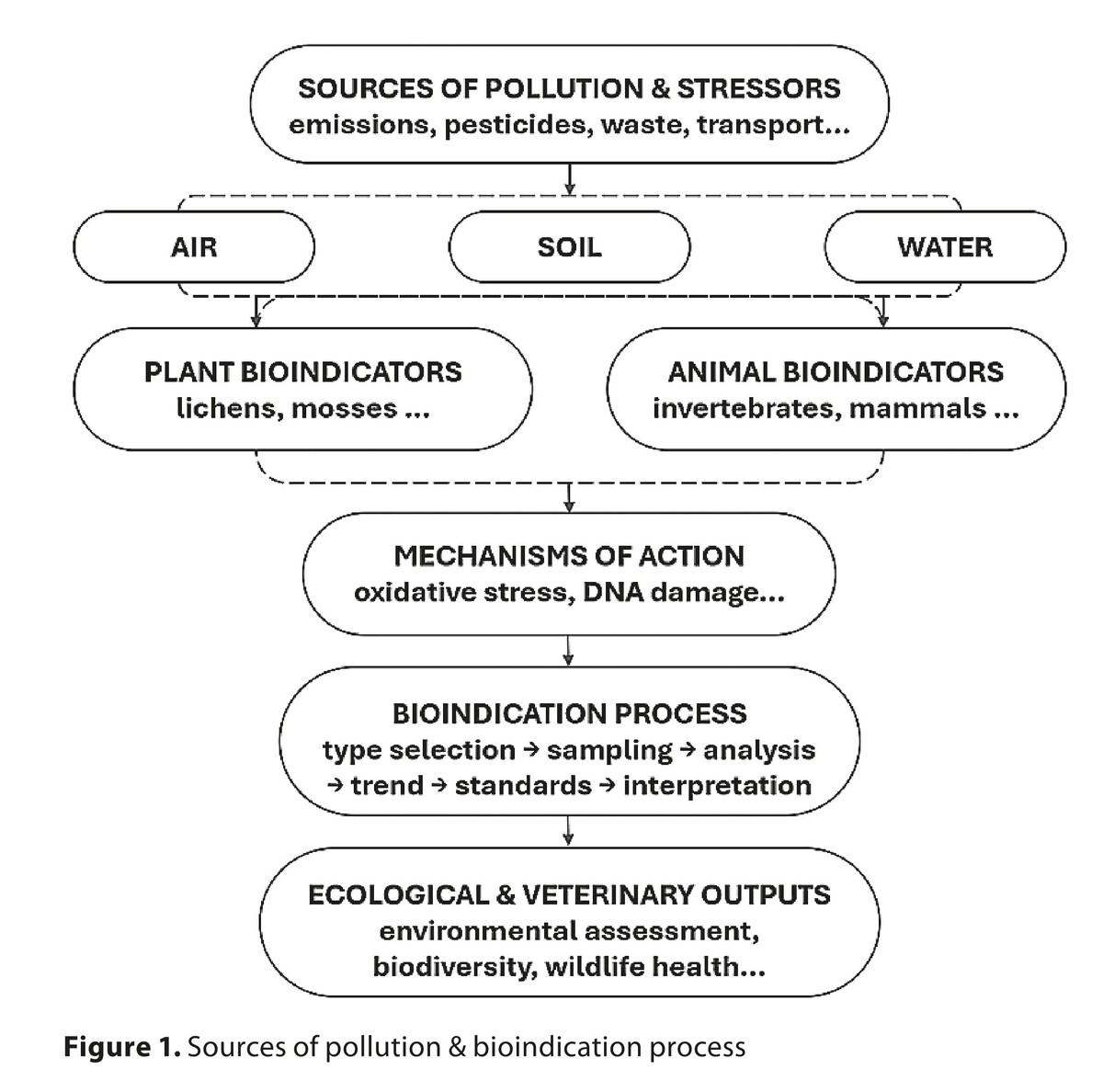
The study focuses on the importance of bioindicators and the process of bioindication which evaluate the selected organisms homeostastis, observation of ecological processes, and the overall assessment of environmental changes.
Brief description of the state of knowledge:
In addition to traditional matrices, such as air, water and soil, bioindicators of plant and animal origin are used to monitor the level of environmental contamination and to control pollution. It is known that bioindicators often contain significantly higher concentrations of certain pollutants than those detected in the matrices themselves. Bioindicators of animal origin allow assessment of environmental quality and its changes over time. They serve as suitable indicators for evaluating the impact of negative anthropogenic activities on ecosystems by studying the reactions of biota to the resulting stress.
Summary:
Bioindication is an important tool in ecotoxicological and veterinary studies, drawing on advances in human and veterinary medicine. As the negative impact of the human population grows on the environment, understanding the role of biodiversity in maintaining ecosystem functions becomes increasingly important. Wildlife biomonitoring using selected wild game mammals has become a common and effective approach for assessing environmental health.
The negative impact of pollutants on organisms is complex and still insufficiently investigated. This is caused by the diversity of organisms and by the high variability of the composition of foreign substances and their synergistic effects on each organism. The mechanisms by which living organisms are damaged differ depending on the type, intensity, and duration of the stress factor and interaction with biotic factors.
Review methods:
The study focuses on the importance of bioindicators and the process of bioindication which evaluate the selected organisms homeostastis, observation of ecological processes, and the overall assessment of environmental changes.
Brief description of the state of knowledge:
In addition to traditional matrices, such as air, water and soil, bioindicators of plant and animal origin are used to monitor the level of environmental contamination and to control pollution. It is known that bioindicators often contain significantly higher concentrations of certain pollutants than those detected in the matrices themselves. Bioindicators of animal origin allow assessment of environmental quality and its changes over time. They serve as suitable indicators for evaluating the impact of negative anthropogenic activities on ecosystems by studying the reactions of biota to the resulting stress.
Summary:
Bioindication is an important tool in ecotoxicological and veterinary studies, drawing on advances in human and veterinary medicine. As the negative impact of the human population grows on the environment, understanding the role of biodiversity in maintaining ecosystem functions becomes increasingly important. Wildlife biomonitoring using selected wild game mammals has become a common and effective approach for assessing environmental health.
FUNDING
Funding source Grants: KEGA 017TUKE-4/2024, VEGA 1/0228/24
PEER REVIEW INFORMATION
Article has been screened for originality
REFERENCES (49)
1.
Klaus VH, Schaub S, Séchaud R, et al. Upscaling of ecosystem service and biodiversity indicators from field to farm to inform agri-environmental decision- and policy-making. Ecol Indic. 2024;163:112104. https://doi.org/10.1016/j.ecol....
2.
Odum HT, Odum, EP. The energetic basis for valuation of ecosystem services. Ecosyst. 2000;3(1):21–23. https://doi.org/10.1007/s10021....
3.
Boyd J, Banzhaf S. What are ecosystem services. The need for standardized environmental accounting units. Ecol Econ. 2007;63(3):616–626. https://doi.org/10.1016/j.ecol....
4.
Kumar M, Kumar P. Valuation of the ecosystem services: A psycho-cultural perspective. Ecol Econ. 2008;64(1):808–819. https://doi.org/10.1016/j.ecol....
5.
Jacob DE, Nelson IU, Ukpong E, et al. Bioindicators in Recreational Planning and Development: Balancing Nature and Human Activities. Springer Nature. 2024;835–878. https://doi.org/10.1007/978-98....
6.
Ballelli S, Tardella FM, Pennesi R, et al. Contribution to the knowledge of the non-calcareous grasslands of the Monti Sibillini National Park central Italy: coeenological structure, syntaxonomy, ecolog, and floristic aspects. Hacquetia. 2022;21(1):41–72. https://doi.org/10.2478/hacq-2....
7.
Li X, Shen X, Jiang W, et al. Comprehensive review of emerging contaminants: Detection technologies, environmental impact, and management strategies. Ecotoxicol Environ Saf. 2024;278(1):116420. https://doi.org/10.1016/j.food....
8.
Srivastava A, Srivastav SK, UpadhyayRK. Cadmium induced pathological and eco-toxicological effects in animals. World J Pharm Res. 2024;12(17):312–331. https://doi.org/10.20959/wjpr2....
9.
Zelenova VO, Zelenov PV, Tutova GF. Bioindication potentials of the grass stand and soil macrofauna for assessing the level of anthropogenic transformation of an urban park are complementary. Biosyst Divers. 2024;32(3):306–313. https://doi.org/10.15421/01243....
10.
Malireddi P, Jarpla M, Patel RD, et al. Safeguarding insects as bio-indicators of environmental changes and pollution. Plant Arch. 2025;25(1):1018–1032. https://doi.org/10.51470/.
11.
Cakaj A, Drzewiecka K, Hanć A, et al. Plants as effective bioindicators for heavy metal pollution monitoring. Environ Res. 2024;256(1):119222. https://doi.org/10.1016/j.envr....
12.
Kai L. Analysis on environmental monitoring of persistent organic pollutants. Web of Conf. 2024;536(5):0201. https://doi.org/10.1051/e3scon....
13.
Feng D, Han Q, Xu L, et al. An ensembled method for predicting dissolved oxygen level in aquaculture environment. Ecol Inform. 2024;80:102501. https://doi.org/10.1016/j.ecoi....
14.
Chandel P, Mahajan D, Thakur K, et al. A review on plankton as a bioindicator: A promising tool for monitoring water quality. WWP. 2024;10(1):213–232. https://doi.org/10.1002/wwp2.1....
15.
Kozminov S, Krapivina E, Paritov A, et al. Ecological monitoring of aquatic and terrestrial ecosystems based on the distribution of modelgroups of living organisms. Web of Conf. 2024;524(5):02011. https://doi.org/10.1051/e3scon....
16.
Hashimi MH, Hashimi R, Ryan Q. Toxic effects of pesticides on humans, plants, animals, pollinators and beneficial organisms. Asian Plant Res J. 2020;5(4):37–47. https://doi.org/10.9734/APRJ/2....
17.
Garai P, Banerjee P, Mondal P, et al. Effect of heavy metals on fishes: Toxicity and Bioaccumulation. J Clin Toxicol. 2021;11(18):1–10. https://doi.org/10.35248/2161-....
18.
Ahmad A, Imran M, Ahsan H. Biomarkers as Biomedical Bioindicators: Approaches and Techniques for the Detection, Analysis, and Validation of Novel Biomarkers of Diseases. Pharmaceutics. 2023;15(6):1630. https://doi.org/10.3390/pharma....
19.
Mansfield I, Reynolds SJ, Lynch I, et al. Birds as bioindicators of plastic pollution in terrestrial and freshwater environments: A 30-year review. Environ Pollut. 2024;348:123790. https://doi.org/10.1016/j.envp....
20.
Edo GI, Samuel PO, Ezekiel GO. Environmental persistence, bioaccumulation, and ecotoxicology of heavy metals. Chem Ecol. 2024;40(3):322–349. https://doi.org/10.1080/027575....
21.
Kirillova NY, Kirillov A, Ruchin AB, et al. Faunal structure of small mammals (Erinaceomorpha, Soricomorpha, Chiroptera and Rodentia) in two protected areas of the Middle Volga region (European Russia). Acta Biol Sib. 2024;10:1165–1184. https://doi.org/10.5281/zenodo....
22.
Can SU, Demirbaş Y, Erduran N, et al. The European hare (Lepus europaeus) as a biomonitor of selected heavy metal pollution in the Marmara region, Türkiye. Contemp Agric. 2025;74(1–2):35–44. https://doi.org/10.2478/contag....
23.
Lešić T, Vulić A, Kudumija N, et al. Evaluation of lipid profiles in selected fresh and dry-cured game meats a comparative approach. Vet Stanica. 2025;56(3):291–302. https://doi.org/10.46419/vs.56....
24.
Mitchell L, Williamson BJ, Masden EA. Methods for highlighting ecological monitoring needs in data sparse regions: a case study of impact assessment for multi component infrastructure installations. Environ Impact Assess Rev. 2024;105:107433. https://doi.org/10.1016/j.eiar....
25.
Yadav PK, Sachan R, Dwivedi DK. Ecological Consequences: Understanding the effects of agricultural pollution on ecosystem, wildlife, and biodiversity. GEP. 2024;13(7):138–153. https://10.4236/gep.2025.13701....
26.
Prosekov A, Kuznetsov A, Rada A, et al. Methods for monitoring large terrestrial animals in the Wild. Forests. 2020;11(8):808. https://doi.org/10.3390/f11080....
27.
Bobek B, Merta D, Furtek J. Winter food and cover refuges of large ungulates in lowland forests of south-western Poland. For Ecol Manag. 2016;359:247–255. https://doi.org/10.1016/j.fore....
28.
Taffetani F, Rismondo M. Bioindicator system for the evaluation of the environmental quality of agro-ecosystems. Fitosociologia. 2009;46(2):3–22.
29.
Hua F, Wang W, Nakagawa S, et al. Ecological filtering shapes the impacts of agricultural deforestation on biodiversity. Nat Ecol Evol. 2024;8(2):251–266. https://doi.org/10.1038/s41559....
30.
Hell P, Rášo V, Slamečka J. Contribution to knowing the effect of landscape vegetation on field game in agrarian country. Folia Venatoria 2003;33:63–77.
31.
Slamecka J, Hell P, Gasparik J. et al. Current status and possibilities of greening the environment of game in agrarian landscapes. Zivotne Prostredie a Palovnictvo. 2006;3(1):98.
32.
Vizzari F, Slamečka J, Sladecek T, et al. Long-Term Monitoring of European Brown Hare (Lepus europaeus) Population in the Slovak Danubian Lowland. Diversity. 2024;16(8):486. https://doi.org/10.3390/d16080....
33.
Felton AM, Wam HK, Borowski Z, et al. Climate change and deer in boreal and temperate regions: From physiology to population dynamics and species distributions. Glob Change Biol. 2024;30(9):17505. https://doi.org/10.1111/gcb.17....
34.
Gao T, Nielsen AB, Hedblom M. Reviewing the strength of evidence of biodiversity indicators for forest ecosystems in Europe. Ecol Indic. 2015;57:420–434. https://doi.org/10.1016/j.ecol....
35.
Hanley TA. Potential role of deer (Cervidae) as ecological indicators of forest management. For Ecol Manag. 1996;88(1–2):199–204. https://doi.org/10.1016/S0378-....
36.
Galloway TS. Biomarkers in environmental and human health risk assessment. Mar Pollut Bull. 2006;53(10–12):606–613. https://doi.org/10.1016/j.marp....
37.
Vashishat A, Patel P, Das Gupta, G, et al. Alternatives of animal models for biomedical research: a comprehensive review of modern approaches. Stem Cell Rev Rep. 2004;20(4):881–899. https://doi.org/10.1007/s12015....
38.
Vidosavljević D, Venus M, Puntarić D, et al. Assessment of Selected Heavy Metals and Arsenic Concentrations in Wild Boar (Sus scrofa L.) from Papuk Nature Park (Croatia). J Xenobiot. 2024;15(3):74. https://doi.org/10.3390/jox150....
39.
Mitra S, Chakraborty AJ, Tareq AM, et al. Impact of heavy metals on the environment and human health: Novel therapeutic insights to counter the toxicity. J King Saud Univ Sci. 2022;34(3):101865. https://doi.org/10.1016/j.jksu....
40.
Spurgeon D, Lahive E, Robinson A. Species sensitivity to toxic substances: Evolution, ecology and applications. Front Environ Sci. 2020;8:1–25. https://doi.org/10.3389/fenvs.....
41.
Talmage SS, Walton BT. Small mammals as monitors of environmental contaminations. Rev Environ Contam Toxicol. 1991;119:47–145. https://doi.org/10.1007/978-1-....
42.
Sarabia TD, Mascarenhas MS, Batistote M. Evaluation of the Main Potentially Toxic Elements and Bioindicator Organisms. Front Environ Sci. 2024;13(4):279–295. https://doi.org/10.21664/2238-....
43.
Brown TJ, Hammers M, Taylor M, et al. Hematocrit, age, and survival in a wild vertebrate population. Ecol Evol. 2021;11(1):214–226. https://doi.org/10.1002/ece3.7....
44.
Beaulieu M. Capturing wild animal welfare: a physiological perspective. Biol Rev. 2024;99(1):1–22. https://doi.org/10.1111/brv.13....
45.
Pearce J, Venier L. Small mammals as bioindicators of sustainable boreal forest management. For Ecol Manag. 2005;6,208(1–3):153–175. https://doi.org/10.1016/j.fore....
46.
Neumann W, Levers C, Widemo F, Hunting as land use: Understanding the spatial associations among hunting, agriculture, and forestry. Ecol Soc. 2022;27(1):1–13. https://doi.org/10.5751/ES-128....
47.
Cooke SJ, Madliger CL, Lennox R, et al. Biological mechanisms matter in contemporary wildlife conservation. iScience. 2023;14(26):106192. https://doi.org/10.1016/j.isci....
48.
Conder JM, Arblaster JA. Development and use of wild game consumption rates in human health risk assessments. Human and Ecological Risk Assessment. Int J Res. 2016;22(1):251–264. https://doi.org/10.1080/108070....
49.
Collas C, Helder R, Guillon E, et al. Roe deer exposure to trace metals and pesticides in forests and agricultural plains of North-eastern France. Environ Sci Pollut Res Int. 2025;32(37):21828–21844. https://doi.org/10.1007/s11356....
Share
RELATED ARTICLE
| eISSN: | 1898-2263 |
| ISSN: | 1232-1966 |


Generation of the DOI (Digital Object Identifier) - task financed under the agreement No NrRCN/SP/0532/2021/1 by the Minister of Science and Higher
© 2006-2026 Journal hosting platform by Bentus
We process personal data collected when visiting the website. The function of obtaining information about users and their behavior is carried out by voluntarily entered information in forms and saving cookies in end devices. Data, including cookies, are used to provide services, improve the user experience and to analyze the traffic in accordance with the Privacy policy. Data are also collected and processed by Google Analytics tool (more).
You can change cookies settings in your browser. Restricted use of cookies in the browser configuration may affect some functionalities of the website.
You can change cookies settings in your browser. Restricted use of cookies in the browser configuration may affect some functionalities of the website.