Online first
Current issue
Archive
Special Issues
About the Journal
Publication Ethics
Anti-Plagiarism system
Instructions for Authors
Instructions for Reviewers
Editorial Board
Editorial Office
Contact
Reviewers
All Reviewers
2025
2024
2023
2022
2021
2020
2019
2018
2017
2016
General Data Protection Regulation (RODO)

RESEARCH PAPER
miR-3615 suppresses proliferation and induces apoptosis in lung adenocarcinoma cells by targetting CALML4
1
Respiratory Medicine, Shanghai Sixth People’s Hospital Jinshan Branch, China
These authors had equal contribution to this work
Corresponding author
Ann Agric Environ Med. 2026;33(3):418-424
KEYWORDS
TOPICS
ABSTRACT
Introduction and objective:
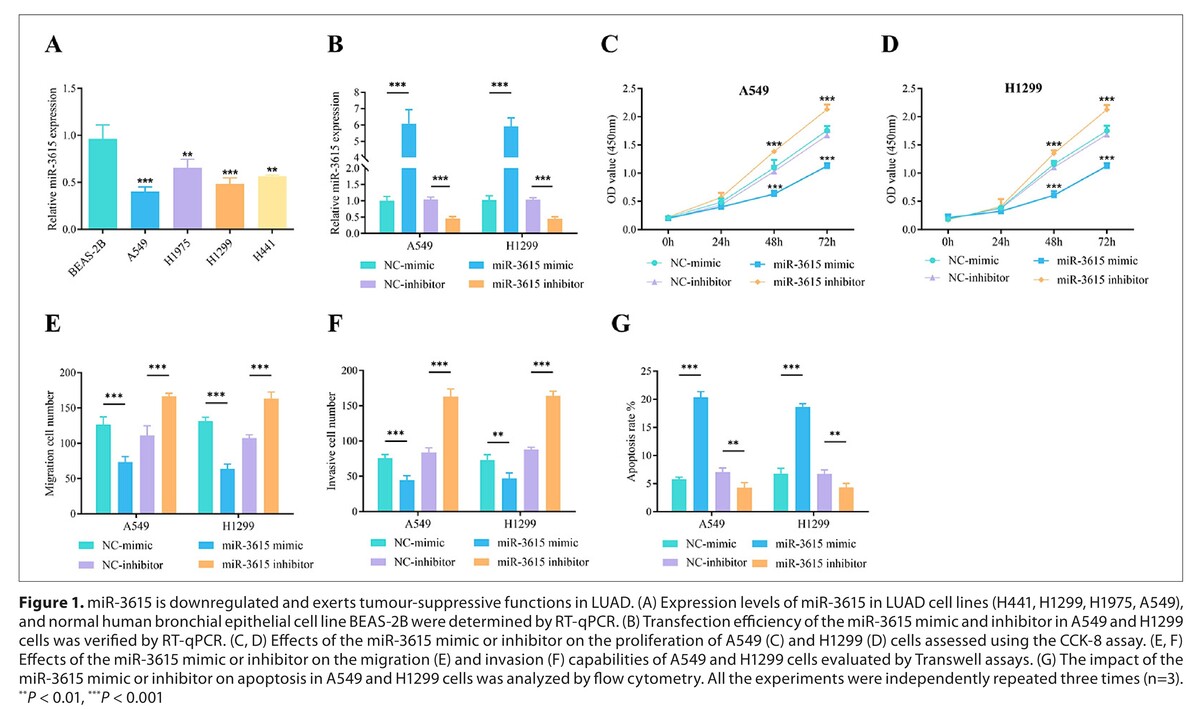
MicroRNAs (miRNAs) are essential in the modulation of cellular activities. Studies suggest that miR-3615 may possess a tumour-suppressive function in lung adenocarcinoma (LUAD); however, its precise role and molecular mechanisms in LUAD progression remain incompletely understood. The aim of the study is to systematically investigate the biological functions and underlying mechanisms of miR-3615 in LUAD.
Material and methods:
The expression of miR-3615 in LUAD cell lines was quantified by real-time quantitative PCR (RT-qPCR). Subsequently, its functional effects on proliferation, migration, invasion, and apoptosis were evaluated in A549 and H1299 cells using the CCK-8 assay, Transwell assay, and flow cytometry, respectively. Potential target genes of miR-3615 were predicted and functionally annotated using bioinformatics methods. The binding interaction of miR-3615 with the CALML4 gene was demonstrated via a dual-luciferase reporter assay.
Results:
miR-3615 expression was notably downregulated in LUAD cell lines compared with normal cells. Overexpression of miR-3615 inhibited the proliferation, migration, and invasion capabilities of LUAD cells while promoting apoptosis. Integrated bioinformatics analysis involving target prediction and functional enrichment identified CALML4 as a key candidate target gene of miR-3615. CALML4 was confirmed as a direct target of miR-3615. The effects of miR-3615 mimic on LUAD cell proliferation, migration, invasion, and apoptosis were partly attenuated by CALML4 overexpression.
Conclusions:
miR-3615 exerts its functional impact on LUAD cells by directly downregulating CALML4, thereby curbing proliferation, migration, and invasion and promoting apoptosis. The elucidated miR-3615/CALML4 axis advances the theoretical foundation for studying LUAD development.
MicroRNAs (miRNAs) are essential in the modulation of cellular activities. Studies suggest that miR-3615 may possess a tumour-suppressive function in lung adenocarcinoma (LUAD); however, its precise role and molecular mechanisms in LUAD progression remain incompletely understood. The aim of the study is to systematically investigate the biological functions and underlying mechanisms of miR-3615 in LUAD.
Material and methods:
The expression of miR-3615 in LUAD cell lines was quantified by real-time quantitative PCR (RT-qPCR). Subsequently, its functional effects on proliferation, migration, invasion, and apoptosis were evaluated in A549 and H1299 cells using the CCK-8 assay, Transwell assay, and flow cytometry, respectively. Potential target genes of miR-3615 were predicted and functionally annotated using bioinformatics methods. The binding interaction of miR-3615 with the CALML4 gene was demonstrated via a dual-luciferase reporter assay.
Results:
miR-3615 expression was notably downregulated in LUAD cell lines compared with normal cells. Overexpression of miR-3615 inhibited the proliferation, migration, and invasion capabilities of LUAD cells while promoting apoptosis. Integrated bioinformatics analysis involving target prediction and functional enrichment identified CALML4 as a key candidate target gene of miR-3615. CALML4 was confirmed as a direct target of miR-3615. The effects of miR-3615 mimic on LUAD cell proliferation, migration, invasion, and apoptosis were partly attenuated by CALML4 overexpression.
Conclusions:
miR-3615 exerts its functional impact on LUAD cells by directly downregulating CALML4, thereby curbing proliferation, migration, and invasion and promoting apoptosis. The elucidated miR-3615/CALML4 axis advances the theoretical foundation for studying LUAD development.
PEER REVIEW INFORMATION
Article has been screened for originality
REFERENCES (25)
1.
Bray F, Ferlay J, Soerjomataram I, et al. Global cancer statistics 2018: GLOBOCAN estimates of incidence and mortality worldwide for 36 cancers in 185 countries. CA Cancer J Clin. 2018;68(6):394–424. http://doi.org/10.3322/caac.21....
2.
Richtmann S, Wilkens D, Warth A, et al. FAM83A and FAM83B as Prognostic Biomarkers and Potential New Therapeutic Targets in NSCLC. Cancers (Basel). 2019;11(5). http://doi.org/10.3390/cancers....
3.
Sorber L, Zwaenepoel K, Deschoolmeester V, et al. Circulating cell-free nucleic acids and platelets as a liquid biopsy in the provision of personalized therapy for lung cancer patients. Lung Cancer. 2017;107:100–7. http://doi.org/10.1016/j.lungc....
4.
Jiang M, Jia K, Wang L, et al. Alterations of DNA damage response pathway: Biomarker and therapeutic strategy for cancer immunotherapy. Acta Pharm Sin B. 2021;11(10):2983–94. http://doi.org/10.1016/j.apsb.....
5.
Stepicheva NA, Song JL. Function and regulation of microRNA-31 in development and disease. Mol Reprod Dev. 2016;83(8):654–74. http://doi.org/10.1002/mrd.226....
6.
Yuan X, Zhang Y, Yu Z. Expression and clinical significance of miR-3615 in hepatocellular carcinoma. J Int Med Res. 2021;49(1):300060520981547. http://doi.org/10.1177/0300060....
7.
Fassan M, Realdon S, Cascione L, et al. Circulating microRNA expression profiling revealed miR-92a-3p as a novel biomarker of Barrett’s carcinogenesis. Pathol Res Pract. 2020;216(5):152907. http://doi.org/10.1016/j.prp.2....
8.
Huang G, Liu Y, Li L, et al. Integration analysis of microRNAs as potential biomarkers in early-stage lung adenocarcinoma: the diagnostic and therapeutic significance of miR-183-3p. Front Oncol. 2024;14:1508715. http://doi.org/10.3389/fonc.20....
9.
Gao S, Guo W, Liu T, et al. Plasma extracellular vesicle microRNA profiling and the identification of a diagnostic signature for stage I lung adenocarcinoma. Cancer Sci. 2022;113(2):648–59. http://doi.org/10.1111/cas.152....
10.
Kim H, Lee YY, Kim VN. The biogenesis and regulation of animal microRNAs. Nat Rev Mol Cell Biol. 2025;26(4):276–96. http://doi.org/10.1038/s41580-....
11.
Yang P, Liu J, Yang T, et al. Construction and Investigation of MicroRNA-mRNA Regulatory Network of Gastric Cancer with Helicobacter pylori Infection. Biochem Res Int. 2020;2020:6285987. http://doi.org/10.1155/2020/62....
12.
Zhang X, Wen Y, Wu F, et al. GSTA1 Conferred Tolerance to Osimertinib and Provided Strategies to Overcome Drug-Tolerant Persister in EGFR-Mutant Lung Adenocarcinoma. J Thorac Oncol. 2025. http://doi.org/10.1016/j.jtho.....
13.
Jiang Y, Zhao L, Wu Y, et al. The Role of NcRNAs to Regulate Immune Checkpoints in Cancer. Front Immunol. 2022;13:853480. http://doi.org/10.3389/fimmu.2....
14.
Seijo LM, Peled N, Ajona D, et al. Biomarkers in Lung Cancer Screening: Achievements, Promises, and Challenges. J Thorac Oncol. 2019;14(3):343–57. http://doi.org/10.1016/j.jtho.....
15.
Fang G, Zhang C, Liu Z, et al. MiR-144-3p inhibits the proliferation and metastasis of lung cancer A549 cells via targeting HGF. J Cardiothorac Surg. 2022;17(1):117. http://doi.org/10.1186/s13019-....
16.
Krętowski R, Jabłońska-Trypuć A, Cechowska-Pasko M. The Effect of Silica Nanoparticles (SiNPs) on Cytotoxicity, Induction of Oxidative Stress and Apoptosis in Breast Cancer Cell Lines. Int J Mol Sci. 2023;24(3). http://doi.org/10.3390/ijms240....
17.
Correia de Sousa M, Gjorgjieva M, Dolicka D, et al. Deciphering miRNAs’ Action through miRNA Editing. Int J Mol Sci. 2019;20(24). http://doi.org/10.3390/ijms202....
18.
Lukasiewicz M, Zwara A, Kowalski J, et al. The Role of Lipid Metabolism Disorders in the Development of Thyroid Cancer. Int J Mol Sci. 2024;25(13). http://doi.org/10.3390/ijms251....
19.
Xu L, Yang Q, Zhou J. Mechanisms of Abnormal Lipid Metabolism in the Pathogenesis of Disease. Int J Mol Sci. 2024;25(15). http://doi.org/10.3390/ijms251....
20.
Cheng C, Geng F, Cheng X, Guo D. Lipid metabolism reprogramming and its potential targets in cancer. Cancer Commun (Lond). 2018;38(1):27. http://doi.org/10.1186/s40880-....
21.
Tang X, Liu L, Li Y, et al. Chemical profiling and investigation of molecular mechanisms underlying anti-hepatocellular carcinoma activity of extracts from Polygonum perfoliatum L. Biomed Pharmacother. 2023;166:115315. http://doi.org/10.1016/j.bioph....
22.
Lin J, Zheng X, Tian X, et al. miR-1247-3p targets STAT5A to inhibit lung adenocarcinoma cell migration and chemotherapy resistance. J Cancer. 2022;13(7):2040–9. http://doi.org/10.7150/jca.651....
23.
Tu Y, Mei F. miR-3648 promotes lung adenocarcinoma-genesis by inhibiting SOCS2 (suppressor of cytokine signaling 2). Bioengineered. 2022;13(2):3044–56. http://doi.org/10.1080/2165597....
24.
Jiang M, Qi F, Zhang K, et al. MARCKSL1-2 reverses docetaxel-resistance of lung adenocarcinoma cells by recruiting SUZ12 to suppress HDAC1 and elevate miR-200b. Mol Cancer. 2022;21(1):150. http://doi.org/10.1186/s12943-....
25.
Chen Y, Zhou Y, Ren R, et al. Harnessing lipid metabolism modulation for improved immunotherapy outcomes in lung adenocarcinoma. J Immunother Cancer. 2024;12(7). http://doi.org/10.1136/jitc-20....
Share
RELATED ARTICLE
| eISSN: | 1898-2263 |
| ISSN: | 1232-1966 |


Generation of the DOI (Digital Object Identifier) - task financed under the agreement No NrRCN/SP/0532/2021/1 by the Minister of Science and Higher
© 2006-2026 Journal hosting platform by Bentus
We process personal data collected when visiting the website. The function of obtaining information about users and their behavior is carried out by voluntarily entered information in forms and saving cookies in end devices. Data, including cookies, are used to provide services, improve the user experience and to analyze the traffic in accordance with the Privacy policy. Data are also collected and processed by Google Analytics tool (more).
You can change cookies settings in your browser. Restricted use of cookies in the browser configuration may affect some functionalities of the website.
You can change cookies settings in your browser. Restricted use of cookies in the browser configuration may affect some functionalities of the website.