Online first
Current issue
Archive
Special Issues
About the Journal
Publication Ethics
Anti-Plagiarism system
Instructions for Authors
Instructions for Reviewers
Editorial Board
Editorial Office
Contact
Reviewers
All Reviewers
2025
2024
2023
2022
2021
2020
2019
2018
2017
2016
General Data Protection Regulation (RODO)

RESEARCH PAPER
miR-6838-5p acts as a tumour suppressor by inhibiting IGF1R levels in non-small cell lung cancer
1
Department of Cardiothoracic Surgery, The First People’s Hospital of Zhengzhou, Zhengzhou, China
2
Department of Cardiothoracic Surgery, Yangxin People’s Hospital, Yangxin, Hubei Province, China
3
Department of Oncology, The Fifth Medical Centre, Chinese PLA General Hospital, China
4
Respiratory and Critical Care Medicine Department, First Medical University Affiliated Central Hospital, Shandong, China
5
Respiratory Medicine, The Third People’s Hospital of Yuhang District, China
These authors had equal contribution to this work
Corresponding author
KEYWORDS
TOPICS
ABSTRACT
Introduction and objective:
Non-small Cell Lung Cancer (NSCLC) destroys lung tissue, causing respiratory failure and even multi-system damage. There is an urgent clinical need for targeted drugs for the early diagnosis of NSCLC. miR-6838-5p is aberrantly expressed in a variety of cancers but its role in NSCLC is unclear. The aim of the study is to evaluate the diagnostic and prognostic value of miR-6838-5p in NSCLC.
Material and methods:
The study included 87 patients with NSCLC and 87 healthy individuals as control. Human normal lung epithelial cells (16HBE) and lung cancer cell lines (A-549/H1299/H1944/NCI-H460/NCI-H1975) were cultured for relevant testing. RT-qPCR was employed to assay miR-6838-5p and insulin-like growth factor 1 receptor (IGF1R) levels. Receiver operating characteristic (ROC) curves and Kaplan-Meier curves were used to assess clinical value. Cell counting kit-8 (CCK-8), flow cytometry, and transwell assays were employed to examine the biological functions of lung cancer cells. IGF1R was identified as downstream of miR-6838-5p by luciferase reporter gene assay.
Results:
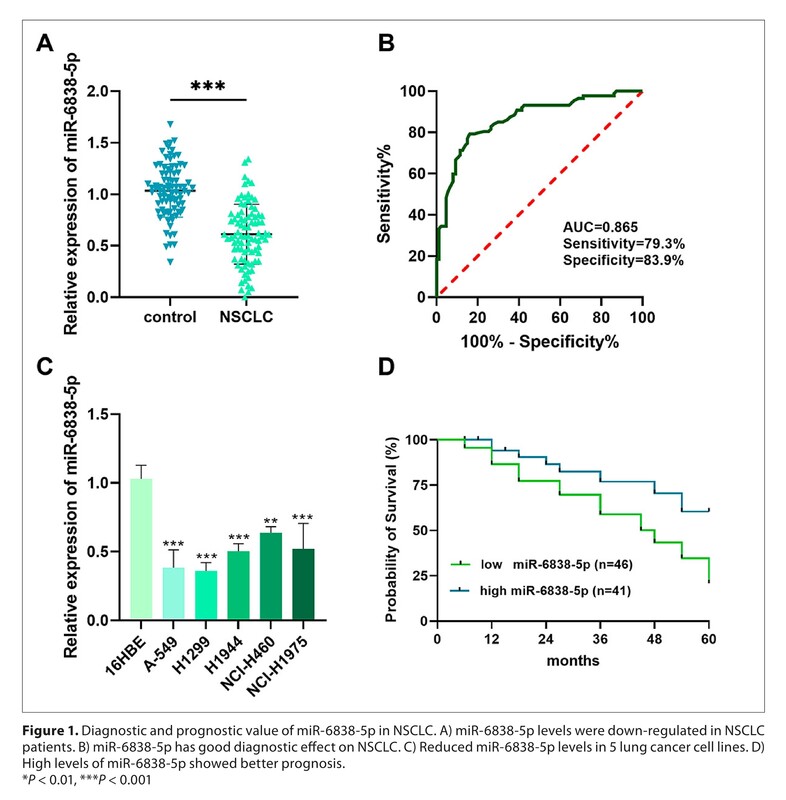
miR-6838-5p level was clearly down-regulated in NSCLC patients. miR-6838-5p demonstrates significant diagnostic value for NSCLC, and patients with high expression of miR-6838-5p exhibit improved prognostic survival rates. And it is closely associated with NSCLC proliferation and migration. IGF1R is a target of miR-6838-5p and up-regulated in lung cancer cell lines. Furthermore, up-regulation of IGF1R partially restored the inhibitory effects of miR-6838-5p over-expression on proliferation and migration, as well as the promotion of apoptosis.
Conclusions:
miR-6838-5p is downregulated in NSCLC and may suppress its malignant progression by inhibiting IGF1R levels. This may provide an effective target for clinical diagnosis and prognosis.
Non-small Cell Lung Cancer (NSCLC) destroys lung tissue, causing respiratory failure and even multi-system damage. There is an urgent clinical need for targeted drugs for the early diagnosis of NSCLC. miR-6838-5p is aberrantly expressed in a variety of cancers but its role in NSCLC is unclear. The aim of the study is to evaluate the diagnostic and prognostic value of miR-6838-5p in NSCLC.
Material and methods:
The study included 87 patients with NSCLC and 87 healthy individuals as control. Human normal lung epithelial cells (16HBE) and lung cancer cell lines (A-549/H1299/H1944/NCI-H460/NCI-H1975) were cultured for relevant testing. RT-qPCR was employed to assay miR-6838-5p and insulin-like growth factor 1 receptor (IGF1R) levels. Receiver operating characteristic (ROC) curves and Kaplan-Meier curves were used to assess clinical value. Cell counting kit-8 (CCK-8), flow cytometry, and transwell assays were employed to examine the biological functions of lung cancer cells. IGF1R was identified as downstream of miR-6838-5p by luciferase reporter gene assay.
Results:
miR-6838-5p level was clearly down-regulated in NSCLC patients. miR-6838-5p demonstrates significant diagnostic value for NSCLC, and patients with high expression of miR-6838-5p exhibit improved prognostic survival rates. And it is closely associated with NSCLC proliferation and migration. IGF1R is a target of miR-6838-5p and up-regulated in lung cancer cell lines. Furthermore, up-regulation of IGF1R partially restored the inhibitory effects of miR-6838-5p over-expression on proliferation and migration, as well as the promotion of apoptosis.
Conclusions:
miR-6838-5p is downregulated in NSCLC and may suppress its malignant progression by inhibiting IGF1R levels. This may provide an effective target for clinical diagnosis and prognosis.
PEER REVIEW INFORMATION
Article has been screened for originality
REFERENCES (29)
1.
Siegel RL, Miller KD, Jemal A. Cancer statistics, 2020. CA: a cancer journal for clinicians. 2020;70(1):7–30.
2.
Parisi C, Abdayem P, Tagliamento M, et al. Neoadjuvant immunotherapy strategies for resectable non-small cell lung cancer (NSCLC): Current evidence among special populations and future perspectives. Cancer Treatment Rev. 2024;131:102845.
3.
Ye MF, Lin D, Li WJ, et al. MiR-26a-5p Serves as an Oncogenic MicroRNA in Non-Small Cell Lung Cancer by Targeting FAF1. Cancer Manag Res. 2020;12:7131–42.
4.
Jeon H, Wang S, Song J, et al. Update 2025: Management of Non-Small-Cell Lung Cancer. Lung. 2025;203(1):53.
5.
Sun B, Zhao J, Shao ZY. MiR-572 promotes the development of non-small cell lung cancer by targeting KLF2. Eur Rev Med Pharmacol Sci. 2022;26(9):3083–90.
6.
Zhang J, Luo Q, Li X, et al. Novel role of immune-related non-coding RNAs as potential biomarkers regulating tumour immunoresponse via MICA/NKG2D pathway. Biomarker Res. 2023;11(1):86.
7.
Zhang X, Huang X, Zhang X, et al. The miR-941/FOXN4/TGF-β feedback loop induces N2 polarization of neutrophils and enhances tumor progression of lung adenocarcinoma. Front Immunol. 2025;16:1561081.
8.
Hassanin AAI, Ramos KS. Circulating Exosomal miRNA Profiles in Non-Small Cell Lung Cancers. Cells. 2024;13(18).
9.
Dou Z, Lu F, Hu J, et al. MicroRNA-6838-5p suppresses the self-renewal and metastasis of human liver cancer stem cells through downregulating CBX4 expression and inactivating ERK signaling. Biol Chem. 2023;404(1):29–39.
10.
Yan K, Hu C, Liu C, et al. LncRNA CERS6-AS1, sponging miR-6838-5p, promotes proliferation and invasion in cervical carcinoma cells by upregulating FOXP2. Histol Histopathol. 2023;38(7):823–35.
11.
Chen Z, Gong Q, Li D, Zhou J. CircKIAA0368 Promotes Proliferation, Migration, and Invasion by Upregulating HOXA10 in Nasopharyngeal Carcinoma. Am J Rhinol Allerg. 2022;36(5):615–27.
12.
Liu B, Chen J, Shang F, et al. Tumor-Derived Exosome FGD5-AS1 Promotes Angiogenesis, Vascular Permeability, and Metastasis in Thyroid Cancer by Targeting the miR-6838-5p/VAV2 Axis. J Oncol. 2022;2022:4702855.
13.
Shen R, Wang X, Wang S, et al. Long Noncoding RNA CERS6-AS1 Accelerates the Proliferation and Migration of Pancreatic Cancer Cells by Sequestering MicroRNA-15a-5p and MicroRNA-6838-5p and Modulating HMGA1. Pancreas. 2021;50(4):617–24.
14.
Ghaderi N, Jung JH, Odde DJ, Peacock J. Clinically validated model predicts the effect of intratumoral heterogeneity on overall survival for non-small cell lung cancer (NSCLC) patients. Computer Methods Prog Biomed. 2021;212:106455.
15.
Lee WC, Reuben A, Hu X, et al. Multiomics profiling of primary lung cancers and distant metastases reveals immunosuppression as a common characteristic of tumor cells with metastatic plasticity. Genome Biol. 2020;21(1):271.
16.
Liu G, Wang P, Zhang H. MiR-6838-5p suppresses cell metastasis and the EMT process in triple-negative breast cancer by targeting WNT3A to inhibit the Wnt pathway. J Gene Med. 2019;21(12):e3129.
17.
Zhao X, Zhu X, Xiao C, Hu Z. LncRNA SH3BP5-AS1 promotes hepatocellular carcinoma progression by sponging miR-6838-5p and activation of PTPN4. Aging. 2024;16(10):8511–23.
18.
Zhang G, Ding L, Sun G, et al. LncRNA AZIN1-AS1 ameliorates myocardial ischemia-reperfusion injury by targeting miR-6838-5p/WNT3A axis to activate Wnt-β/catenin signaling pathway. In vitro cellular & developmental biology Animal. 2022;58(1):54–68.
19.
Zhang Y, Yuan X, Xu J, Gu H. CircRBM33 induces endothelial dysfunction by targeting the miR-6838-5p/PDCD4 axis affecting blood-brain barrier in mice with cerebral ischemia-reperfusion injury. Clin Hemorheol Microcircul. 2023;85(4):355–70.
20.
Wang J, Zhang L, Wang C, et al. LINC00313/miR-4429 axis provides novel biomarkers for the diagnosis and prognosis of non-small cell lung cancer. Acta biochimica Polonica. 2022;69(2):343–8.
21.
Xue L, Tan Q, Xu J, et al. [MiR-6838-5p overexpression inhibits proliferation of breast cancer MCF-7 cells by downregulating DDR1 expression]. Nan fang yi ke da xue xue bao = J Southern Med Univ. 2024;44(9):1677–84.
22.
Zhang T, Ji C, Zhang Y, et al. LncRNA SNHG1 Accelerates Cell Proliferation, Migration, and Invasion of Hepatoblastoma Through Mediating miR-6838-5p/PIM3/RhoA Axis. Biochem Genetics. 2024;62(1):59–76.
23.
Waters JA, Robinson M, Lujano-Olazaba O, et al. Omental Preadipocytes Stimulate Matrix Remodeling and IGF Signaling to Support Ovarian Cancer Metastasis. Cancer Res. 2024;84(13):2073–89.
24.
Yang B, Li G, Wang S, et al. Tumor-associated macrophages/C-X-C motif chemokine ligand 1 promotes breast cancer autophagy-mediated chemoresistance via IGF1R/STAT3/HMGB1 signaling. Cell death Dis. 2024;15(10):743.
25.
Nagamine H, Yashiro M, Mizutani M, et al. Insulin-like growth factor 1 receptor expression correlates with programmed death ligand 1 expression and poor survival in non-small cell lung cancer. PloS one. 2024;19(10):e0297397.
26.
Zhang A, Ting H, Ma J, et al. Development and validation of a 16-gene T-cell- related prognostic model in non-small cell lung cancer. Front Immunol. 2025;16:1566597.
27.
Zheng J, Liu Y, Zhu F, et al. Picropodophyllin induces ferroptosis via blockage of AKT/NRF2/SLC7A11 and AKT/NRF2/SLC40A1 axes in hepatocellular carcinoma as a natural IGF1R inhibitor. Phytomed Inter J Phytotherapy Phytopharmacol. 2025;143:156840.
28.
Nagamine H, Yashiro M, Mizutani M, et al. Establishing a new human lung squamous cell carcinoma cell line, OMUL-1, expressing insulin-like growth factor 1 receptor and programmed cell death ligand 1. Thoracic Cancer. 2025;16(1):e15488.
29.
Li F, Wang X, Zhang J, et al. RBM8A, a new target of TEAD4, promotes breast cancer progression by regulating IGF1R and IRS-2. J Translational Med. 2024;22(1):823.
Share
RELATED ARTICLE
| eISSN: | 1898-2263 |
| ISSN: | 1232-1966 |


Generation of the DOI (Digital Object Identifier) - task financed under the agreement No NrRCN/SP/0532/2021/1 by the Minister of Science and Higher
© 2006-2026 Journal hosting platform by Bentus
We process personal data collected when visiting the website. The function of obtaining information about users and their behavior is carried out by voluntarily entered information in forms and saving cookies in end devices. Data, including cookies, are used to provide services, improve the user experience and to analyze the traffic in accordance with the Privacy policy. Data are also collected and processed by Google Analytics tool (more).
You can change cookies settings in your browser. Restricted use of cookies in the browser configuration may affect some functionalities of the website.
You can change cookies settings in your browser. Restricted use of cookies in the browser configuration may affect some functionalities of the website.