Online first
Current issue
Archive
Special Issues
About the Journal
Publication Ethics
Anti-Plagiarism system
Instructions for Authors
Instructions for Reviewers
Editorial Board
Editorial Office
Contact
Reviewers
All Reviewers
2025
2024
2023
2022
2021
2020
2019
2018
2017
2016
General Data Protection Regulation (RODO)

RESEARCH PAPER
Self-assessment of health status and identification of traffic hazards for urban cyclists
1
Department of Medical Anthropology, Institute of Rural Health, Lublin, Poland
Corresponding author
Ann Agric Environ Med. 2026;33(2):259-264
KEYWORDS
TOPICS
ABSTRACT
Introduction and objective:
The bicycle as a means of transport gains popularity among the inhabitants of European cities, being not only an alternative to cars, but also a way to improve health and wellbeing. The aim of the study is to identify and provide an in-depth analysis of health benefits, as well as potential environmental and traffic hazards resulting from regular commuting to work by bicycle.
Material and methods:
The study, conducted in the form of a diagnostic survey, included 285 adult inhabitants of Lublin, Poland. The criterion of purposive sampling was the respondents’ occupational activity and choosing a bicycle as a means of commuting to the place of work. The study was carried out using an author-constructed questionnaire and a standardized research tool – Satisfaction with Life Scale. Statistical analysis was performed by means of χ2 test for independence; the p values p≤0.05 were considered statistically significant.
Results:
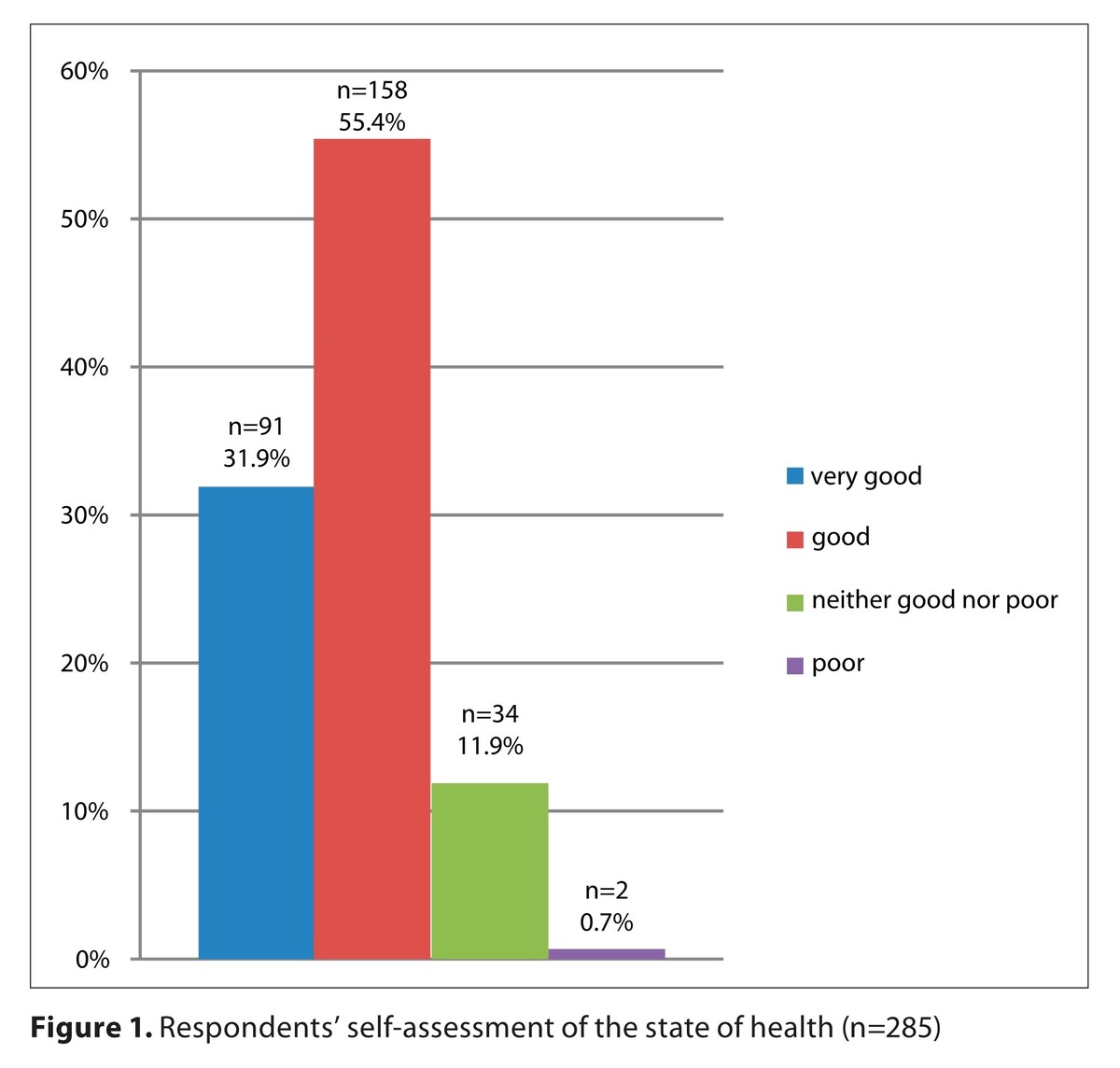
Most respondents evaluated their overall health as good (55.4%) or very good (31.9%), and their self-assessed immune status as high (57.9%) or very high (23.5%). Year-round cycling was significantly associated with a higher self-assessment of health (p<0.01). Commuting by bicycle was associated with improved physical fitness (43.9%) and immunity (21.4%). Cyclists achieved a mean SWLS score of 23.4, indicating above-average life satisfaction. The main identified traffic hazards were cars/drivers (60%) and insufficient infrastructure (41.8%).
Conclusions:
Regular commuting to work by bicycle is positively associated with perceived health benefits, including higher self-assessed fitness, higher self-assessed immune status, and fewer reported colds, as well as with above-average satisfaction with life. However, road safety concerns and insufficient cycling infrastructure remain significant barriers to active and safe commuting.
The bicycle as a means of transport gains popularity among the inhabitants of European cities, being not only an alternative to cars, but also a way to improve health and wellbeing. The aim of the study is to identify and provide an in-depth analysis of health benefits, as well as potential environmental and traffic hazards resulting from regular commuting to work by bicycle.
Material and methods:
The study, conducted in the form of a diagnostic survey, included 285 adult inhabitants of Lublin, Poland. The criterion of purposive sampling was the respondents’ occupational activity and choosing a bicycle as a means of commuting to the place of work. The study was carried out using an author-constructed questionnaire and a standardized research tool – Satisfaction with Life Scale. Statistical analysis was performed by means of χ2 test for independence; the p values p≤0.05 were considered statistically significant.
Results:
Most respondents evaluated their overall health as good (55.4%) or very good (31.9%), and their self-assessed immune status as high (57.9%) or very high (23.5%). Year-round cycling was significantly associated with a higher self-assessment of health (p<0.01). Commuting by bicycle was associated with improved physical fitness (43.9%) and immunity (21.4%). Cyclists achieved a mean SWLS score of 23.4, indicating above-average life satisfaction. The main identified traffic hazards were cars/drivers (60%) and insufficient infrastructure (41.8%).
Conclusions:
Regular commuting to work by bicycle is positively associated with perceived health benefits, including higher self-assessed fitness, higher self-assessed immune status, and fewer reported colds, as well as with above-average satisfaction with life. However, road safety concerns and insufficient cycling infrastructure remain significant barriers to active and safe commuting.
PEER REVIEW INFORMATION
Article has been screened for originality
REFERENCES (25)
1.
Andersen LB, Anderssen S, Bach N, et al. Wytyczne UE dotyczące aktywności fizycznej. Zalecane działania polityczne wspierające aktywność fizyczną wpływającą pozytywnie na zdrowie. Bruksela: Grupa Robocza UE „Sport i Zdrowie”; 2008. p. 3.
2.
Żukowska Z. Aktywność fizyczna w prozdrowotnym stylu życia współczesnego człowieka. In: Kultura fizyczna i zdrowotna współczesnego człowieka – teoretyczne podstawy i praktyczne implikacje. Łódź: Akademia Wychowania Fizycznego w Warszawie, ZWWF w Białej Podlaskiej; 2008. p. 10–18.
3.
Warburton DE, Nicol CW, Bredin SS. Health benefits of physical activity: the evidence. CMAJ. 2006;174(6):801–809.
4.
Dhuli K, Naureen Z, Medori MC, et al. Physical activity for health. J Prev Med Hyg. 2022;63(2 Suppl 3):E150-E159. doi:10.15167/2421-4248/jpmh2022.63.2S3.2756.
5.
Shao T, Verma HK, Pande B, et al. Physical Activity and Nutritional Influence on Immune Function: An Important Strategy to Improve Immunity and Health Status. Front Physiol. 2021;12:751374. doi:10.3389/fphys.2021.751374.
6.
Załęski D, Krankiewicz M, Berdzińska M, et al. Effects of Regular Physical Activity on Metabolic, Cardiovascular and Cancer Outcomes: A Review of Current Evidence. Qual Sport. 2026;49:67645. doi:10.12775/QS.2026.49.67645.
7.
Dunn J, Keadle SK, Strath SJ. Advancing physical activity metrics: a call for standardization and benchmarking in device-based data. J Meas Phys Behav. 2025;8(1):1–3. https://doi.org/10.1123/jmpb.2....
8.
Johan de Hartog J, Boogaard H, Nijland H, et al. Do the health benefits of cycling outweigh the risks? Environ Health Perspect. 2010;118(8):1109–1116. doi:10.1289/ehp.0901747.
9.
Friel C, Walsh D, Whyte B, et al. Health benefits of pedestrian and cyclist commuting: evidence from the Scottish Longitudinal Study. BMJ Public Health. 2024;2(1):e001295. doi:10.1136/bmjph-2024-001295.
10.
Dutheil F, Pélangeon S, Duclos M, et al. Protective Effect on Mortality of Active Commuting to Work: A Systematic Review and Meta-analysis. Sports Med. 2020;50(12):2237–2250. https://doi.org/10.1007/s40279....
11.
Tainio M, Jovanovic Andersen Z, Nieuwenhuijsen MJ, et al. Air pollution, physical activity and health: A mapping review of the evidence. Environ Int. 2021;147:105954. doi:10.1016/j.envint.2020.105954.
12.
Fan J, Feng L, Zhang Z, et al. Association of active commuting with incidence of depression and anxiety: prospective cohort study. Transl Psychiatry. 2025;15(1):39. https://doi.org/10.1038/s41398....
14.
Buehler R, Pucher J. COVID-19 Impacts on Cycling, 2019–2020. Transport Rev. 2021;41(4):393–400. doi:10.1080/01441647.2021.1914900.
15.
Avila-Palencia I, Int Panis L, Dons E, et al. The effects of transport mode use on self-perceived health, mental health, and social contact measures: A cross-sectional and longitudinal study. Environ Int. 2018;120:199–206. doi:10.1016/j.envint.2018.08.002.
16.
Kalliolahti E, Aalto V, Salo P, et al. Associations between commute mode use and self-rated health and work ability among Finnish public sector employees. Scand J Public Health. 2024;52(4):468–475. doi:10.1177/14034948231159212.
17.
Baran C, Belgacem S, Paillet M, et al. Active Commuting as a Factor of Cardiovascular Disease Prevention: A Systematic Review with Meta-Analysis. Journal of Functional Morphology and Kinesiology. 2024;9(3):125. https://doi.org/10.3390/jfmk90....
18.
Zhang W, Zeng S, Nie Y, et al. Meta-analysis of high-intensity interval training effects on cognitive function in older adults and cognitively impaired patients. Front Physiol. 2025;16:1543217. https://doi.org/10.3389/fphys.....
19.
Rodríguez-Gutiérrez E, Torres-Costoso A, Saz-Lara A, et al. Effectiveness of high-intensity interval training on peripheral brain-derived neurotrophic factor in adults: A systematic review and network meta-analysis. Scand J Med Sci Sports. 2024;34(1):e14496. https://doi.org/10.1111/sms.14....
20.
Mizdrak A, Tatah L, Mueller N, et al. Assessing the health impacts of changes in active transport: an updated systematic review. J Transp Health. 2023;33:101702. https://doi.org/10.1016/j.jth.....
21.
Fitch-Polse D, Agarwal S. The benefits of active transportation interventions: A review of the evidence. J Transp Land Use. 2025;18(1):77–122. doi:10.5198/jtlu.2025.2468.
22.
Ma L. Active Travel Commuting and Autonomic Stress Recovery in Urban Populations. J Urban Health. 2025. https://doi.org/10.1007/s11524....
23.
Tao Y, Petrović A, van Ham M. Commuting behaviours and subjective wellbeing: a critical review of longitudinal research. Transp Rev. 2023;43(4):599–621. https://doi.org/10.1080/014416....
24.
Gaffney AW, Hang JQ, Lee MS, et al. Commuting mode and pulmonary function in Shanghai, China. Eur Respir J. 2016;47(3):733–741. https://doi.org/10.1183/139930....
25.
Scrivano L, Tessari A, Marcora SM, et al. Active mobility and mental health: A scoping review towards a healthier world. Cambridge Prisms: Global Mental Health. 2024;11:e1. doi:10.1017/gmh.2023.74.
Share
RELATED ARTICLE
| eISSN: | 1898-2263 |
| ISSN: | 1232-1966 |


Generation of the DOI (Digital Object Identifier) - task financed under the agreement No NrRCN/SP/0532/2021/1 by the Minister of Science and Higher
© 2006-2026 Journal hosting platform by Bentus
We process personal data collected when visiting the website. The function of obtaining information about users and their behavior is carried out by voluntarily entered information in forms and saving cookies in end devices. Data, including cookies, are used to provide services, improve the user experience and to analyze the traffic in accordance with the Privacy policy. Data are also collected and processed by Google Analytics tool (more).
You can change cookies settings in your browser. Restricted use of cookies in the browser configuration may affect some functionalities of the website.
You can change cookies settings in your browser. Restricted use of cookies in the browser configuration may affect some functionalities of the website.