Online first
Current issue
Archive
Special Issues
About the Journal
Publication Ethics
Anti-Plagiarism system
Instructions for Authors
Instructions for Reviewers
Editorial Board
Editorial Office
Contact
Reviewers
All Reviewers
2025
2024
2023
2022
2021
2020
2019
2018
2017
2016
General Data Protection Regulation (RODO)

RESEARCH PAPER
Evaluation of relationship between type of body shape assessed using waist-to-hip ratio, and occurrence of cardiovascular risk factors in patients with acute coronary syndrome
1
Department of Public Health, Collegium Medicum, Jan Kochanowski University, Kielce, Poland
2
Department of Public Health, Academy of Medical Sciences of Applied and Holistic Sciences, Warsaw, Poland
3
Department of Education and Research in Health Sciences, Faculty of Health Science, Medical University, Warsaw, Poland
4
National Center for Health Policy and Research on Health Inequalities, Cardinal Stefan Wyszynski University, Warsaw, Poland
5
Faculty of Medical Sciences, Silesian University, Katowice, Poland
6
Faculty of Medical Sciences, Medical Academy of Applied Sciences, Warsaw, Poland
7
Departament of Medical Anthropology, Institute of Rural Health, Lublin, Poland
Corresponding author
Małgorzata Goździewska
Departament of Medical Anthropology, Institute of Rural Health, Lublin, Jaczewskiego 2, 20-090, Lublin, Poland
Departament of Medical Anthropology, Institute of Rural Health, Lublin, Jaczewskiego 2, 20-090, Lublin, Poland
Ann Agric Environ Med. 2026;33(2):249-258
KEYWORDS
TOPICS
ABSTRACT
Introduction and objective:
Morbidity due to cardiovascular diseases (CVD), including acute coronary syndrome (ACS) is closely related with the presence of risk factors. Obesity causes changes in body composition and constitutes a CVD risk factor on the population level. The aim of the study is to evaluate the relationship between the type of body shape measured by waist-to-hip ratio (WHR), and the occurrence of cardiovascular risk factors in patients with ACS.
Material and methods:
The study included 253 patients with the first event of ACS hospitalized in the 2nd Cardiology Clinic at the Kielce Province Cardiology Centre, Poland, using the following methods: analysis of records, estimation, anthropometric measurements, and laboratory tests.
Results:
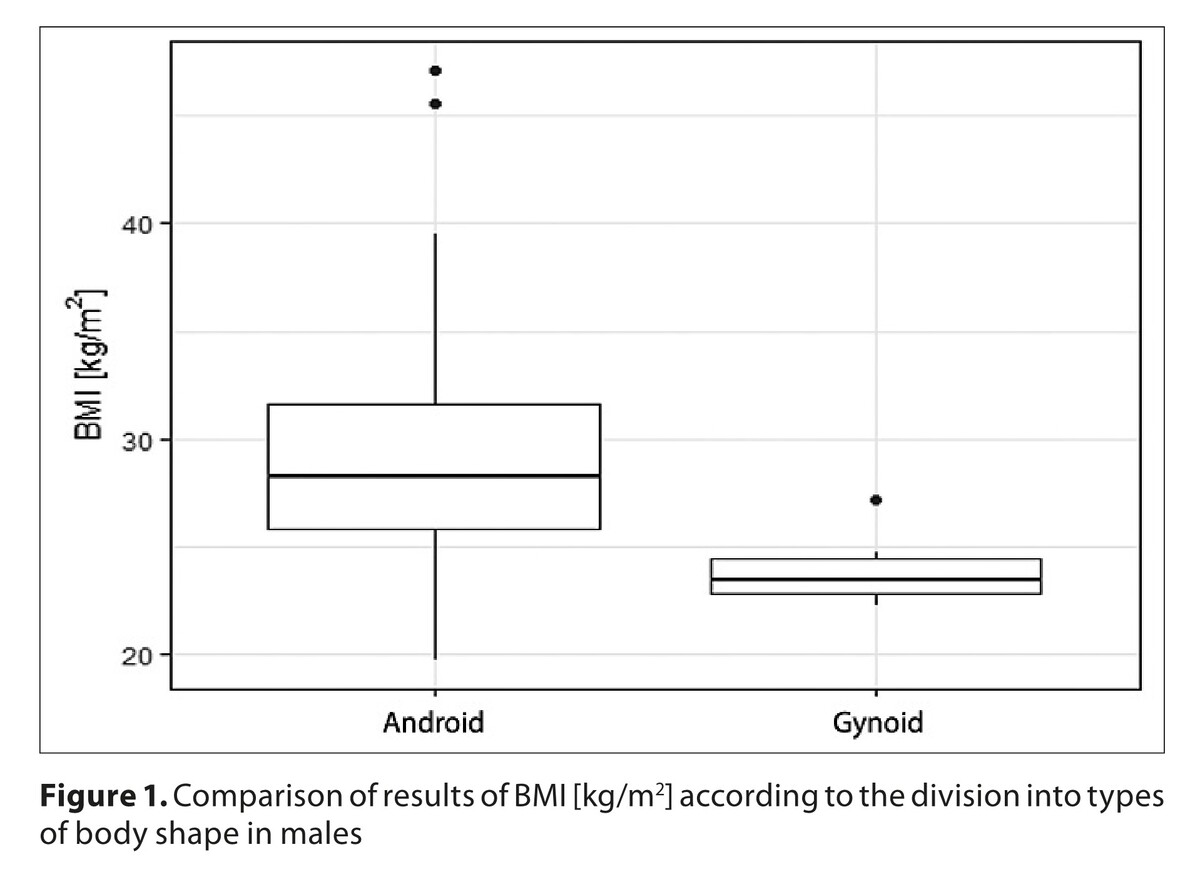
The analyzed group of males and females was characterized by significantly more frequent occurrence of overweight and obesity with an android body shape. It was also observed that patients with an android body type had a higher concentration of triglycerides in blood plasma. Arterial hypertension and type 2 diabetes also more often concerned patients with an android body type.
Conclusions:
The results obtained allow the presumption that the determination of fatty tissue distribution is useful while assessing the risk of carbohydrate and lipid metabolism disorders. Despite the type of body shape determined in a patient it exerts an effect on the change of metabolism, and additionally predisposes to the occurrence of arterial hypertension and type 2 diabetes.
Morbidity due to cardiovascular diseases (CVD), including acute coronary syndrome (ACS) is closely related with the presence of risk factors. Obesity causes changes in body composition and constitutes a CVD risk factor on the population level. The aim of the study is to evaluate the relationship between the type of body shape measured by waist-to-hip ratio (WHR), and the occurrence of cardiovascular risk factors in patients with ACS.
Material and methods:
The study included 253 patients with the first event of ACS hospitalized in the 2nd Cardiology Clinic at the Kielce Province Cardiology Centre, Poland, using the following methods: analysis of records, estimation, anthropometric measurements, and laboratory tests.
Results:
The analyzed group of males and females was characterized by significantly more frequent occurrence of overweight and obesity with an android body shape. It was also observed that patients with an android body type had a higher concentration of triglycerides in blood plasma. Arterial hypertension and type 2 diabetes also more often concerned patients with an android body type.
Conclusions:
The results obtained allow the presumption that the determination of fatty tissue distribution is useful while assessing the risk of carbohydrate and lipid metabolism disorders. Despite the type of body shape determined in a patient it exerts an effect on the change of metabolism, and additionally predisposes to the occurrence of arterial hypertension and type 2 diabetes.
PEER REVIEW INFORMATION
Article has been screened for originality
REFERENCES (29)
1.
Florek K, Kübler M, Górka M, et al. New Modifiable Risk Factors Influencing Coronary Artery Disease Severity. Inter J Mol Sci. 2024;25(14):7766. https://doi.org/10.3390/ijms25....
2.
Cicha-Mikołajczyk A, Piwońska A, Borowiec A, et al. Disparities in knowledge of cardiovascular risk factors and prevention methods related to cardiovascular status and functional health literacy in Poland, 2020–2021. Pol Heart J. 2023;81(7–8):700–707. https://doi.org/10.33963/KP.a2....
3.
Gorczyca-Michta I, Wożakowska-Kapłon B. Patient with arterial hypertension and hypercholesterolaemia — can we be more effective in treatment? Folia Cardiol. 2017;12(3):262–270. https://doi.org/10.5603/FC.201... (in Polish).
4.
Piepoli MF, Hoes AW, Agewall S, et al. 2016 European Guidelines on cardiovascular disease prevention in clinical practice: The Sixth Joint Task Force of the European Society of Cardiology and Other Societies on Cardiovascular Disease Prevention in Clinical Practice (constituted by representatives of 10 societies and by invited experts) Developed with the special contribution of the European Association for Cardiovascular Prevention & Rehabilitation (EACPR). Eur Heart J. 2016;37(29):2315–2381. https://doi.org/10.1093/eurhea....
5.
Buttaev MR, Kazamanova VI, Vyazovtseva VV, et al. Prophylactics of heart and society effects in patients with diabetes mellitus. Revista Latinoamericana de Hipertension. 2025;(1):24. https://doi.org/10.5281/zenodo....
6.
Dina C, Tit DM, Radu A, et al. Obesity, Dietary Patterns, and Cardiovascular Disease: A Narrative Review of Metabolic and Molecular Pathways. Curr Issues Molec Biol. 2025;47(6):440. https://doi.org/10.3390/cimb47....
7.
Pflanz CP, Tozer DJ, Harshfield EL, et al. Central obesity is selectively associated with cerebral gray matter atrophy in 15,634 subjects in the UK Biobank. Inter J Obes. 2022;46(5):1059–1067. https://doi.org/10.1038/s41366....
8.
Bays H. Evaluation and Practical Management of Increased Visceral Fat: Should Cardiologists Lose Sleep Over It? JACC. 2022;79(13):1266–1269. https://doi.org/10.1016/j.jacc....
9.
Koskinas KC, Van Craenenbroeck EM, Antoniades C, et al. Obesity and cardiovascular disease: an ESC clinical consensus statement. Eur J Prev Cardiol. 2025;32(3):184–220. https://doi.org/10.1093/eurjpc....
10.
Pakhare M, Anjankar A. Critical correlation between obesity and cardiovascular diseases and recent advancements in obesity. Cureus. 2024;16(1). https://doi.org/10.7759/cureus....
11.
Ahmed SK, Mohammed RA. Obesity: Prevalence, causes, consequences, management, preventive strategies and future research directions. Metab Open. 2025;27:100375. https://doi.org/10.1016/j.meto....
12.
Sonaglioni A, Ferrulli A, Nicolosi GL, et al. The influence of anthropometrics on cardiac mechanics in healthy women with opposite obesity phenotypes (Android vs Gynoid). Cureus. 2024;16(6):e59832.
13.
Macut D, Ognjanović S, Ašanin M, et al. Metabolic syndrome and myocardial infarction in women. Curr Pharm Des. 2021;27(29):3568–3574.
14.
Collet JP, Thiele H, Barbato E, et al. 2023 ESC Guidelines for the management of acute coronary syndromes. Eur Heart J. 2023;44:3720–3826.
15.
Wolska M, Uchmanowicz I, Zelek L, et al. Effectiveness of a nurse-led program of frequent educational meetings in achieving weight loss in patients with coronary artery disease: A prospective study from Poland. Polish Heart J. 2024;82(11):1109–1118. doi:10.33963/v.phj.103133.
16.
Visseren FLJ, Mach F, Smulders YM, et al. 2021 ESC Guidelines on cardiovascular disease prevention in clinical practice. Eur Heart J. 2021;42:3227–3337.
17.
Mach F, Baigent C, Catapano AL, et al. 2019 ESC/EAS Guidelines for the management of dyslipidaemias (with subsequent updates 2022–2023). Eur Heart J. 2020;41:111–188.
18.
Hygriv Rao B, Rama Raju NS, Srinivasa Raju CS, et al. Metabolic risk factors in first acute coronary syndrome (MERIFACS) Study. Indian Heart J. 2022;74(4):275–281. doi:10.1016/j.ihj.2022.07.002. Epub 2022 Aug 3. Erratum in: Indian Heart J. 2022;74(5):430. doi:10.1016/j.ihj.2022.10.003. PMID: 35931204; PMCID: PMC9453050.
19.
Khattab T, Aljeesh Y. Risk factors of acute coronary syndrome among patients admitted to cardiac care units at governmental hospitals in the Gaza Strip: Case-control study. Int J Cardiol Cardiovasc Risk Prev. 2025;26:200466. doi:10.1016/j.ijcrp.2025.200466. PMID: 40703854; PMCID: PMC12284688.
20.
McDonagh TA, Metra M, Adamo M, et al. 2021 ESC Guidelines for the diagnosis and treatment of acute and chronic heart failure. Eur Heart J. 2021;42:3599–3726.
21.
Hartopo AB, Fachiroh J, Puspitawati I, et al. Serum endothelin-1 level positively correlates with waist and hip circumferences in stable coronary artery disease patients. Rev Cardiovasc Med. 2021;22(3):919–924. doi:10.31083/j.rcm2203099. PMID: 34565091.
22.
Jibran MS, Suleman M, Khan SU. Increased Neck Circumference and Increased Waist-Hip Ratio: Predictive Factors of Acute Myocardial Infarction. Cureus. 2023;15(3):e36777. doi:10.7759/cureus.36777. PMID: 37123795; PMCID: PMC10133831.
23.
Khattab T, Aljeesh Y. Risk factors of acute coronary syndrome among patients admitted to cardiac care units at governmental hospitals in the Gaza Strip: Case-control study. Int J Cardiol Cardiovasc Risk Prev. 2025;26:20046.
24.
Hartopo AB, Fachiroh J, Puspitawati I, et al. Serum endothelin-1 level positively correlates with waist and hip circumferences in stable coronary artery disease patients. Rev Cardiovasc Med. 2021;22(3):919–92.
25.
Zhang X, Yang L, Xiao C, et al. Association between waist-to-hip ratio and risk of myocardial infarction: a systematic evaluation and meta-analysis. Front Cardiovasc Med. 2024;11:1438817. doi:10.3389/fcvm.2024.1438817.
26.
Rafsanjani K, Rabizadeh S, Ebrahimiantabrizi A, et al. Waist-to-hip ratio as a contributor associated with higher atherosclerotic cardiovascular disease risk assessment in patients with diabetes: a cross-sectional study. BMC Cardiovasc Disord. 2024;24:297. doi:10.1186/s12872-024-04297-w.
27.
Szczepańska E, Słoma-Krześlak M, Białek-Dratwa A, et al. Adipose dysfunction indices as a key to cardiometabolic risk assessment—A population-based study of post-myocardial infarction patients. Metabolites. 2024;14(6):299. doi:10.3390/metabo14060299.
28.
Arslan N, Akbulut G, Süleymanoğlu M, et al. The relationship between body mass index, anthropometric measurements and GRACE risk score in acute coronary syndrome. Nutr Food Sci. 2023;53(5):913–923. doi:10.1108/NFS-06-2022-0177.
29.
Mansoori A, Allahyari M, Mirvahabi MS, et al. Predictive properties of novel anthropometric and biochemical indexes for prediction of cardiovascular risk. Diabetol Metab Syndr. 2024;16:1516. doi:10.1186/s13098-024-01516-4.
Share
RELATED ARTICLE
| eISSN: | 1898-2263 |
| ISSN: | 1232-1966 |


Generation of the DOI (Digital Object Identifier) - task financed under the agreement No NrRCN/SP/0532/2021/1 by the Minister of Science and Higher
© 2006-2026 Journal hosting platform by Bentus
We process personal data collected when visiting the website. The function of obtaining information about users and their behavior is carried out by voluntarily entered information in forms and saving cookies in end devices. Data, including cookies, are used to provide services, improve the user experience and to analyze the traffic in accordance with the Privacy policy. Data are also collected and processed by Google Analytics tool (more).
You can change cookies settings in your browser. Restricted use of cookies in the browser configuration may affect some functionalities of the website.
You can change cookies settings in your browser. Restricted use of cookies in the browser configuration may affect some functionalities of the website.