Online first
Current issue
Archive
Special Issues
About the Journal
Publication Ethics
Anti-Plagiarism system
Instructions for Authors
Instructions for Reviewers
Editorial Board
Editorial Office
Contact
Reviewers
All Reviewers
2025
2024
2023
2022
2021
2020
2019
2018
2017
2016
General Data Protection Regulation (RODO)

REVIEW PAPER
Intestinal and vaginal microbiota as determinants of maternal and neonatal health in gestational diabetes mellitus – a narrative review
1
Gynaecology, Chair and Department of Obstetrics and Perinatology, Medical University, Lublin, Poland
2
Anaesthesiology and Intensive Care, University Clinical Hospital No. 4, Lublin, Poland
3
Third Department of Gynaecology, Medical University, Lublin, Poland
4
First Department of Anaesthesiology and Intensive Therapy, Medical University, Lublin, Poland
Corresponding author
Kamila Gorczyca
Gynecology, Chair and Department of Obstetrics and Perinatology, Medical University of Lublin, Relaksowa, 15/20, 20-819, Lublin, Poland
Gynecology, Chair and Department of Obstetrics and Perinatology, Medical University of Lublin, Relaksowa, 15/20, 20-819, Lublin, Poland
KEYWORDS
probioticsgestational diabetes mellitusgut microbiotavaginal microbiotapregnancy complicationsmaternal and neonatal health
TOPICS
ABSTRACT
Introduction and objective:
Gestational diabetes mellitus (GDM) is the most common metabolic complication of pregnancy, associated with adverse maternal and neonatal outcomes and increased long-term metabolic risk. Recent studies indicate that intestinal and vaginal microbiota play an important role in the pathogenesis and clinical course of GDM. The aim of the review is to summarize current evidence on alterations in maternal gut and vaginal microbiota in GDM and their clinical relevance.
Review methods:
A narrative review was conducted of observational, experimental, and meta-analytic studies indexed in PubMed and Scopus, focusing on microbiota composition, metabolic parameters, and perinatal outcomes in gestational diabetes mellitus.
Brief description of the state of knowledge:
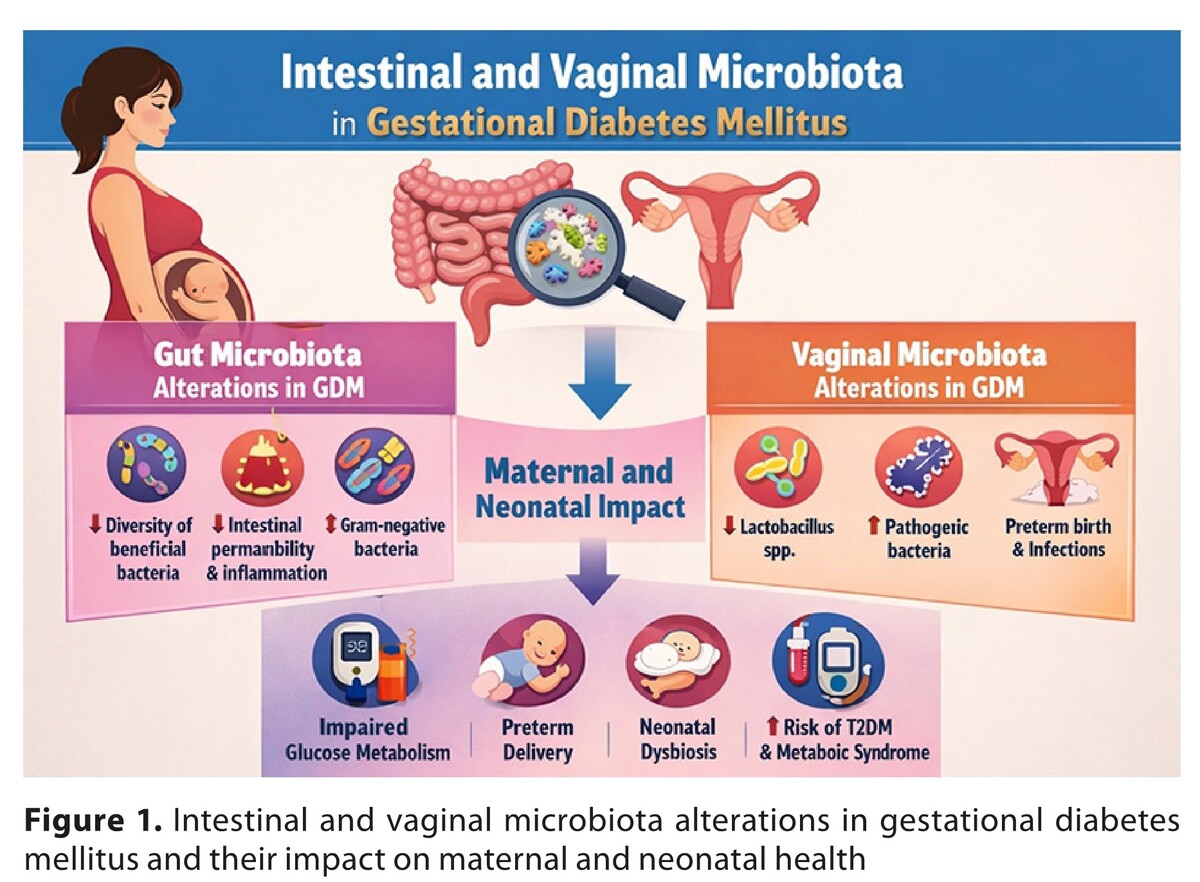
GDM is associated with reduced gut microbial diversity, depletion of short-chain fatty acid–producing bacteria, and increased abundance of Gram-negative species, contributing to inflammation and impaired glucose metabolism. Vaginal dysbiosis, characterized by reduced Lactobacillus dominance, is linked to bacterial vaginosis, preterm birth, and intrauterine infections. Both gut and vaginal microbiota alterations may influence neonatal microbial colonization and metabolic programming.
Summary:
The available evidence indicates that gut and vaginal microbiota are key determinants of metabolic and reproductive health in women with gestational diabetes mellitus. Interventions based on probiotics, prebiotics, and lifestyle modification show potential in restoring microbial balance and improving glycaemic control, although further large-scale clinical studies are warranted. Assessment and targeted modulation of maternal microbiota may represent promising strategies for the prevention of GDM-related complications and for the development of personalized approaches in maternal care.
Gestational diabetes mellitus (GDM) is the most common metabolic complication of pregnancy, associated with adverse maternal and neonatal outcomes and increased long-term metabolic risk. Recent studies indicate that intestinal and vaginal microbiota play an important role in the pathogenesis and clinical course of GDM. The aim of the review is to summarize current evidence on alterations in maternal gut and vaginal microbiota in GDM and their clinical relevance.
Review methods:
A narrative review was conducted of observational, experimental, and meta-analytic studies indexed in PubMed and Scopus, focusing on microbiota composition, metabolic parameters, and perinatal outcomes in gestational diabetes mellitus.
Brief description of the state of knowledge:
GDM is associated with reduced gut microbial diversity, depletion of short-chain fatty acid–producing bacteria, and increased abundance of Gram-negative species, contributing to inflammation and impaired glucose metabolism. Vaginal dysbiosis, characterized by reduced Lactobacillus dominance, is linked to bacterial vaginosis, preterm birth, and intrauterine infections. Both gut and vaginal microbiota alterations may influence neonatal microbial colonization and metabolic programming.
Summary:
The available evidence indicates that gut and vaginal microbiota are key determinants of metabolic and reproductive health in women with gestational diabetes mellitus. Interventions based on probiotics, prebiotics, and lifestyle modification show potential in restoring microbial balance and improving glycaemic control, although further large-scale clinical studies are warranted. Assessment and targeted modulation of maternal microbiota may represent promising strategies for the prevention of GDM-related complications and for the development of personalized approaches in maternal care.
PEER REVIEW INFORMATION
Article has been screened for originality
REFERENCES (38)
1.
Petitclerc I, Perron J, Dugas C, et al. Association between gestational diabetes mellitus, maternal health and diet, and gut microbiota in mother-infant dyads. BMC Pregnancy Childbirth. 2025 Apr 24;25(1):486.
2.
Gurung M, Li Z, You H, et al. Role of gut microbiota in type 2 diabetes pathophysiology. J Clin Endocrinol Metab. 2020 Feb 1;105(2):e154-e173.
3.
Zhang X, Shen D, Fang Z, et al. Human gut microbiota changes reveal the progression of glucose intolerance. Cell Metab. 2013 Nov 5;18(5):675–685.
4.
Dias S, Pheiffer C, Adam S. The Maternal Microbiome and Gestational Diabetes Mellitus: Cause and Effect. Microorganisms. 2023 Aug 31;11(9):2217.
5.
Qin J, Li Y, Cai Z, et al. A metagenome-wide association study of gut microbiota in type 2 diabetes. Nature. 2012 Oct 4;490(7418): 55–60.
6.
Gorczyca K, Obuchowska A, Kimber-Trojnar Ż, et al. Changes in the Gut Microbiome and Pathologies in Pregnancy. Int J Environ Res Public Health. 2022 Jan;19(16):9961.
7.
Koren O, Goodrich JK, Cullender TC, et al. Host remodeling of the gut microbiome and metabolic changes during pregnancy. Cell. 2012 Aug 3;150(3):470–80.
8.
Crusell MKW, Hansen TH, Nielsen T, et al. Gestational diabetes is associated with change in the gut microbiota composition in third trimester of pregnancy and postpartum. Microbiome. 2018 May 15;6(1):89.
9.
Ferrocino I, Ponzo V, Gambino R, et al. Changes in the gut microbiota composition during pregnancy in patients with gestational diabetes mellitus (GDM). Sci Rep. 2018 Aug 15;8(1):12216.
10.
Kuang YS, Lu JH, Li SH, et al. Connections between the human gut microbiome and gestational diabetes mellitus. GigaScience. 2017 Aug 1;6(8):1–12.
11.
Cortez RV, Taddei CR, Sparvoli LG, et al. Microbiome and its relation to gestational diabetes. Endocrine. 2019 Feb;64(2):254–264.
12.
Larsen N, Vogensen FK, van den Berg FWJ, et al. Gut microbiota in human adults with type 2 diabetes differs from non-diabetic adults. PLoS One. 2010 Feb 5;5(2):e9085.
13.
Hasain Z, Mokhtar NM, Kamaruddin NA, et al. Gut Microbiota and Gestational Diabetes Mellitus: A Review of Host-Gut Microbiota Interactions and Their Therapeutic Potential. Front Cell Infect Microbiol. 2020;10:188.
14.
Le Chatelier E, Nielsen T, Qin J, et al. Richness of human gut microbiome correlates with metabolic markers. Nature. 2013 Aug 29;500(7464):541–6.
15.
Karamali M, Dadkhah F, Sadrkhanlou M, et al. Effects of probiotic supplementation on glycaemic control and lipid profiles in gestational diabetes: A randomized, double-blind, placebo-controlled trial. Diabetes Metab. 2016 Sep;42(4):234–41.
16.
Callaway LK, McIntyre HD, Barrett HL, et al. Probiotics for the Prevention of Gestational Diabetes Mellitus in Overweight and Obese Women: Findings From the SPRING Double-Blind Randomized Controlled Trial. Diabetes Care. 2019 Mar;42(3):364–71.
17.
Valdes AM, Walter J, Segal E, Spector TD. Role of the gut microbiota in nutrition and health. BMJ. 2018 Jun 13;361:k2179.
18.
Romero R, Hassan SS, Gajer P, et al. The vaginal microbiota of pregnant women who subsequently have spontaneous preterm labor. Am J Obstet Gynecol. 2014 Mar;210(3):239.e1–239.e15.
19.
Sun M, Wu W, Liu Z, Cong Y. Microbiota metabolite short chain fatty acids, GPCR, and inflammatory bowel diseases. J Gastroenterol. 2017 Jan;52(1):1–8.
20.
Canfora EE, Jocken JW, Blaak EE. Short-chain fatty acids in control of body weight and insulin sensitivity. Nat Rev Endocrinol. 2015 Oct;11(10):577–91.
21.
Alsharairi NA. Exploring the Diet-Gut Microbiota-Epigenetics Crosstalk Relevant to Neonatal Diabetes. Genes. 2023 Apr 29;14(5):1017.
22.
Basson AR, Lam M, Cominelli F. Complementary and Alternative Medicine Strategies for Therapeutic Gut Microbiota Modulation in Inflammatory Bowel Disease and their Next-Generation Approaches. Gastroenterol Clin North Am. 2017 Dec;46(4):689–729.
23.
Luoto R, Laitinen K, Nermes M, Isolauri E. Impact of maternal probiotic-supplemented dietary counselling on pregnancy outcome and prenatal and postnatal growth: a double-blind, placebo-controlled study. Br J Nutr. 2010 Jun;103(12):1792–9.
24.
Ravel J, Gajer P, Abdo Z, et al. Vaginal microbiome of reproductive-age women. Proc Natl Acad Sci U S A. 2011 Mar 15;108 Suppl 1 (Suppl 1):4680–7.
25.
Borges S, Silva J, Teixeira P. The role of lactobacilli and probiotics in maintaining vaginal health. Arch Gynecol Obstet. 2014 Mar;289(3):479–89.
26.
Lin YP, Chen WC, Cheng CM, Shen CJ. Vaginal pH Value for Clinical Diagnosis and Treatment of Common Vaginitis. Diagnostics. 2021 Oct 27;11(11):1996.
27.
Romero R, Theis KR, Gomez-Lopez N, et al. The Vaginal Microbiota of Pregnant Women Varies with Gestational Age, Maternal Age, and Parity. Microbiol Spectr. 11(4):e03429–22.
28.
Petricevic L, Domig KJ, Nierscher FJ, et al. Characterisation of the vaginal Lactobacillus microbiota associated with preterm delivery. Sci Rep. 2014 May 30;4(1):5136.
29.
Nuriel-Ohayon M, Neuman H, Koren O. Microbial changes during pregnancy, birth, and infancy. Front Microbiol. 2016 Jun 29;7:1031.
30.
MacIntyre DA, Chandiramani M, Lee YS, et al. The vaginal microbiome during pregnancy and the postpartum period in a European population. Sci Rep. 2015 Mar 11;5:8988.
31.
DiGiulio DB, Callahan BJ, McMurdie PJ, et al. Temporal and spatial variation of the human microbiota during pregnancy. Proc Natl Acad Sci U S A. 2015 Sep 1;112(35):11060–5.
32.
Petrova MI, Reid G, Vaneechoutte M, Lebeer S. Lactobacillus species as biomarkers and agents that can promote various aspects of vaginal health. Front Physiol. 2015 Apr 17;6:81.
33.
Reid G, Beuerman D, Heinemann C, Bruce AW. Probiotic Lactobacillus dose required to restore and maintain a normal vaginal flora. FEMS Immunol Med Microbiol. 2001 Dec;32(1):37–41.
34.
McDonald HM, O’Loughlin JA, Jolley P, et al. Vaginal infection and preterm labour. Br J Obstet Gynaecol. 1991 May;98(5):427–35.
35.
Dominguez-Bello MG, Costello EK, Contreras M, et al. Delivery mode shapes the acquisition and structure of the initial microbiota across multiple body habitats in newborns. Proc Natl Acad Sci U S A. 2010 Jun 29;107(26):11971–5.
36.
Mueller NT, Bakacs E, Combellick J, et al. The infant microbiome development: mom matters. Trends Mol Med. 2015 Feb;21(2):109–17.
37.
Fettweis JM, Brooks JP, Serrano MG, et al. Differences in vaginal microbiome in African American women versus women of European ancestry. Microbiol Read Engl. 2014 Oct;160(Pt 10):2272–82.
38.
Jarde A, Lewis-Mikhael AM, Moayyedi P, et al. Pregnancy outcomes in women taking probiotics or prebiotics: a systematic review and meta-analysis. BMC Pregnancy Childbirth. 2018 Jan 8;18(1):14..
Share
RELATED ARTICLE
| eISSN: | 1898-2263 |
| ISSN: | 1232-1966 |


Generation of the DOI (Digital Object Identifier) - task financed under the agreement No NrRCN/SP/0532/2021/1 by the Minister of Science and Higher
© 2006-2026 Journal hosting platform by Bentus
We process personal data collected when visiting the website. The function of obtaining information about users and their behavior is carried out by voluntarily entered information in forms and saving cookies in end devices. Data, including cookies, are used to provide services, improve the user experience and to analyze the traffic in accordance with the Privacy policy. Data are also collected and processed by Google Analytics tool (more).
You can change cookies settings in your browser. Restricted use of cookies in the browser configuration may affect some functionalities of the website.
You can change cookies settings in your browser. Restricted use of cookies in the browser configuration may affect some functionalities of the website.