Online first
Current issue
Archive
Special Issues
About the Journal
Publication Ethics
Anti-Plagiarism system
Instructions for Authors
Instructions for Reviewers
Editorial Board
Editorial Office
Contact
Reviewers
All Reviewers
2025
2024
2023
2022
2021
2020
2019
2018
2017
2016
General Data Protection Regulation (RODO)

REVIEW PAPER
Point-of-Care Ultrasound (POCUS) – An innovative diagnostic tool in emergency and prehospital medicine

1
Student Scientific Society for Medical Simulation and Education, Medical University, Lublin, Poland
2
Ist Department of Medical Radiology, Medical University, Lublin, Poland
3
Specialist and Tactical Simulation Unit Faculty of Medicine, Medical University, Lublin, Poland
4
Department of Paediatric Anaesthesiology and Intensive Care Medicine, Children’s University Hospital, Lublin, Poland
Corresponding author
Magdalena Zwierzchowska
Student Scientific Society for Medical Simulation and Education, Medical University of Lublin, Poland
Student Scientific Society for Medical Simulation and Education, Medical University of Lublin, Poland
KEYWORDS
emergency medicineprehospital carepoint-of-care ultrasound (POCUS)healthcare cost reductionultrasound protocolsprehospital ultrasound (PHUS)
TOPICS
ABSTRACT
Introduction and objective:
Point-of-Care Ultrasound (POCUS) is a diagnostic technique that allows the rapid assessment of patients in prehospital settings. The main advantage is that it can be used in locations without standard ultrasound devices, such as ambulances, medical rescue helicopters, or accident sites. The aim of the review is to summarize the current evidence on the role and benefits of POCUS in prehospital and emergency medicine.
Review methods:
A narrative literature review was conducted using the PubMed database with the key words ‘POCUS’, ‘ultrasound’ and ‘prehospital’. A total of 64 articles (January – March 2024) were identified, of which 26 met the inclusion criteria.
Brief description of the state of knowledge:
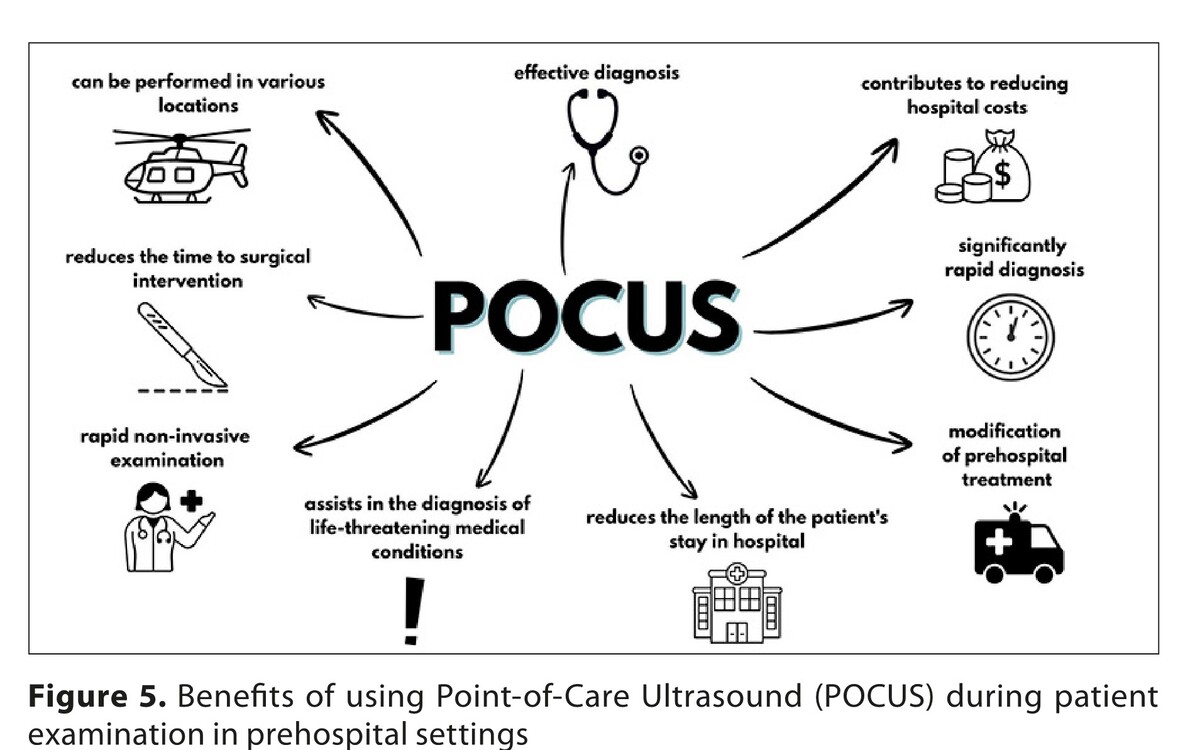
When used correctly, POCUS reduces the time to surgical intervention, aids in selecting the most appropriate healthcare facility, and improves triage efficiency. Its short examination time helps reduce complications and mortality rates, which is especially important for trauma patients. Studies show that POCUS reduces hospital costs, primarily by decreasing the length of patient hospitalization. It demonstrates high sensitivity and specificity for diagnosing conditions such as pulmonary and cardiovascular abnormalities, as well as deep vein thrombosis. This makes it a valuable tool in time-sensitive situations with limited access to advanced diagnostics. POCUS has recently gained attention for its utility in out-of-hospital cardiac arrest (OHCA). When performed properly, it does not disrupt cardiopulmonary resuscitation (CPR) and can even enhance the resuscitation effectiveness.
Summary:
POCUS is a rapid, cost-effective, and efficient tool that benefits patients, healthcare institutions, and the broader healthcare system.
Point-of-Care Ultrasound (POCUS) is a diagnostic technique that allows the rapid assessment of patients in prehospital settings. The main advantage is that it can be used in locations without standard ultrasound devices, such as ambulances, medical rescue helicopters, or accident sites. The aim of the review is to summarize the current evidence on the role and benefits of POCUS in prehospital and emergency medicine.
Review methods:
A narrative literature review was conducted using the PubMed database with the key words ‘POCUS’, ‘ultrasound’ and ‘prehospital’. A total of 64 articles (January – March 2024) were identified, of which 26 met the inclusion criteria.
Brief description of the state of knowledge:
When used correctly, POCUS reduces the time to surgical intervention, aids in selecting the most appropriate healthcare facility, and improves triage efficiency. Its short examination time helps reduce complications and mortality rates, which is especially important for trauma patients. Studies show that POCUS reduces hospital costs, primarily by decreasing the length of patient hospitalization. It demonstrates high sensitivity and specificity for diagnosing conditions such as pulmonary and cardiovascular abnormalities, as well as deep vein thrombosis. This makes it a valuable tool in time-sensitive situations with limited access to advanced diagnostics. POCUS has recently gained attention for its utility in out-of-hospital cardiac arrest (OHCA). When performed properly, it does not disrupt cardiopulmonary resuscitation (CPR) and can even enhance the resuscitation effectiveness.
Summary:
POCUS is a rapid, cost-effective, and efficient tool that benefits patients, healthcare institutions, and the broader healthcare system.
PEER REVIEW INFORMATION
Article has been screened for originality
REFERENCES (32)
1.
Weile J, Brix J, Moellekaer AB. Is point-of-care ultrasound disruptive innovation? Formulating why POCUS is different from conventional comprehensive ultrasound. Crit Ultrasound J. 2018;10(1):25.
2.
Kowalczyk D, Turkowiak M, Piotrowski WJ, et al. Unlocking Diagnostic Precision: FATE Protocol Integration with BLUE and eFAST Protocols for Enhanced Pre-Hospital Differential Diagnosis of Pleural Effusion Manifested as Dyspnea in Adults-A Pilot Study. J Clin Med. 2024;13(6):1573.
3.
O’Dochartaigh D, Douma M, Alexiu C, et al. Utilization Criteria for Prehospital Ultrasound in a Canadian Critical Care Helicopter Emergency Medical Service: Determining Who Might Benefit. Prehosp Disaster Med. 2017;32(5):536–540.
4.
Lenz TJ, Phelan MB, Grawey T. Determining a Need for Point-of-Care Ultrasound in Helicopter Emergency Medical Services Transport. Air Med J. 2021;40(3):175–178.
5.
O’Dochartaigh D, Douma M. Prehospital ultrasound of the abdomen and thorax changes trauma patient management: A systematic review. Injury. 2015;46(11):2093–2102.
6.
Lauridsen SV, Bøtker MT, Eldrup N, et al. Prehospital point-of-care ultrasound in ruptured abdominal aortic aneurysms-a retrospective cohort study. Acta Anaesthesiol Scand. 2024;68(5):693–701.
7.
Melniker LA, Leibner E, McKenney MG, et al. Randomized controlled clinical trial of point-of-care, limited ultrasonography for trauma in the emergency department: the first sonography outcomes assessment program trial. Ann Emerg Med. 2006;48(3):227–235.
8.
Lobo MJCD, Tavares SCCNM, Pereira de Almeida RP. Point of care prehospital ultrasound in Basic Emergency Services in Portugal. Health Sci Rep. 2022;5(5):e847.
9.
Yates JG, Baylous D. Aeromedical Ultrasound: The Evaluation of Point-of-care Ultrasound During Helicopter Transport. Air Med J. 2017;36(3):110–115.
10.
Kowalczyk D, Turkowiak M, Piotrowski WJ, et al. Ultrasound on the Frontlines: Empowering Paramedics with Lung Ultrasound for Dyspnea Diagnosis in Adults-A Pilot Study. Diagnostics (Basel). 2023;13(22):3412.
11.
Ienghong K, Cheung LW, Tiamkao S, et al. The Utilization of Handheld Ultrasound Devices in a Prehospital Setting. Prehosp Disaster Med. 2022;37(3):355–359.
12.
Yates JG, Baylous D. Air Medical Ultrasound: Looking Back to See What We Have Learned for the Future. Air Med J. 2022;41(6):536–541.
13.
Baid H, Vempalli N, Kumar S, et al. Point of care ultrasound as initial diagnostic tool in acute dyspnea patients in the emergency department of a tertiary care center: diagnostic accuracy study. Int J Emerg Med. 2022;15(1):27.
14.
Hafner C, Manschein V, Klaus DA, et al. Live stream of prehospital point-of-care ultrasound during cardiopulmonary resuscitation – A feasibility trial. Resuscitation. 2024;194:110089.
15.
Russell FM, Harrison NE, Hobson O, et al. Diagnostic accuracy of prehospital lung ultrasound for acute decompensated heart failure: A systematic review and Meta-analysis. Am J Emerg Med. 2024;80:91–98.
16.
Gundersen EA, Juhl-Olsen P, Bach A, et al. PrehospitaL Ultrasound in Undifferentiated DyspnEa (PreLUDE): a prospective, clinical, observational study. Scand J Trauma Resusc Emerg Med. 2023;31(1):6.
17.
Russell FM, Supples M, Tamhankar O, et al. Prehospital lung ultrasound in acute heart failure: Impact on diagnosis and treatment. Acad Emerg Med. 2024;31(1):42–48.
18.
Popat A, Harikrishnan S, Seby N, et al. Utilization of Point-of-Care Ultrasound as an Imaging Modality in the Emergency Department: A Systematic Review and Meta-Analysis. Cureus. 2024;16(1): e52371.
19.
Blanco P, Martínez Buendía C. Point-of-care ultrasound in cardiopulmonary resuscitation: a concise review. J Ultrasound. 2017;20(3):193–198.
20.
Paul JA, Panzer OPF. Point-of-care Ultrasound in Cardiac Arrest. Anesthesiology. 2021;135(3):508–519.
21.
Fitzgibbon JB, Lovallo E, Escajeda J, et al. Feasibility of Out-of-Hospital Cardiac Arrest Ultrasound by EMS Physicians. Prehosp Emerg Care. 2019;23(3):297–303.
22.
Scharonow M, Weilbach C. Prehospital point-of-care emergency ultrasound: a cohort study. Scand J Trauma Resusc Emerg Med. 2018;26(1):49.
23.
Rice JA, Brewer J, Speaks T, et al. The POCUS Consult: How Point of Care Ultrasound Helps Guide Medical Decision Making. Int J Gen Med. 2021;14:9789–9806.
25.
Huis In ‘t Veld MA, Allison MG, Bostick DS, et al. Ultrasound use during cardiopulmonary resuscitation is associated with delays in chest compressions. Resuscitation. 2017;119:95–98.
26.
Clattenburg EJ, Wroe P, Brown S, et al. Point-of-care ultrasound use in patients with cardiac arrest is associated prolonged cardiopulmonary resuscitation pauses: A prospective cohort study. Resuscitation. 2018;122:65–68.
27.
Vianen NJ, Van Lieshout EMM, Vlasveld KHA, et al. Impact of Point-of-Care Ultrasound on Prehospital Decision Making by HEMS Physicians in Critically Ill and Injured Patients: A Prospective Cohort Study. Prehosp Disaster Med. 2023;38(4):444–449.
28.
Smallwood N, Dachsel M. Point-of-care ultrasound (POCUS): unnecessary gadgetry or evidence-based medicine? Clin Med (Lond). 2018;18(3):219–224.
29.
Regulation of the Minister of Health of 7 March 2024 amending the regulation on emergency medical procedures and health services other than emergency medical procedures that may be performed by paramedics. Journal of Laws, 2024.
30.
Regulation of the Minister of Health of 2 July 2024 amending the regulation on the type and scope of preventive, diagnostic, therapeutic, and rehabilitative services provided independently by nurses or midwives without a physician’s referral. Journal of Laws, 2024.
31.
Stucchi R, Weinstein ES, Ripoll-Gallardo A, et al. Impact of Point-of-Care Ultrasound on Secondary Triage: A Pilot Study. Disaster Med Public Health Prep. 2022;17:e194.
32.
Labaf A, Åhman-Persson L, Husu LS, et al. Performance of a point-of-care ultrasound platform for artificial intelligence-enabled assessment of pulmonary B-lines. Cardiovasc Ultrasound. 2025;23(1):3.
Share
RELATED ARTICLE
| eISSN: | 1898-2263 |
| ISSN: | 1232-1966 |


Generation of the DOI (Digital Object Identifier) - task financed under the agreement No NrRCN/SP/0532/2021/1 by the Minister of Science and Higher
© 2006-2026 Journal hosting platform by Bentus
We process personal data collected when visiting the website. The function of obtaining information about users and their behavior is carried out by voluntarily entered information in forms and saving cookies in end devices. Data, including cookies, are used to provide services, improve the user experience and to analyze the traffic in accordance with the Privacy policy. Data are also collected and processed by Google Analytics tool (more).
You can change cookies settings in your browser. Restricted use of cookies in the browser configuration may affect some functionalities of the website.
You can change cookies settings in your browser. Restricted use of cookies in the browser configuration may affect some functionalities of the website.