Online first
Current issue
Archive
Special Issues
About the Journal
Publication Ethics
Anti-Plagiarism system
Instructions for Authors
Instructions for Reviewers
Editorial Board
Editorial Office
Contact
Reviewers
All Reviewers
2025
2024
2023
2022
2021
2020
2019
2018
2017
2016
General Data Protection Regulation (RODO)

RESEARCH PAPER
Determinants of mental well-being among family members of individuals with Autism Spectrum Disorder (ASD)
1
School of Public Health, Centre of Postgraduate Medical Education, Warsaw, Poland
2
Department of Public Health, Medical University, Warsaw, Poland
3
Department of Medical Informatics and Statistics, Medical University, Lublin, Poland
Corresponding author
Mariola Borowska
School of Public Health, Centre of Postgraduate Medical Education of Warsaw, Warsaw, Poland, Poland
School of Public Health, Centre of Postgraduate Medical Education of Warsaw, Warsaw, Poland, Poland
KEYWORDS
TOPICS
ABSTRACT
Introduction and objective:
Autism spectrum disorder (ASD) poses significant clinical, social, and economic challenges, affecting not only individuals diagnosed with the condition but also their families. Increasing evidence highlights a substantial psychosocial burden among caregivers, which may translate into broader societal and economic costs. The aim of this study was to assess the mental well-being of family members of individuals with ASD and to identify its determinants in relation to selected socio-demographic factors and time since diagnosis.
Material and methods:
A cross-sectional study was conducted in February 2025 among 310 adult family members of individuals diagnosed with ASD. Data were collected using the Computer-Assisted Web Interview (CAWI) method via the Ariadna Nationwide Research Panel. Mental well-being was measured using the WHO-5 Well-Being Index.
Results:
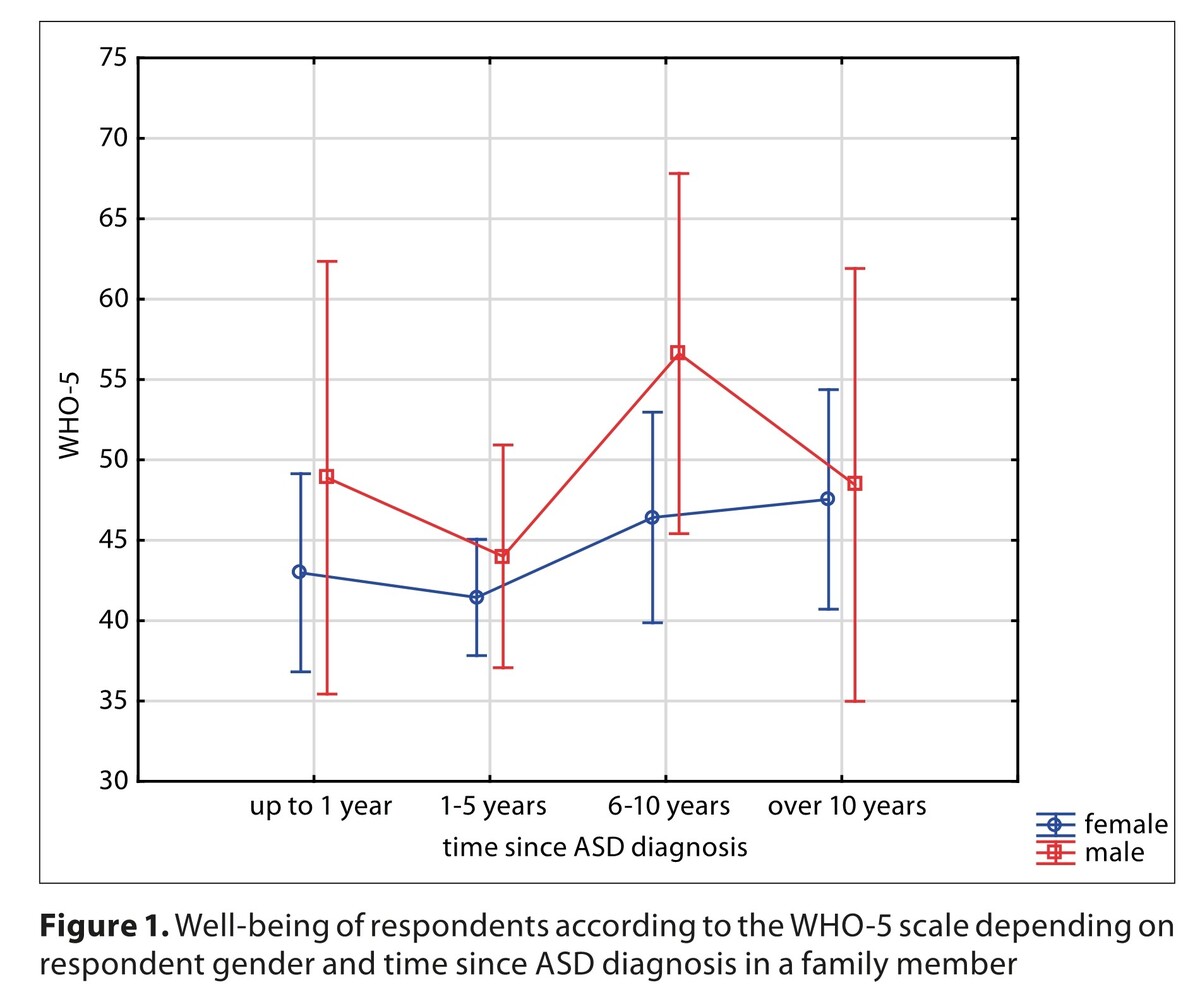
The findings revealed reduced mental well-being among respondents, with a median WHO-5 score of 44, and 57.74% of participants scoring below the threshold, indicating impaired well-being. No statistically significant differences were found in well-being depending on respondent gender (p = 0.124), gender of the family member with ASD (p = 0.539), or time since diagnosis (p = 0.113). Additionally, no significant interaction effects were observed in two-way ANOVA models.
Conclusions:
Reduced mental well-being appears to be a common and persistent feature among family members of individuals with ASD, independent of basic socio-demographic factors. The findings highlight the need for comprehensive, long-term support strategies addressing both psychological and socio-economic aspects of caregiving. From the perspective of health economics, improving caregiver well-being may contribute to reducing the indirect costs associated with ASD.
Autism spectrum disorder (ASD) poses significant clinical, social, and economic challenges, affecting not only individuals diagnosed with the condition but also their families. Increasing evidence highlights a substantial psychosocial burden among caregivers, which may translate into broader societal and economic costs. The aim of this study was to assess the mental well-being of family members of individuals with ASD and to identify its determinants in relation to selected socio-demographic factors and time since diagnosis.
Material and methods:
A cross-sectional study was conducted in February 2025 among 310 adult family members of individuals diagnosed with ASD. Data were collected using the Computer-Assisted Web Interview (CAWI) method via the Ariadna Nationwide Research Panel. Mental well-being was measured using the WHO-5 Well-Being Index.
Results:
The findings revealed reduced mental well-being among respondents, with a median WHO-5 score of 44, and 57.74% of participants scoring below the threshold, indicating impaired well-being. No statistically significant differences were found in well-being depending on respondent gender (p = 0.124), gender of the family member with ASD (p = 0.539), or time since diagnosis (p = 0.113). Additionally, no significant interaction effects were observed in two-way ANOVA models.
Conclusions:
Reduced mental well-being appears to be a common and persistent feature among family members of individuals with ASD, independent of basic socio-demographic factors. The findings highlight the need for comprehensive, long-term support strategies addressing both psychological and socio-economic aspects of caregiving. From the perspective of health economics, improving caregiver well-being may contribute to reducing the indirect costs associated with ASD.
PEER REVIEW INFORMATION
Article has been screened for originality
REFERENCES (26)
1.
Talantseva OI, Romanova RS, Shurdova EM, et.al. The global prevalence of autism spectrum disorder: A three-level meta-analysis. Front Psychiatry. 2023;14:1071181. doi:10.3389/fpsyt.2023.1071181.
2.
Lord C, Elsabbagh M, Baird G, et al. Autism spectrum disorder. Lancet. 2018;392(10146):508–520. doi:10.1016/S0140-6736(18)31129-2.
3.
Zeidan J, Fombonne E, Scorah J, et al. Global prevalence of autism: A systematic review update. Autism Res. 2022;15(5):778–790. doi:10.1002/aur.2696.
4.
Maenner MJ, Shaw KA, Baio J, et al. Prevalence of Autism Spectrum Disorder Among Children Aged 8 Years – Autism and Developmental Disabilities Monitoring Network, 11 Sites, United States, 2016. MMWR Surveill Summ. 2020;69(4):1–12. Published 2020 Mar 27. doi:10.15585/mmwr.ss6904a1.
5.
Xu G, Strathearn L, Liu B, et al. Prevalence and Treatment Patterns of Autism Spectrum Disorder in the United States, 2016. JAMA Pediatr. 2019;173(2):153–159. doi:10.1001/jamapediatrics.2018.4208.
6.
Musetti A, Manari T, Dioni B, et al. Parental Quality of Life and Involvement in Intervention for Children or Adolescents with Autism Spectrum Disorders: A Systematic Review. J Personalized Med. 2021;11(9):894. https://doi.org/10.3390/jpm110....
7.
Cage E, Di Monaco J, Newell V. Experiences of Autism Acceptance and Mental Health in Autistic Adults. J Autism Dev Disord. 2018;48(2):473–484. doi:10.1007/s10803-017-3342-7.
8.
Cheatham KL, Fernando DM. Family resilience and parental stress in families of children with autism. Fam J. 2022;30(3):356–364. doi:10.1177/10664807211052494.
9.
Alfakeh S, Aljahdali GH, Benfeef ST. Caregiver mental health burden in families of children with autism in Saudi Arabia. Discov Ment Health. 2026;6(1):65. Published 2026 Apr 21. doi:10.1007/s44192-026-00379-7.
10.
Dijkstra-de Neijs L, Boeke DB, van Berckelaer-Onnes IA, et al. Parental stress and quality of life in parents of young children with autism. Child Psychiatry Hum Dev. 2024. doi:10.1007/s10578-024-01693-3.
11.
Weitlauf AS, Broderick N, Stainbrook JA, et al. Mindfulness-based stress reduction for parents implementing early intervention for autism: a randomized controlled trial. Pediatrics. 2020;145(Suppl 1):S81–S92. doi:10.1542/peds.2019-1895K.
12.
Hayes SA, Watson SL. The impact of parenting stress: a meta-analysis of studies comparing the experience of parenting stress in parents of children with and without autism spectrum disorder. J Autism Dev Disord. 2013;43(3):629–642. doi:10.1007/s10803-012-1604-y.
13.
Pruitt MM, Willis K, Timmons L, et al. The impact of maternal, child, and family characteristics on the daily well-being and parenting experiences of mothers of children with autism spectrum disorder. Autism. 2016;20(8):973–985. doi:10.1177/1362361315620409.
14.
Reed P, Howse J, Ho B, et al. Relationship between perceived limit-setting abilities, autism spectrum disorder severity, behaviour problems and parenting stress in mothers of children with autism spectrum disorder. Autism. 2017;21(8):952–959. doi:10.1177/1362361316658775.
15.
Carbone PS, Stipelman CH, Villalobos ME, et al. A Comparison of Parent-Reported Severe Autism With Mild/Moderate Autism Among US Children. J Dev Behav Pediatr. 2024;45(5):e422-e430. doi:10.1097/DBP.0000000000001306.
16.
Tarver J, Palmer M, Webb S, et al. Child and parent outcomes following parent interventions for child emotional and behavioral problems in autism spectrum disorders: A systematic review and meta-analysis. Autism. 2019;23(7):1630–1644. doi:10.1177/1362361319830042.
17.
Yorke I, White P, Weston A, et al. The Association Between Emotional and Behavioral Problems in Children with Autism Spectrum Disorder and Psychological Distress in Their Parents: A Systematic Review and Meta-analysis. J Autism Dev Disord. 2018;48(10):3393–3415. doi:10.1007/s10803-018-3605-y.
18.
Siu QKY, Yi H, Chan RCH, et al. The Role of Child Problem Behaviors in Autism Spectrum Symptoms and Parenting Stress: A Primary School-Based Study. J Autism Dev Disord. 2019;49(3):857–870. doi:10.1007/s10803-018-3791-7.
19.
Buescher AVS, Cidav Z, Knapp M, et al. Costs of Autism Spectrum Disorders in the United Kingdom and the United States. JAMA Pediatr. 2014;168(8):721–728. doi:10.1001/jamapediatrics.2014.210.
20.
Cidav Z, Munson J, Estes A, et al. Cost Offset Associated With Early Start Denver Model for Children With Autism. J Am Acad Child Adolesc Psychiatry. 2017;56(9):777–783. doi:10.1016/j.jaac.2017.06.007.
21.
Leslie DL. Understanding the Costs of Autism Services. J Am Acad Child Adolesc Psychiatry. 2017;56(9):727–728. doi:10.1016/j.jaac.2017.06.014.
22.
Kopańska M, Szczygielski J, Batrman P, et al. Evaluation of craniosacral therapy effects on brain wave patterns in children with mild autism spectrum disorder using the QEEG method. Acta Neuropsychol. 2025;23(3):335 349. doi:10.5604/01.3001.0055.2411.
23.
Kopańska M, Ochojska D, Sarzyńska I, et al. The use of quantitative electroencephalography (eyes closed) to assess the effectiveness of neurofeedback therapy in children with mild autism spectrum disorders revealing attention deficit disorders. Acta Neuropsychol. 2025;23(1):27 46. doi:10.5604/01.3001.0054.9911.
24.
Kopańska M, Ochojska D, Brydak K, et al. The importance of QEEG in diagnosing and evaluating the effectiveness of EEG biofeedback therapy in children with mild autism spectrum disorder revealing attention deficit disorder. Acta Neuropsychol. 2024;22(4):463 479. doi:10.5604/01.3001.0054.7856.
25.
Oono IP, Honey EJ, McConachie H. Parent mediated early intervention for young children with autism spectrum disorders (ASD). Cochrane Database Syst Rev. 2013;2013(4):CD009774.
26.
Rogers SJ, Estes A, Lord C, et al. A multisite randomized controlled trial comparing parent mediated interventions for toddlers with autism. J Am Acad Child Adolesc Psychiatry. 2021;60(6):710 722.
Share
RELATED ARTICLE
| eISSN: | 1898-2263 |
| ISSN: | 1232-1966 |


Generation of the DOI (Digital Object Identifier) - task financed under the agreement No NrRCN/SP/0532/2021/1 by the Minister of Science and Higher
© 2006-2026 Journal hosting platform by Bentus
We process personal data collected when visiting the website. The function of obtaining information about users and their behavior is carried out by voluntarily entered information in forms and saving cookies in end devices. Data, including cookies, are used to provide services, improve the user experience and to analyze the traffic in accordance with the Privacy policy. Data are also collected and processed by Google Analytics tool (more).
You can change cookies settings in your browser. Restricted use of cookies in the browser configuration may affect some functionalities of the website.
You can change cookies settings in your browser. Restricted use of cookies in the browser configuration may affect some functionalities of the website.