Online first
Current issue
Archive
Special Issues
About the Journal
Publication Ethics
Anti-Plagiarism system
Instructions for Authors
Instructions for Reviewers
Editorial Board
Editorial Office
Contact
Reviewers
All Reviewers
2025
2024
2023
2022
2021
2020
2019
2018
2017
2016
General Data Protection Regulation (RODO)

RESEARCH PAPER
Comparison of the efficacy of oxytocin and carbetocin in the prevention of post-operative haemorrhage after caesarean section
1
Department of Obstetrics and Gynaecology, Ağrı Eleşkirt District State Hospital, Turkey
2
Department of Obstetrics and Gynaecology, Manavgat State Hospital, Turkey
3
Department of Obstetrics and Gynaecology, Gümüşhane State Hospital, Turkey
4
Department of Obstetrics and Gynaecology, Antalya Training and Research Hospital, Turkey
Corresponding author
KEYWORDS
TOPICS
ABSTRACT
Introduction and objective:
Postpartum haemorrhage (PPH) is the leading preventable cause of maternal mortality, with uterine atony as its primary cause in caesarean sections. Compared to standard oxytocin, carbetocin offers a more sustained uterotonic effect. The aim of the study is to compare the clinical efficacy of prophylactic carbetocin versus oxytocin in high-risk caesarean deliveries.
Material and methods:
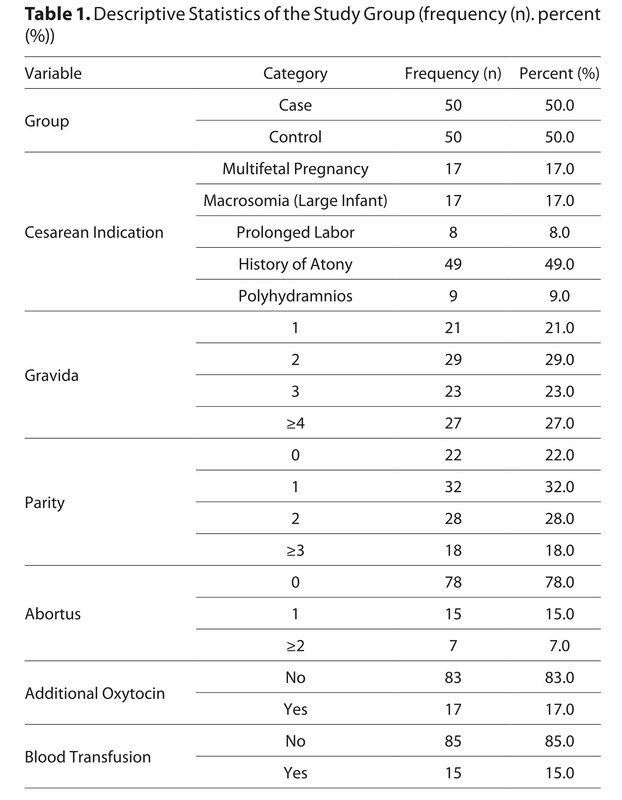
This prospective, randomized controlled study was conducted with 100 pregnant women presenting with high-risk factors for PPH (multiple gestation, macrosomia, polyhydramnios, prolonged labour, history of uterine atony). The cases were divided into two equal groups: the control group (n=50) received a standard oxytocin infusion, and the study group (n=50) received a single dose (100 µg) of carbetocin prophylaxis. Demographic characteristics, postoperative laboratory parameters, the need for additional uterotonics, and the requirement for blood transfusions were compared between the groups.
Results:
The need for additional uterotonics (oxytocin) was found to be significantly lower in the carbetocin group at 4%, compared to 30% in the standard oxytocin group (p<0.01). The requirement for blood transfusion was 4% in the carbetocin group and 26% in the control group (p>0.05).
Conclusions:
Single-dose carbetocin is significantly more effective than standard oxytocin at for maintaining uterine contraction and decreasing the need for additional uterotonics in high-risk cesarean deliveries. The results indicate that carbetocin is a robust alternative for optimizing postpartum haemorrhage (PPH) management and reducing clinical workload.
Postpartum haemorrhage (PPH) is the leading preventable cause of maternal mortality, with uterine atony as its primary cause in caesarean sections. Compared to standard oxytocin, carbetocin offers a more sustained uterotonic effect. The aim of the study is to compare the clinical efficacy of prophylactic carbetocin versus oxytocin in high-risk caesarean deliveries.
Material and methods:
This prospective, randomized controlled study was conducted with 100 pregnant women presenting with high-risk factors for PPH (multiple gestation, macrosomia, polyhydramnios, prolonged labour, history of uterine atony). The cases were divided into two equal groups: the control group (n=50) received a standard oxytocin infusion, and the study group (n=50) received a single dose (100 µg) of carbetocin prophylaxis. Demographic characteristics, postoperative laboratory parameters, the need for additional uterotonics, and the requirement for blood transfusions were compared between the groups.
Results:
The need for additional uterotonics (oxytocin) was found to be significantly lower in the carbetocin group at 4%, compared to 30% in the standard oxytocin group (p<0.01). The requirement for blood transfusion was 4% in the carbetocin group and 26% in the control group (p>0.05).
Conclusions:
Single-dose carbetocin is significantly more effective than standard oxytocin at for maintaining uterine contraction and decreasing the need for additional uterotonics in high-risk cesarean deliveries. The results indicate that carbetocin is a robust alternative for optimizing postpartum haemorrhage (PPH) management and reducing clinical workload.
ABBREVIATIONS
ALT – Alanine Aminotransferase
AST – Aspartate Aminotransferase
BMI – Body Mass Index
BUN – Blood Urea Nitrogen
CRE – Creatinine
Hb – Haemoglobin
Hct – Haematocrit
INR – International Normalized Ratio
NLR – Neutrophil-to-Lymphocyte Ratio -
PLT – Platelet
PPH – Postpartum Hemorrhage
WBC – White Blood Cell (Leukocyte)
PEER REVIEW INFORMATION
Article has been screened for originality
REFERENCES (22)
1.
Muñoz M, Acheson AG, Auerbach M, et al. Patient blood management in obstetrics: prevention and treatment of postpartum haemorrhage. A NATA consensus statement. Blood Transfus. 2019;17(2):112–136. doi:10.2450/2019.0245-18.
2.
Sadiku OD, Aina SA, Odoemene CC, et al. Approaches to the Prevention and Treatment of Postpartum Hemorrhage: A Systematic Review of Past Advances, Recent Developments, and Best Practices. Cureus. 2024; 16: e65096. doi:10.7759/cureus.65096.
3.
Mohamed TAEH, Chandraharan E. Recognition and management of postpartum hemorrhage. Maternal-Fetal Med. 2025;7(1):29–37. doi:10.1097/FM9.0000000000000256.
4.
World Health Organization. Lifesaving solution dramatically reduces severe bleeding after childbirth [Internet]. Geneva: World Health Organization; 2023 May 9 [cited 2026 Jun 15]. Available from: https://www.who.int/news/item/....
5.
Kamal K, Gul G, Nawab S. Frequency of Postpartum Hemorrhage after Elective Cesarean Section and Emergency Cesarean Section. Indus J Biosci Res. 2025;3(4). doi:10.70749/ijbr.v3i4.2200.
6.
Santas G, Santas F. Trends of caesarean section rates in Turkey. J Obstet Gynaecol. 2018;38(5):658–662. doi:10.1080/01443615.2017.1400525.
7.
Ashwal E, Bson RB, Aviram A, et al. Risk factors for postpartum hemorrhage following cesarean delivery. J Matern Fetal Neonatal Med. 2022;35(19):3626–3630. doi:10.1080/14767058.2020.1834533.
8.
Hosseinzadeh M, Heshmatkhah E, Abtahi D. Prevalence and Risk Factors of Postpartum Hemorrhage in Cesarean Section: A Retrospective Cohort Study. J Obstet Gynecol Cancer Res. 2023;8(3):285–292. doi:10.30699/jogcr.8.3.285.
9.
Włodarczyk Z, Śliwka A, Maciocha H, et al. The Role of Accurate Estimations of Blood Loss and Identification of Risk Factors in the Management of Early Postpartum Hemorrhage in Women Undergoing a Cesarean Section. J Clin Med. 2025;14(6):1861. doi:10.3390/jcm14061861.
10.
Begley CM, Gyte GM, Devane D, et al. Active versus expectant management for women in the third stage of labour. Cochrane Database Syst Rev. 2019(2):CD007412. doi:10.1002/14651858.CD007412.pub5.
11.
Kalafat E, Gokce A, O’Brien P, et al. Efficacy of carbetocin in the prevention of postpartum hemorrhage: a systematic review and Bayesian meta-analysis of randomized trials. J Matern Fetal Neonatal Med. 2019;1–14. doi:10.1080/14767058.2019.1664463.
12.
Gallos ID, Papadopoulou A, Man R, et al. Uterotonic agents for preventing postpartum haemorrhage: a network meta-analysis. Cochrane Database Syst Rev. 2018;12:CD011689. https://doi.org/10.1002/146518....
13.
Sun H, Xu L, Li Y, et al. Effectiveness and safety of carboxytocin versus oxytocin in preventing postpartum hemorrhage: A systematic review and meta-analysis. J Obstet Gynaecol Res. 2022;48(4):889–901. doi:10.1111/jog.15174.
14.
Voon HY, Suharjono HN, Shafie AA, et al. Carbetocin versus oxytocin for the prevention of postpartum hemorrhage: a meta-analysis of randomized controlled trials in cesarean deliveries. Taiwan J Obstet Gynecol. 2018;57(3):332–339. doi:10.1016/j.tjog.2018.04.002.
15.
El-Goly NA, Maged A, Kamal W, et al. Carbetocin versus oxytocin in prevention of postpartum hemorrhage after cesarean delivery in high-risk women: a systematic review and meta-analysis. Arch Gynecol Obstet. 2025;312:291–309. doi:10.1007/s00404-025-08014-6.
16.
Goel V, Karya U, Rani A, et al. Hemodynamic and uterotonic effects of carbetocin versus oxytocin in a cesarean section with a high risk of postpartum hemorrhage. Cureus. 2025;17:e83504. doi:10.7759/cureus.83504.
17.
Munazira F, Rahman Z, Ahmed N, et al. Carbetocin versus oxytocin in the prevention of postpartum hemorrhage in cesarean section: a prospective randomised comparative study. Int J Reprod Contracept Obstet Gynecol. 2025;14(12):4174–4180. doi:10.18203/2320–1770.ijrcog20253880.
18.
Reddy SPT, Sirsam S, Raut NN. Carbetocin versus oxytocin in active management of third stage of labor: a randomized controlled trial. Int J Reprod Contracept Obstet Gynecol. 2026;15(5):1612–1617. doi:10.18203/2320-1770.ijrcog20261256.
19.
Delorme P, Kayem G, Legardeur H, et al. Carbetocin versus Oxytocin for the Prevention of Postpartum Hemorrhage in Cesarean Deliveries: A Retrospective Study of Two Consecutive Periods. AJP Rep. 2020 Jul;10(3):e241-e246. doi:10.1055/s-0040-1715163. Epub 2020 Aug 27. PMID: 33133760; PMCID: PMC7591351.
20.
Samimi M, Hosseiniara R, Akbari H, et al. Carbetocin versus oxytocin with or without tranexamic acid for preventing postpartum hemorrhage in cesarean delivery: a randomized controlled trial. BMC Pregnancy Childbirth. 2026;26:183. doi:10.1186/s12884-026-08674-5.
21.
Elgendy H, Bendary AA, Mohamed S. Hysteroscopic Study in Cases of Peri-menopausal Bleeding and its Correlation with Obesity. Evid Based Women’s Health J. 2024;14(1):… doi:10.21608/ebwhj.2024.268894.1298.
22.
Butwick AJ, Abreo A, Bateman BT, et al. Effect of maternal body mass index on postpartum hemorrhage. Obstet Anesth Dig. 2019 Mar;39(1):18–19. doi:10.1097/01.aoa.0000552889.96813.3b.
| eISSN: | 1898-2263 |
| ISSN: | 1232-1966 |


Generation of the DOI (Digital Object Identifier) - task financed under the agreement No NrRCN/SP/0532/2021/1 by the Minister of Science and Higher
© 2006-2026 Journal hosting platform by Bentus
We process personal data collected when visiting the website. The function of obtaining information about users and their behavior is carried out by voluntarily entered information in forms and saving cookies in end devices. Data, including cookies, are used to provide services, improve the user experience and to analyze the traffic in accordance with the Privacy policy. Data are also collected and processed by Google Analytics tool (more).
You can change cookies settings in your browser. Restricted use of cookies in the browser configuration may affect some functionalities of the website.
You can change cookies settings in your browser. Restricted use of cookies in the browser configuration may affect some functionalities of the website.